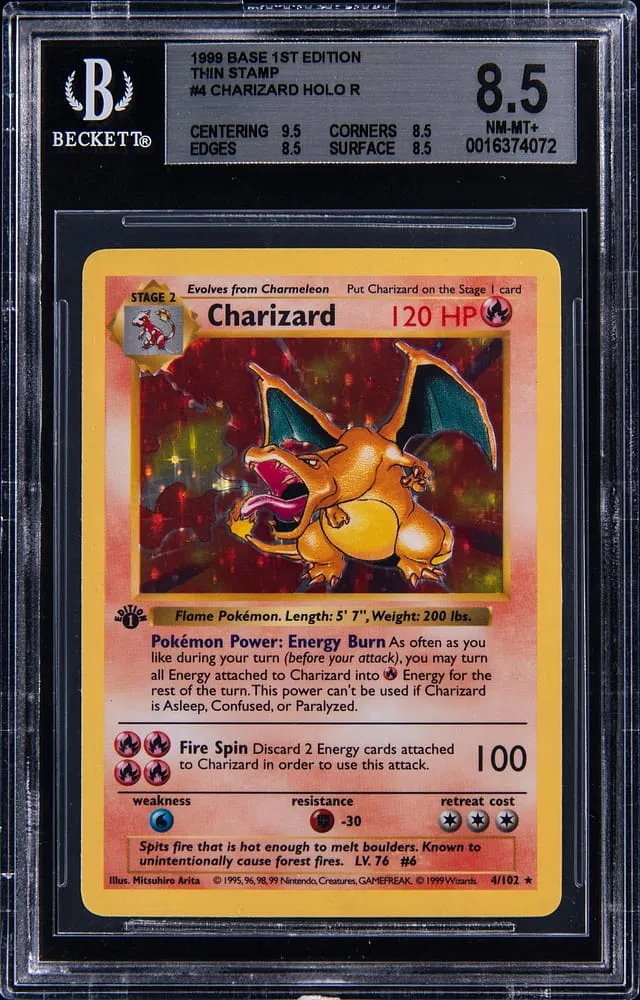
1999 1st Edition Charizard BGS 8.5 Sells for $27K
Goldin sold a 1999 Pokémon Base Set 1st Edition Holo Charizard BGS 8.5 Thin Stamp for $27,450. See how this result fits recent Charizard sales.
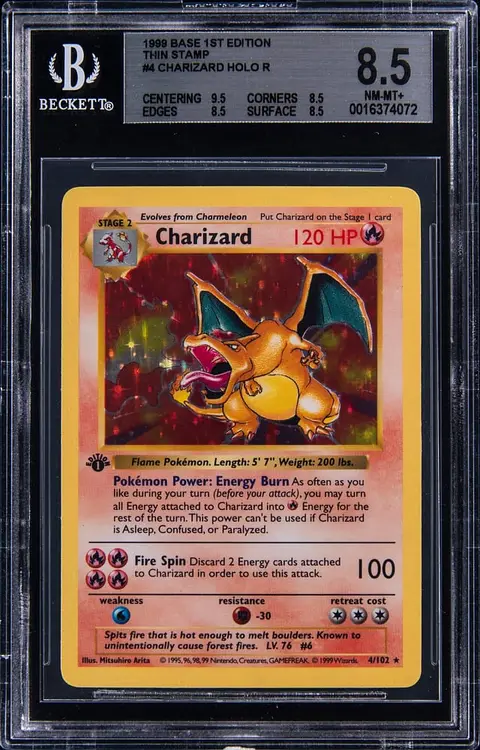
Sold Card
1999 Pokemon Base Set 1st Edition Holo #4 Charizard, Thin Stamp - BGS NM-MT+ 8.5
Sale Price
Platform
Goldin1999 Pokémon Base Set 1st Edition Holo Charizard is one of those cards that needs no introduction, but it still deserves a careful look when a notable copy changes hands.
On March 9, 2026, Goldin reported the sale of a 1999 Pokémon Base Set 1st Edition Holo #4 Charizard (Thin Stamp) graded BGS NM-MT+ 8.5 for $27,450. For collectors tracking the high‑end Pokémon market, this is a useful data point in a segment that has matured but remains very active.
The card: a cornerstone of the Pokémon hobby
Card details
- Character: Charizard
- Year: 1999
- Set: Pokémon TCG Base Set (1st Edition)
- Card number: #4/102
- Variant: 1st Edition, Holographic, Thin Stamp
- Era: Vintage WOTC (Wizards of the Coast)
- Key issue: Widely considered the flagship vintage Pokémon card
- Grading company: Beckett Grading Services (BGS)
- Grade: 8.5 NM-MT+ (sub‑grades can matter, but those weren’t provided here)
This is not a rookie card in the sports sense, but within Pokémon it functions similarly: a first‑print, first‑set anchor card of the franchise’s most recognizable character. Among Base Set holos, Charizard is the clear headliner and a priority target for both long‑time and returning collectors.
Thick vs. thin stamp
This particular copy is noted as a Thin Stamp version. Early 1st Edition Base Set cards show two general stamp styles on the “1st Edition” black ink stamp:
- Thick stamp: Bolder, heavier printing of the “1st Edition” logo
- Thin stamp: Lighter, more delicate version of the same logo
Both are genuine 1st Edition prints. Collectors do track the distinction, though the premium (if any) tends to be more about personal preference and condition than a universally agreed hierarchy. The key point is that this is a true 1st Edition holo Charizard from the original English Base Set print run.
Grading context: BGS 8.5 in the Charizard hierarchy
BGS (Beckett Grading Services) is one of the major third‑party grading companies, alongside PSA and CGC. A BGS 8.5 NM-MT+ typically indicates:
- Minor but visible edge or corner wear
- Light surface or print issues
- Strong overall eye appeal, but not a high‑end mint or gem‑mint example
In the 1st Edition Charizard landscape, collectors often think in terms of tiers:
- Top tier: BGS/PSA 10, BGS 9.5 — record and near‑record territory, trophy‑level copies
- High tier: BGS/PSA 9 — flagship grade for many serious collectors
- Mid tier: BGS/PSA 8 to 8.5 — still expensive, but more accessible than 9s and 10s
- Entry tier: Lower grades and raw (ungraded) copies
A BGS 8.5 sits in the middle–upper segment: noticeably nicer than a straight 8, but not competing with the very high six‑figure and seven‑figure sales seen at the peak of the hobby for gem‑mint examples.
Market context: reading a $27,450 result
The Goldin sale on March 9, 2026 closed at $27,450. To interpret that, it helps to look at how this card and very similar copies have been trading over the last few years. While exact figures vary by sub‑grades, eye appeal, and stamp type, the general picture has been:
- PSA/BGS 10s: Historically achieved some of the highest recorded prices in the hobby during the 2020–2021 run‑up, then pulled back as the market cooled. Those earlier peak sales often exceeded multiple hundreds of thousands of dollars and, in a few cases, crossed into seven figures.
- BGS/PSA 9s: Settled into a wide but lower range than their pandemic‑era highs, with recent comps (comparable sales used for price context) typically landing well below peak but still commanding strong five‑ or low six‑figure results depending on the auction house and timing.
- BGS/PSA 8–8.5: These have become a bellwether for how deep collector demand is beyond top‑pop (highest grade) examples. Recent results across major auction platforms have generally shown:
- Some softening from the absolute peak years
- A more stable, narrower band of realized prices as the market matured
- Stronger performance for copies with excellent centering and minimal print defects
Within that framework, $27,450 for a BGS 8.5 Thin Stamp at Goldin in early 2026 appears broadly consistent with a stabilized, post‑peak but still healthy market for mid‑high grade 1st Edition Charizards. It does not represent a new headline record, but it reinforces that demand for strong vintage copies remains deep.
Without identical recent BGS 8.5 Thin Stamp comps visible across every platform, the most accurate interpretation is: this sale sits in line with other mid‑high grade 1st Edition Charizard prices rather than standing out as an outlier.
Why this card continues to matter
Several factors keep this card at the center of the Pokémon conversation:
Historical importance
1999 Base Set is the first widely distributed English Pokémon TCG set. Within it, Charizard #4/102 is the face of the set and a cultural touchpoint for an entire generation of players and collectors.Vintage WOTC era
Cards from the Wizards of the Coast era (1999–2003) have a finite supply. While more graded copies appear as raw cards are submitted, the total print run is long finished. That scarcity—relative to modern print runs—helps support long‑term interest.Cross‑collectible appeal
Unlike many sports cards that are tied heavily to a single team or season, Charizard appeals across:- TCG players
- Video game fans
- Anime and manga fans
- General pop‑culture collectors
Condition sensitivity
Base Set holos are prone to edge wear, print lines, and scratching. Clean copies with strong centering and gloss are not easy to find, especially in original 1st Edition form.Maturity of the Pokémon market
The intense surge in 2020–2021 was followed by a cooling period and then a more selective, data‑driven phase. This Goldin sale reflects that maturity: prices are no longer chasing headlines, but serious collectors still allocate significant budgets to key vintage anchors.
Thin Stamp vs. other versions
For context, collectors often compare this card against a few close relatives:
1st Edition Holo Charizard – Thick Stamp
Same card and artwork; the main difference is the print style of the 1st Edition stamp. Some collectors prefer thick stamp aesthetically, but both are legitimate first‑print variants.Shadowless (non‑1st Edition) Holo Charizard
Early unlimited‑print copies without the drop shadow around the Pokémon box. Considered scarcer and more desirable than later unlimited prints but below 1st Edition in terms of hierarchy.Unlimited Holo Charizard
Widely printed; values are significantly lower in most grades, though PSA/BGS 10 examples can still command meaningful prices.Other languages and reprints
Japanese Base, later reprint sets, and special edition Charizards give collectors alternatives at lower price points, but they do not replace the 1999 English 1st Edition holo as the flagship.
In this structure, a BGS 8.5 1st Edition Thin Stamp sits firmly in the upper tier of Charizard collecting, below the record‑setting copy types but comfortably ahead of later printings.
What this sale suggests for collectors
For new and returning collectors:
- This sale shows that key vintage Pokémon cards still transact regularly at major auction houses.
- Condition, grading company, and small details like stamp type continue to matter.
- The market appears more measured than in the early‑2020s spike, with prices anchored by a larger base of informed bidders.
For active hobbyists and small sellers:
- Auction venue matters. A $27,450 result at Goldin on March 9, 2026 reflects both the card and the platform’s buyer pool. Realized prices for similar cards can differ between Goldin, PWCC, Heritage, eBay, and other venues.
- Presentation and sub‑grades can influence outcomes. Within BGS 8.5, copies with strong centering and high sub‑grades (especially centering and surface) can outperform weaker‑looking 8.5s.
- Comps are a tool, not a promise. When using comparable sales to price your own card, it’s useful to factor in grade, eye appeal, timing, and whether the sale was a fixed‑price listing or a competitive auction.
Final thoughts
The 1999 Pokémon Base Set 1st Edition Holo #4 Charizard remains a benchmark card for the entire trading card hobby. This BGS NM-MT+ 8.5 Thin Stamp copy changing hands for $27,450 at Goldin on March 9, 2026 is another data point confirming that serious capital still flows toward high‑quality vintage Pokémon.
For collectors building a long‑term collection, it underscores why this card is often viewed as a cornerstone. For market watchers, it adds one more reference sale to the evolving price history of one of the hobby’s most recognizable pieces.
As always, these observations are about recent sales and context, not predictions. The Charizard market has already gone through multiple cycles, and future pricing will depend on broader hobby interest, overall economic conditions, and how many high‑quality copies surface for sale over time.
If you track or own a 1st Edition Base Charizard in any grade, this Goldin result is a useful benchmark to keep in your notes—especially if you’re considering grading, upgrading, or eventually bringing your own copy to market.