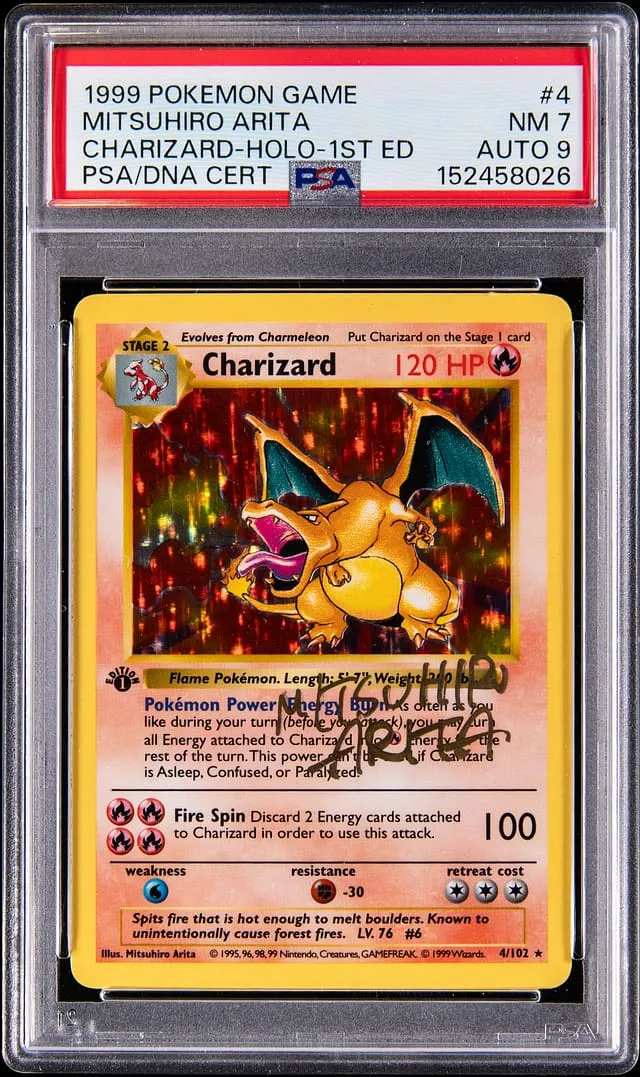
1999 1st Edition Charizard Arita Auto Sells for $20,740
Goldin sells a 1999 Pokémon Base Set 1st Edition Holo Charizard, PSA 7 with Mitsuhiro Arita PSA/DNA 9 auto, for $20,740. Here’s the market context.
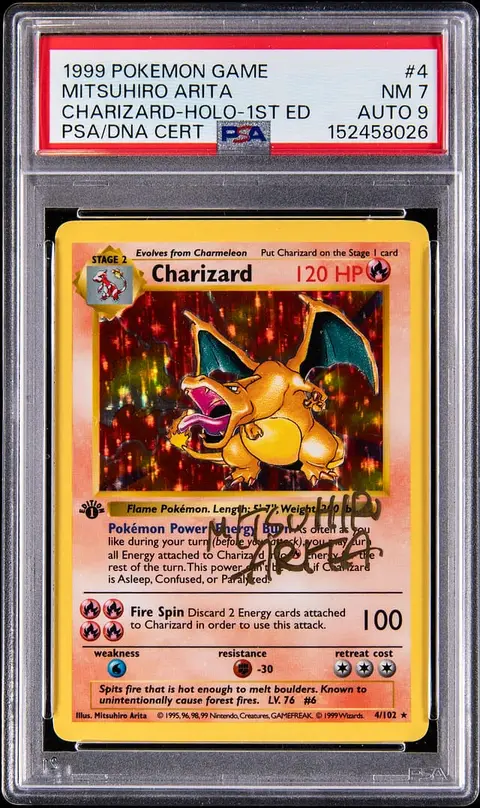
Sold Card
1999 Pokemon Base Set 1st Edition Holo #4 Charizard Signed By Mitsuhiro Arita - PSA NM 7, PSA/DNA MINT 9
Sale Price
Platform
Goldin1999 Pokémon Base Set 1st Edition Holo Charizard Signed by Arita Sells for $20,740
On May 18, 2026, a key piece of early Pokémon history crossed the block at Goldin: a 1999 Pokémon Base Set 1st Edition Holo Charizard #4, graded PSA NM 7 with a PSA/DNA MINT 9 autograph from illustrator Mitsuhiro Arita. The card sold for $20,740.
For many collectors, this card combines three pillars of the hobby: the original English Base Set, the hobby’s most recognizable character, and an on‑card signature from the artist who drew it.
In this breakdown, we’ll look at what exactly this card is, how the price fits into recent sales, and why autographed 1st Edition Charizards have carved out a distinct lane in the market.
The card at a glance
- Character: Charizard
- Year: 1999
- Set: Pokémon Base Set (English)
- Edition: 1st Edition
- Card number: #4/102
- Variant: Holographic (Holo)
- Status: Key issue / flagship chase card of the set (not a “rookie” in the sports sense, but the anchor card of early Pokémon)
- Grading company: PSA
- Card grade: PSA NM 7 (Near Mint)
- Autograph authentication: PSA/DNA MINT 9
- Signature: On‑card, signed by illustrator Mitsuhiro Arita
Within the non‑sports trading card world, the 1st Edition Base Set Holo Charizard is one of the most recognized cards of the last 30 years. It’s the card many kids chased in packs in 1999 and the one many returning collectors look for first when they re‑enter the hobby.
This particular copy adds an important extra dimension: a high‑grade, authenticated autograph from Mitsuhiro Arita, the original artist behind the Base Set Charizard artwork.
Why this card matters to collectors
1. Core position in the Pokémon hobby
The 1999 English Base Set is often treated as Pokémon’s “flagship” release for the TCG. When collectors say “Base Set Charizard,” they almost always mean this card. The 1st Edition Holo version is the most iconic configuration:
- 1st Edition stamp on the left side indicates the earliest English print run.
- Holographic foil background gives it the premium chase feel.
- Charizard became the face of the early TCG in the same way that certain star rookies anchor a sports product.
Even in a mid grade like PSA 7, 1st Edition Holo Charizards are viewed as core collection pieces rather than speculative plays.
2. Arita autograph as a separate lane
Autographed copies signed by Mitsuhiro Arita form a parallel lane of demand:
- Artist‑signed cards are closer to signed prints or original art in the art world. Collectors are targeting the creator, not just the character.
- PSA/DNA encapsulation separates authenticated, hobby‑standard signatures from raw or unverified autos.
- Autograph grade (MINT 9) matters to collectors who treat the signature itself like a condition attribute.
The result is that Arita‑signed 1st Edition Charizards often track a different market pattern than unsigned copies in the same card grade.
3. Era and nostalgia
This card sits squarely in what most collectors consider late 1990s vintage / early WotC era for Pokémon. For many returning collectors, this was their first exposure to the TCG in childhood. That nostalgia is one of the main demand drivers.
While Base Set cards were printed in large quantities overall, high‑end combinations (1st Edition, holo, clean surface, centered, and now signed and authenticated) are relatively thin on the market compared to how many people want one nice copy.
Market context and recent sales
In hobby language, “comps” refers to comparable recent sales that help frame where a card’s current market range sits. “Pop report” means the population report, or how many copies of a card exist in each grade at a grading company.
Instead of focusing on any single sale, it’s often more useful to think in ranges by configuration:
Unsigned 1st Edition Holo Charizard (for context)
Across recent years, unsigned copies of this card have generally shown:
- PSA 7 unsigned: Often trading in a range that has moved over time with broader Pokémon sentiment, generally well below the peak pandemic pricing but still at a substantial premium to raw ungraded copies. Individual realized prices can swing with eye appeal (centering, print lines) and auction visibility.
- PSA 8–10 unsigned: Selling at much higher multiples than PSA 7, especially in PSA 9 and PSA 10 where population is more constrained and demand from set builders and investors is stronger.
The key takeaway: the card grade itself (PSA 7 vs PSA 8 or higher) makes a meaningful difference in unsigned pricing.
Arita‑signed 1st Edition Charizard
For autographed copies, the market is thinner and more specialized. A few broad patterns:
- Premium to unsigned: Authenticated Arita autos on 1st Edition Charizard typically command a premium over an equivalent unsigned copy, though the exact multiple varies by card grade and auto grade.
- Autos as a smaller segment: There are far fewer PSA‑slabbed, Arita‑signed 1st Edition Charizards than unsigned copies, so each auction can look a bit different depending on who shows up to bid.
- Autograph grade matters: PSA/DNA 9 and 10 autos tend to be favored when the card grade is mid‑range (like PSA 6–8), because the signature becomes the main eye‑appeal feature.
With a final price of $20,740 at Goldin on May 18, 2026, this PSA 7 / PSA‑DNA 9 Arita‑signed example sits in a range that:
- Reflects a significant markup over what a typical unsigned PSA 7 1st Edition Charizard has been achieving in recent periods.
- Lands below the very top tier pricing seen for higher‑grade signed copies or for gem‑mint unsigned copies at the height of various Pokémon spikes.
Viewed simply, the result looks like a strong but not record‑setting price for a mid‑grade, artist‑signed 1st Edition Charizard with a high‑grade autograph.
How collectors might read this sale
Without turning this into advice, it’s useful to look at how different groups of collectors might interpret a sale like this.
1. Set and character collectors
Collectors who are trying to own one solid 1st Edition Charizard may see this as confirmation that:
- Mid‑grade copies remain accessible compared with high‑grade examples, but
- Artist‑signed and authenticated copies are forming their own pricing tier.
For some, a PSA 7 with a high‑grade Arita auto is more appealing than a higher card grade without a signature, especially if they view the card as a display piece.
2. Signature and art‑focused collectors
Collectors who focus on signatures and original art tend to see Arita‑signed cards as a bridge between trading cards and art collecting:
- The illustrator’s involvement makes the item feel more like a signed artwork.
- The PSA/DNA MINT 9 auto grade provides reassurance on presentation quality.
From that angle, the $20,740 result supports the idea that there is sustained demand for well‑presented Arita signatures on iconic cards, even when the underlying card grade is in the middle of the scale.
3. Small sellers and hobbyists
For small sellers, this sale is a reminder of how nuanced pricing can be:
- A raw or unsigned 1st Edition Charizard, even in similar visual condition, will not match this price level.
- Documentation matters: PSA grading plus PSA/DNA authentication and auto grading significantly change how buyers value the card.
- Presentation matters: Clean signature placement, good pen choice, and lack of smudging all contribute to the auto grade, which in turn influences the end result.
Factors behind demand for this card type
Several underlying drivers help explain why this lane has stayed active:
- Long‑term recognition – The Base Set Charizard is so well‑known that even casual observers understand what it is, which tends to support stable interest.
- Artist visibility – Mitsuhiro Arita is widely recognized among Pokémon fans. His public signings and appearances keep awareness of his role alive.
- Finite signing windows – While Arita has done multiple signing events, the pool of nicely graded, 1st Edition holo Charizards with strong signatures is naturally limited by:
- How many cards people were willing to bring to signings.
- How many were subsequently submitted and crossed into PSA slabs with good grades on both card and auto.
- Display appeal – In a slab, the combination of classic artwork and bold signature has strong shelf presence, which is a real factor for many collectors.
Takeaways if you’re watching this segment of the market
Again, this is not financial advice, but there are a few practical lessons collectors and small sellers can draw from the sale:
- Think in configurations, not just in card titles. A 1st Edition Charizard can mean many different things: raw, unsigned graded, signed, dual‑graded, etc. Each configuration has its own price range.
- Card grade and auto grade work together. For mid‑grade cards, a strong autograph grade can carry a lot of the value story.
- Auction venue and timing matter. A high‑visibility auction house like Goldin, on a clear auction calendar date, can help bring out bidders who specifically chase Arita autos or 1st Edition Charizards.
- Data beats headlines. Instead of reacting to any single realized price, it’s more useful to track a handful of recent sales over time in the same configuration and grade band.
Where this sale fits historically
Over the last several years, record headlines in the Pokémon space have mostly been set by:
- High‑grade (PSA 10) Base Set 1st Edition Charizards.
- Rare promotional issues and special releases in ultra‑high grade.
Against that backdrop, this $20,740 result is best understood as a solid, mid‑tier landmark:
- Not a record for the card overall.
- Not a record for Arita‑signed examples at the highest grades.
- But a meaningful marker for where the market currently values a PSA 7, PSA/DNA 9 configuration through a major auction house on May 18, 2026.
Final thoughts
For collectors who care about both the history of the Pokémon TCG and the artists behind it, this 1999 Pokémon Base Set 1st Edition Holo Charizard #4, PSA 7 with an Arita PSA/DNA 9 signature, represents a compelling convergence of nostalgia, artwork, and documented provenance.
At $20,740 through Goldin on May 18, 2026, it reinforces the idea that the hobby is increasingly comfortable treating artist‑signed key issues as a distinct category—one that sits alongside, rather than beneath, traditional unsigned high‑grade chase cards.
As always, the best approach is to know exactly which configuration you are looking at, compare it against recent sales of similar copies, and collect in the lane that fits your own interests and comfort level.