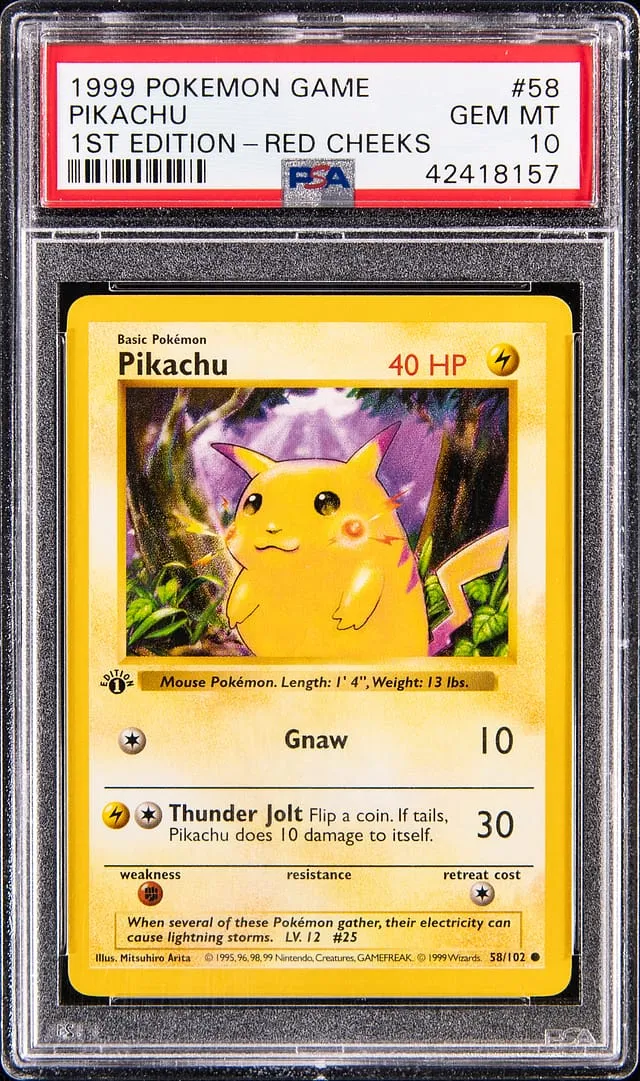
1999 1st Ed Red Cheeks Pikachu PSA 10 sells for $25K
A PSA 10 1999 Pokémon Base 1st Edition Red Cheeks Pikachu sold for $25,475 at Goldin. See why this key early Pikachu still matters to collectors.
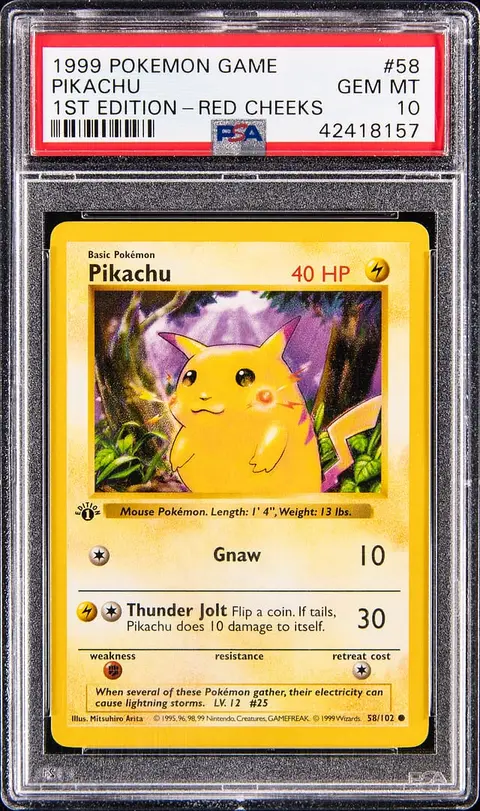
Sold Card
1999 Pokemon Base Set 1st Edition #58 Red Cheeks Pikachu - PSA GEM MT 10
Sale Price
Platform
Goldin1999 Pokémon Base Set 1st Edition #58 Red Cheeks Pikachu in PSA 10 quietly remains one of the most watched early-era Pokémon cards. A recent sale through Goldin on 2026-05-18 put new attention on this classic: the card realized $25,475.
Below is a breakdown of what sold, why this specific version matters, and how the price fits into the broader market context for early Pikachu cards.
The card at a glance
- Character: Pikachu
- Year: 1999
- Set: Pokémon Base Set – 1st Edition (English)
- Card number: #58
- Variant: “Red Cheeks” artwork (early print run)
- Rookie / key issue? Widely treated as Pikachu’s key early English card and a hobby icon
- Grading company: PSA (Professional Sports Authenticator)
- Grade: GEM MT 10 (Gem Mint)
- Attributes: Non-holo, early print artwork variant, strong nostalgia factor
The Base Set 1st Edition Pikachu comes in two main artwork variants: Red Cheeks and Yellow Cheeks. The Red Cheeks version represents the earlier print run, where Pikachu’s cheeks are a deeper red. It was later changed to a more orange/yellow look, creating a clear visual distinction that collectors now recognize as a variant.
In PSA’s grading system, GEM MT 10 is the highest standard grade, indicating a virtually flawless copy with strong centering, sharp corners, clean edges, and no noticeable print or surface issues.
Why the Red Cheeks Pikachu matters to collectors
A key card from the first English Pokémon set
The 1999 Base Set 1st Edition is the starting point of English Pokémon TCG history. For many collectors, it is the equivalent of a “rookie year” set in sports cards. Pikachu’s first major English appearance in that product has made this card a long-running target for:
- Nostalgia-driven collectors who opened these packs as kids.
- Set builders aiming to complete 1st Edition Base Set in high grade.
- Character collectors who focus specifically on Pikachu.
While Charizard usually headlines the set, 1st Edition Pikachu is one of the most recognizable non-holo cards in the hobby. Its place in pop culture—as the franchise mascot—gives it broader appeal than most commons.
Red Cheeks vs. Yellow Cheeks
The Red Cheeks artwork was part of the earliest English print wave. The later Yellow Cheeks version is more common overall, especially in high grade.
That difference has led many collectors to treat Red Cheeks as the prime early English Pikachu to own from Base Set, particularly in top grades like PSA 9 and PSA 10.
Era and condition challenges
This card is from what the hobby often calls the vintage or early era of Pokémon (late 1990s). At the time, few people were sleeve-protecting or grading base commons. Many copies were played, shuffled, traded, and stored loosely, which:
- Decreased the supply of clean, gradable raw copies.
- Increased the value separation between average-condition cards and true Gem Mint examples.
That condition scarcity is most visible at the very top of the grading scale.
The Goldin sale: $25,475 on 2026-05-18
On 2026-05-18, Goldin auctioned a 1999 Pokémon Base Set 1st Edition #58 Red Cheeks Pikachu – PSA GEM MT 10, closing at $25,475.
Goldin has become one of the more visible auction houses for higher-end TCGs, particularly for graded Pokémon, so realized prices there often help set or confirm market ranges for key cards.
Market context and recent comp ranges
In hobby language, “comps” (comparables) are recent sales of the same or very similar cards used to understand current price levels.
For 1st Edition Red Cheeks Pikachu in PSA 10, the market has seen several phases over the past few years:
- A strong run-up during the broader Pokémon boom.
- A cooling-off and normalization period as more supply came to market and speculative demand faded.
- A gradual stabilization where nostalgia buyers, character collectors, and set builders became the main drivers.
Looking across public auction and fixed-price marketplaces over recent years, PSA 10 Red Cheeks Pikachu has commonly traded in a tens-of-thousands of dollars range, with exact numbers moving based on:
- Short-term hobby sentiment.
- Population changes (how many PSA 10s exist).
- Presentation quality even within the PSA 10 grade (centering eye appeal, print quality, etc.).
Against that backdrop, the $25,475 Goldin result on 2026-05-18 sits within the established range for this card in PSA 10 in the mid‑2020s market environment—neither an outlier record, nor a distressed price. Instead, it looks like a representative, data-point sale in a more mature, post-boom market.
If anything, the result reinforces that serious demand for true gem copies of key 1st Edition Base cards remains steady, even after the intense spikes of earlier years.
Population and scarcity in PSA 10
While exact population figures (the number of copies graded at each grade level) change over time as more cards are submitted, a few structural points tend to stay true:
- There are many total 1st Edition Base Pikachu cards in the PSA population across all grades.
- The number of PSA 10 Red Cheeks examples is much smaller than the total graded population.
- Each additional PSA 10 added still requires a high-quality raw card, which is increasingly difficult to find 25+ years after release.
This combination—popular character, iconic set, and relatively constrained gem population—is a classic pattern for cards that keep collector interest over the long term, without needing speculative narratives.
How this sale fits into the bigger picture
For long-time collectors
If you have been tracking 1st Edition Base for years, this Goldin sale lines up with the card’s status as a core, blue-chip-style Pikachu piece rather than a short-lived fad. The price confirms that collectors are still willing to pay a premium for the cleanest examples.
For returning collectors
If you are just coming back to the hobby and remember pulling Pikachu from packs in 1999, this result highlights a few key realities:
- Raw vs. graded: Loose childhood copies, even if they look decent, usually do not match PSA 10 standards.
- Condition drives value: Small flaws—whitening on corners, scratches, or print lines—tend to push a card into PSA 7–9 territory, which carry very different price levels than PSA 10.
- Early variants matter: The Red Cheeks vs. Yellow Cheeks distinction is a good example of how subtle print differences can impact collector focus.
For small sellers and hobbyists
If you buy and sell on a smaller scale, this sale can be useful as a reference point, not a guaranteed target price:
- A PSA 10 result at $25,475 does not mean a PSA 8 or PSA 9 copy is anywhere near that number. Prices tend to drop steeply as you move down from gem mint.
- When looking up comps, make sure you filter by edition (1st Edition vs. Unlimited), variant (Red vs. Yellow Cheeks), and grade. Small differences here can lead to big price differences.
Takeaways
From a collector-to-collector perspective, this Goldin sale confirms a few steady themes in the Pokémon market:
- Key early Pikachu cards remain central to the hobby. Even while other segments of the market cycle up and down, this card continues to attract strong bids.
- Top grades command a serious premium. The gap between PSA 10 and lower grades isn’t just about the number on the label; it’s about the real difficulty of finding 25-year-old commons in truly flawless condition.
- Variant knowledge matters. Understanding details like the Red Cheeks print run helps collectors navigate listings and price data more confidently.
As always, this sale is one data point, not a prediction. But for those tracking the health of vintage Pokémon, a $25,475 result on a 1st Edition Red Cheeks Pikachu PSA 10 on 2026-05-18 at Goldin is a clear sign that core, nostalgia-driven cards continue to hold a meaningful place in the modern trading card landscape.