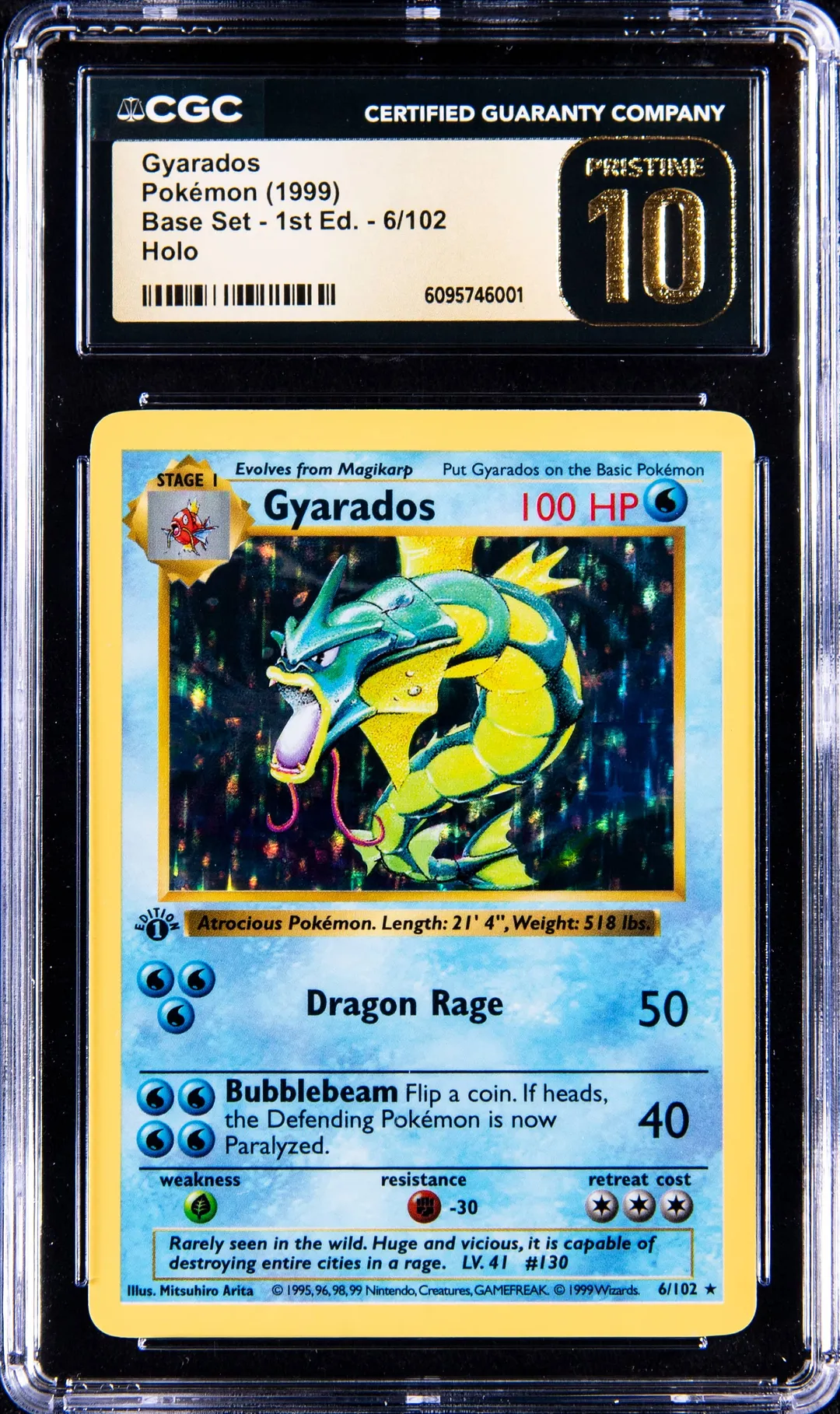
1999 1st Ed Holo Gyarados CGC 10 Sells for $21K
Goldin sold a 1999 Pokémon Base 1st Edition Holo Gyarados CGC Pristine 10 (Pop 2) for $21,080. See the context, comps, and what it means for collectors.
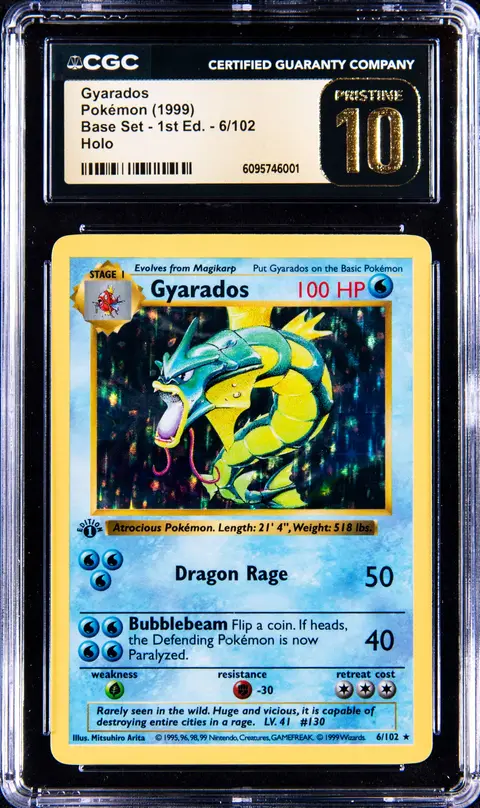
Sold Card
1999 Pokemon Base Set 1st Edition Holo #6 Gyarados - CGC PRISTINE 10 - Pop 2
Sale Price
Platform
Goldin1999 Pokémon Base Set 1st Edition Holo Gyarados in a CGC Pristine 10 holder is one of those cards that quietly sits near the top of many collectors’ long-term wishlists. On February 16, 2026, one of just two CGC Pristine 10 copies surfaced at Goldin and closed at $21,080, adding a fresh data point to the market for early WotC-era Pokémon grails.
In this breakdown, we’ll look at what this card is, why collectors care, and how this sale fits into the broader price picture.
The card at a glance
- Title: 1999 Pokémon Base Set 1st Edition Holo #6 Gyarados
- Set: 1999 Pokémon TCG Base Set (English), 1st Edition
- Card number: #6/102
- Character: Gyarados
- Foiling: Holographic (Holo)
- Edition: 1st Edition, the earliest English print run
- Year/era: 1999, early WotC (Wizards of the Coast) era, generally treated as vintage Pokémon
- Grading company: CGC (Certified Guaranty Company)
- Grade: CGC PRISTINE 10
- Special attributes: None beyond holo/1st Edition, but an extremely high technical grade
- Population: Pop 2 in CGC Pristine 10 (per the listing notes)
This is not a rookie card in the sports sense, but for Pokémon, 1st Edition Base Set is the hobby’s foundational release. Within that set, Gyarados is one of the key non-Charizard holos, alongside cards like Blastoise, Venusaur, Chansey, and Alakazam.
Why this Gyarados matters to collectors
1. 1st Edition Base Set: the foundation
The 1999 1st Edition Base Set is the first English Pokémon TCG printing. For many collectors, it represents the moment the game and brand truly exploded outside Japan. Cards from this set carry historical weight in the same way early Topps or O-Pee-Chee runs matter in vintage sports.
Within Base Set, there are 16 holographic rares. They form the core of what many consider the “classic” Pokémon lineup. Even beyond Charizard, high-end examples of these holos have become long-term anchors in many collections.
2. Gyarados as a character
Gyarados isn’t the face of the franchise like Pikachu or Charizard, but it’s still one of the most recognizable Generation 1 Pokémon:
- It evolves from Magikarp, a card and character that has its own cult following.
- In the games and anime, Gyarados is portrayed as powerful and intimidating, which resonates with long-time fans.
- The Base Set artwork—originally by Mitsuhiro Arita—has become the default mental image of Gyarados for a generation of players.
So while Gyarados may not always headline record lists, it sits squarely in that next tier of nostalgia-driven, highly recognizable characters.
3. CGC Pristine 10 and population scarcity
A CGC Pristine 10 is a very high bar. CGC’s top grades (Pristine 10 and Perfect 10) are typically awarded to a very small fraction of cards submitted, especially for older, mass-distributed sets from 1999.
Important points about grade and scarcity:
- Vintage condition: 1st Edition Base holos were often played with, carried around, and stored in less-than-ideal conditions. That makes pack-fresh, totally clean copies tougher to find today.
- High-grade difficulty: Even when a card looks sharp to the naked eye, subgrades like centering, corners, and surface can hold it back. Achieving a Pristine 10 usually requires near-flawless centering and virtually no print or handling flaws.
- Pop report (population report): A "pop report" is the grading company’s count of how many copies of a specific card exist in each grade. Here, the card is described as Pop 2 in CGC Pristine 10, confirming that only two examples existed at that level at the time of sale.
In other words, this isn’t just a strong copy of a desirable Gyarados. It’s one of the cleanest examples currently recognized by a major third-party grader.
Market context: where does $21,080 fit?
The Goldin sale on February 16, 2026 closed at $21,080 USD. To understand that number, it helps to look at the broader landscape:
1. 1st Edition Gyarados across grades and graders
Using public auction and marketplace data (Goldin, Heritage, PWCC, eBay, and major fixed-price platforms), recent sales for 1st Edition Base Set Gyarados generally show a clear grade ladder:
- Mid grades (PSA 6–7, CGC 6–7): Often in the low-to-mid hundreds of dollars, depending on eye appeal and subgrades.
- Strong graded copies (PSA 8–9, CGC 8–9): Typically into the low-to-mid thousands of dollars. High-end 9s with strong centering and clean holo surfaces can stretch higher.
- Gem Mint tier (PSA 10, BGS 9.5/10, CGC 10): Significantly more expensive, with price differences driven by the grading company’s reputation, perceived strictness, and the specific label (e.g., Pristine vs Perfect).
Within that Gem Mint tier, older sales have shown that PSA 10 1st Edition Gyarados can command a healthy multiple over PSA 9s, especially during stronger Pokémon sentiment cycles. Pristine-level grades from CGC or BGS tend to sit at the top of that pyramid, reflecting the combination of set status, character popularity, and technical condition.
2. How this CGC Pristine 10 result compares
Recent public sales data for CGC Pristine 10 copies of this exact card are limited, due in part to the very low population. That makes direct “apples to apples” comparisons difficult.
However, some consistent patterns show up when comparing across similar tiers:
- Pristine vs Gem Mint: In many segments of the market, a Pristine 10 commands a premium over a standard Gem Mint 10 or equivalent, especially when pop counts are very low.
- Pop 2 impact: With only two known Pristine 10s at CGC, each auction event has outsized importance in setting expectations.
Against that backdrop, the $21,080 hammer at Goldin fits into a range that makes sense relative to:
- Prior high-end sales of 1st Edition Base Set holos in very strong grades.
- The known scarcity of this exact grade for Gyarados.
- The general premium associated with ultra-high grades from CGC for vintage Pokémon.
Rather than standing out as an obvious outlier, this result looks like a measured reflection of both condition rarity and set significance in early 2026.
What this sale signals for the market
1. Ongoing respect for non-Charizard Base Set holos
While Charizard usually dominates headlines, sales like this Gyarados show that collectors continue to value the rest of the 1st Edition holo lineup. When top-condition, low-population copies surface, there is still meaningful bidding interest.
For collectors, this reinforces a key idea:
The broader 1st Edition holo set—beyond Charizard—still carries long-term collector attention, especially at the very top of the condition spectrum.
2. Condition and grading company still matter
This sale underscores how much grade and grading company shape outcomes:
- The difference between a strong 9, a 10, and a Pristine 10 can be multiples in price.
- CGC’s Pristine label has established itself as a serious benchmark for technical condition, particularly in vintage Pokémon.
For newer collectors, it’s a reminder to:
- Look closely at population reports and not just the numeric grade.
- Understand that a “10” from different grading companies can carry different market perceptions.
3. 1999–2000 WotC era remains a central focus
Steady, data-backed results like this suggest that the Wizards of the Coast era (1999–2003) continues to act as a structural core of the Pokémon market. While modern and ultra-modern sets cycle in and out of focus, early Base/Jungle/Fossil and Neo-era cards keep attracting long-term collectors.
Gyarados sits in that core group: not the single top headline card, but a character and card that many collectors want represented in high quality.
Takeaways for collectors and small sellers
If you’re collecting or selling 1st Edition Base Set holos, here are a few grounded observations from this sale:
- Top-end condition is a different market. A CGC Pristine 10 Pop 2 Gyarados lives in a very different price and buyer tier than lightly played or mid-grade copies of the same card.
- Understanding comps is key. “Comps” (comparable recent sales) work best when you match grade, grading company, and overall eye appeal as closely as possible. Using a Pristine 10 result to price a raw or mid-grade card will lead to unrealistic expectations.
- Population reports are worth checking. A Pop 2 grade on a vintage card is a strong signal that the supply of similar-level copies is extremely limited.
- Focus on what you can control. For most collectors, that means careful storage, thoughtful grading submissions, and buying the best condition you’re comfortable with at your budget.
Final thoughts
The February 16, 2026 Goldin sale of the 1999 Pokémon Base Set 1st Edition Holo #6 Gyarados – CGC Pristine 10 (Pop 2) at $21,080 is a clear marker for what ultra-elite condition can mean on a historically important, nostalgia-heavy card.
It doesn’t rewrite the entire Pokémon market on its own, but it does quietly confirm a few things:
- 1st Edition Base Set holos remain highly respected.
- Condition rarity at the very top still commands a premium.
- CGC’s Pristine label has an established place in the conversation for high-end vintage Pokémon.
For collectors and small sellers watching the space, this sale is another useful datapoint in understanding how the market continues to sort and value the very best surviving copies from 1999.