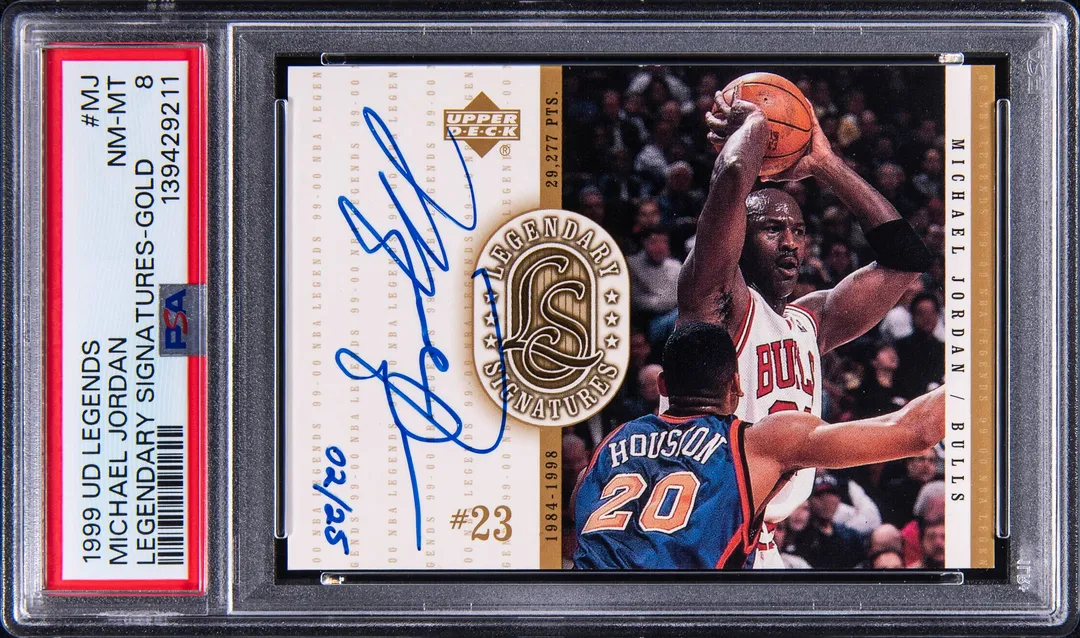
1999-00 UD Legends Jordan Gold Auto /25 Sells for $183K
Goldin sold a 1999-00 Upper Deck Legends Legendary Signatures Gold Michael Jordan /25 PSA 8 for $183,000. Here’s the context for collectors.
Sold Card
1999-00 Upper Deck Legends Legendary Signatures Gold #MJ Michael Jordan Signed Card (#02/25) - PSA NM-MT 8
Sale Price
Platform
Goldin1999-00 Upper Deck Legends Legendary Signatures Gold #MJ Michael Jordan Signed Card (#02/25) - PSA NM-MT 8 Sold for $183,000
On January 4, 2026, Goldin closed a notable Michael Jordan sale that caught the attention of both advanced and returning collectors: a 1999-00 Upper Deck Legends Legendary Signatures Gold #MJ, serial numbered 02/25, graded PSA NM-MT 8, realized $183,000.
For a late‑1990s Jordan autograph, especially from an on-card, low-numbered insert set, this result sits in an important middle ground between museum-level MJ pieces (Exquisite, PMG, key rookies) and more accessible signed issues.
In this post, we’ll break down what the card is, why collectors care about this specific insert, and how this sale fits into recent market context.
Card overview: what exactly sold?
Card details
- Player: Michael Jordan
- Team: Chicago Bulls (card imagery and era)
- Year: 1999-00
- Set: Upper Deck Legends
- Subset: Legendary Signatures
- Parallel: Gold
- Card number: #MJ
- Serial numbering: #02/25 (only 25 copies produced)
- Autograph: On-card (signed directly on the card surface)
- Grading company: PSA
- Grade: NM-MT 8 (Near Mint-Mint)
- Auto authentication: PSA/DNA certified as part of the slab
This is not a rookie card; it’s a late‑career issue from Jordan’s post‑dynasty era. But within the hobby, 1999-00 Upper Deck Legends Legendary Signatures is widely viewed as an important late-90s autograph insert. The Gold parallel, limited to /25, is the premium tier of that run.
Key attributes collectors focus on:
- Low serial numbering (/25): Fixed, small print run gives the card structural scarcity.
- On-card autograph: Many collectors prefer on-card autographs to sticker autos because they feel more connected to the player and usually present better visually.
- Legends insert line: The Legendary Signatures name has become a recognizable brand within late-1990s Upper Deck products, especially for Hall of Famers.
As a PSA 8, this copy is strong but not gem mint. For late‑90s foil and autograph cards, an 8 is still solid—corners, edges, and surface often show more wear than base cards from the same era.
Why this set and parallel matter to collectors
1. Late‑90s autograph era for Jordan
The late 1990s represent a turning point in basketball cards. Companies were experimenting with:
- Pack‑inserted, certified autographs
- Low-numbered parallels
- More premium card stock and foil finishes
Jordan’s earliest certified autographs and low-serial inserts are now treated as key historical pieces in the post‑rookie part of his catalog. While Exquisite (2003-04) and high‑end 1990s inserts like Precious Metal Gems sit at the top of the pyramid, sets like 1999-00 Upper Deck Legends Legendary Signatures form a core layer just beneath that tier.
The Gold Legendary Signatures /25 is a clear step up from Jordan’s more common auto issues:
- Far lower print runs than many early‑2000s signed cards.
- A set theme focused on all-time greats, not just current players.
- Clean design that frames the autograph as the star of the card.
2. Historical set positioning
Upper Deck Legends products are often remembered for their checklist of Hall of Famers and retired stars. The Legendary Signatures inserts are one of the more recognizable autograph inserts from this era, especially when you look across multiple sports.
For basketball collectors, the combination of:
- A Jordan autograph
- A low-numbered Gold parallel
- And late-90s production
makes this a target for collectors who want a Jordan auto that feels historically significant but is rarer than his later, higher‑print autographs.
Grading and scarcity: PSA 8 in a /25 world
A serial number of 25 means there are only 25 copies of the Gold parallel in existence, regardless of grading. That’s absolute scarcity, not just grading scarcity.
PSA’s grade of NM-MT 8 signals:
- Clean overall presentation.
- Minor flaws under close inspection—perhaps a tiny corner touch, light edge chipping, or subtle surface issue.
For many collectors chasing scarce autograph inserts, a PSA 8 is an acceptable grade, especially for:
- Foil-heavy late‑90s cards, which are harder to keep in true mint condition.
- Autographed cards, where eye-appeal and bold ink sometimes matter more than a one- or two-point difference in technical grade.
In a /25 card, the real question is usually less “Can I get a 10?” and more “Will one of these surface at all, and will the autograph look good?”
Market context: where does $183,000 fit?
This copy sold at Goldin on January 4, 2026 for $183,000.
When looking at price context—often referred to in the hobby as “comps” (short for comparables, meaning recent sale prices of similar items)—collectors typically examine:
- The same card in different grades.
- Other serial numbers from the same print run.
- Closely related Jordan autograph inserts from the late‑1990s and early‑2000s.
For this specific card, public sales data is relatively thin because only 25 copies exist, and not all are graded or frequently offered. That means:
- There are fewer recent, direct comps than you’d see for a Jordan rookie in PSA 8 or PSA 9.
- Individual results can move up or down more sharply with each auction.
From available public records on comparable Jordan autograph inserts with similar scarcity and era, the $183,000 result:
- Sits above the pricing of more common Jordan autos from the 2000s and later.
- Tracks closer to what experienced collectors expect for low-numbered, late-90s MJ autographs from respected brands.
Because exact sales of this specific serial number and grade are limited, this Goldin sale effectively becomes a fresh reference point for:
- Future Legendary Signatures Gold Jordan listings.
- Other rare, late-90s MJ auto inserts when sellers and buyers negotiate value.
Rather than a definitive “new norm,” it’s more useful to see this as one data point in a thin but important comp set.
How collectors interpret a sale like this
For hobbyists, a six‑figure sale like this usually isn’t about day‑trading or short‑term flips. Instead, it reinforces a few ongoing themes in the Jordan market:
Prime-era Jordan autos with scarcity remain in demand.
When collectors talk about “blue-chip” MJ pieces, they increasingly look beyond rookies to select autograph and insert runs from the late‑1990s and early‑2000s.Low serial numbering matters.
A card limited to 25 copies behaves differently in the market than a card that can be easily found in multiple copies every month. Buyers know they may wait years to see a copy surface again.Established brands carry weight.
Upper Deck’s late‑90s reputation for premium inserts and autographs continues to support values on its Jordan issues, particularly when the design is clean and the print run is clearly defined.Grade is important, but not everything.
In highly limited autograph cards, collectors often prioritize:- Signature quality (bold, well-centered, no smearing)
- Overall eye appeal
- Serial number and set
over squeezing the last grading point.
What this means for different types of collectors
If you’re newer or returning to the hobby
This sale is a helpful case study in how high-end Jordan cards are evaluated:
- Focus on era (late‑90s), scarcity (/25), autograph type (on-card), and brand (Upper Deck Legends).
- Learn to read a grading label: PSA 8 is Near Mint-Mint, and for older, foil-based autograph cards, that can be more than acceptable.
You don’t need a six‑figure budget to apply these ideas. Look for:
- Smaller‑name players in similar insert structures.
- Non-Gold or higher-print versions of the same concept.
If you’re an active hobbyist or small seller
This Goldin result on January 4, 2026 can be useful when:
- Pricing other late‑90s MJ autos with clearly defined print runs.
- Evaluating the spread between, say, a /25 Gold and a non-numbered or higher-numbered autograph from the same era.
Because data is thin at this tier, it’s sensible to:
- Treat this sale as one important comp, not the only one.
- Look across other platforms and auction houses for similar MJ autograph inserts to understand broader trends.
Takeaways
The 1999-00 Upper Deck Legends Legendary Signatures Gold #MJ Michael Jordan, serial numbered 02/25 and graded PSA NM-MT 8, selling for $183,000 at Goldin on January 4, 2026 highlights a few key truths about the current Jordan market:
- Scarce, on-card autographs from the late‑1990s continue to command strong attention.
- Upper Deck’s Legends and Legendary Signatures branding still resonates with collectors who favor historically important insert sets.
- In ultra-low print runs, each auction result helps shape expectations for the next, rather than fitting neatly into a crowded comp history.
For collectors tracking the evolution of high-end Jordan cards, this sale is another data point showing how carefully selected, low-numbered autograph issues from his playing and immediate post‑playing era occupy a lasting place in the hobby.
figoca will continue monitoring similar sales across major auction houses so collectors can understand not just the headlines, but the context behind them.