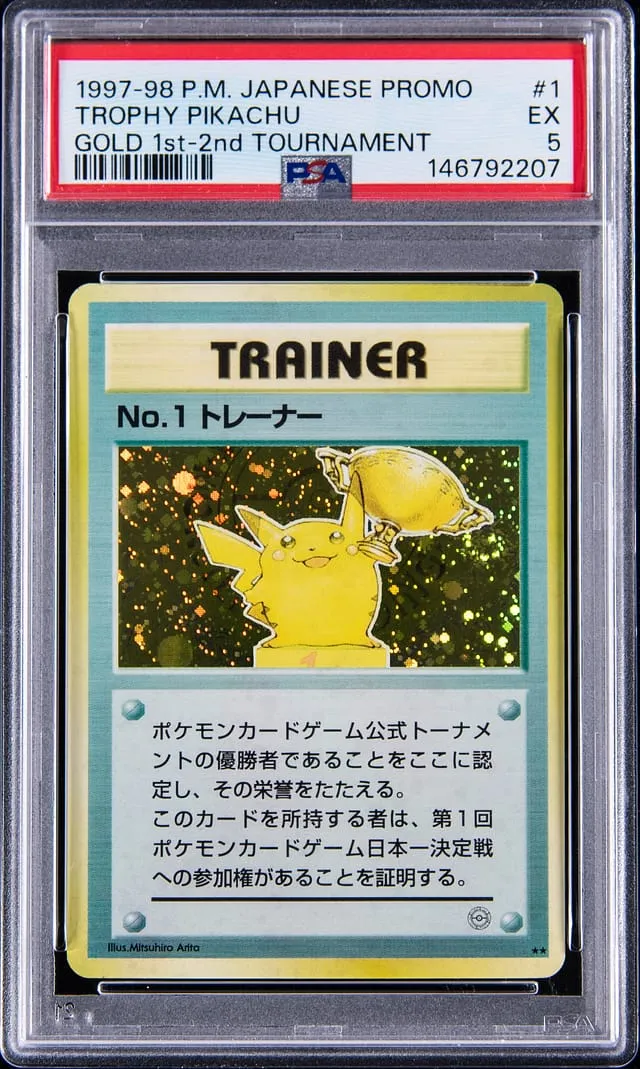
1998 Trophy Pikachu Gold 1st Place Sells for $268K
Goldin sold a 1998 Japanese Trophy Pikachu Gold 1st Place PSA 5 with original prizes for $268,400. See the context behind this rare Pokémon sale.
Sold Card
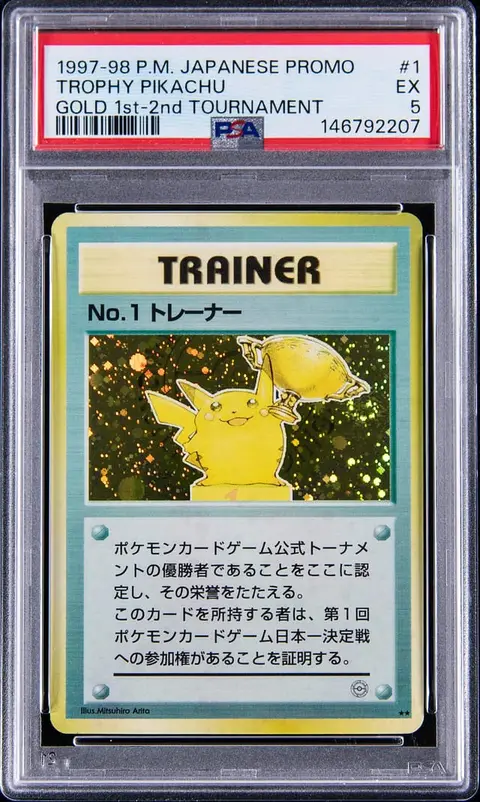
1998 Pokemon Japanese Promo Gold 1st Place 2nd Tournament #1 Trophy Pikachu - PSA EX 5 - Includes Plaque, Hat, Red Parka, Gold Chansey Coin
Sale Price
Platform
GoldinWhen a 1998 Pokémon Trophy Pikachu surfaces publicly, the hobby pays attention. When that card is a Japanese Gold 1st Place 2nd Tournament #1 Trophy Pikachu, graded PSA EX 5 and paired with its original prize items — plaque, hat, red parka, and gold Chansey coin — it becomes a hobby landmark.
On February 23, 2026, Goldin sold this historic prize card and memorabilia bundle for $268,400. For collectors who track the very top of the Pokémon market, this is a meaningful data point and a rare window into a card that almost never changes hands.
What exactly is this Trophy Pikachu?
Let’s break down the card and its context clearly:
- Character: Pikachu
- Year: 1998
- Origin: Japanese tournament prize promo
- Card title: Trophy Pikachu (often referred to with the “Gold 1st Place” designation)
- Event: 2nd Tournament (1998 Pokémon tournament series in Japan)
- Card number: #1 on the trophy card itself
- Grading company: PSA (Professional Sports Authenticator)
- Grade: EX 5 (Excellent)
- Accompanying items: original winner’s plaque, tournament hat, red parka, and gold Chansey coin
This is not a pack-pulled card. It was awarded to top finishers — in this case, 1st place — in an early official Pokémon tournament in Japan. That makes it more like a sports trophy than a traditional trading card release. In hobby terms, it’s considered a key issue and one of the most important early Pikachu cards, even if it isn’t a “rookie card” in the standard sense.
Why Trophy Pikachu matters to collectors
Early Japanese trophy cards occupy a special tier in Pokémon collecting:
- Ultra-low print and distribution. These cards were awarded only to tournament winners and top finishers, not sold to the public. The number of copies is tiny compared with even the rarest booster pack cards.
- Historical significance. 1997–1999 is the foundational era for Pokémon TCG. Trophy Pikachu cards document organized play at the very beginning of the game’s history.
- Pikachu as the mascot. Pikachu is the face of the franchise. Key early Pikachu issues tend to have durable demand because they appeal to character collectors, high-end Pokémon specialists, and even non-TCG Pokémon fans.
- Provenance and completeness. When original prize items — like winner’s plaque, apparel, and coins — are preserved with the card, they strengthen the story. That story matters a lot at this level of collecting.
Because of all this, Trophy Pikachu cards are typically held by long-term collectors. They appear at auction infrequently, and each appearance adds a new puzzle piece to the long-term price history.
Details of this Goldin sale
- Auction house: Goldin
- Sale date (UTC): February 23, 2026
- Realized price: $268,400
- Item: 1998 Pokémon Japanese Promo Gold 1st Place 2nd Tournament #1 Trophy Pikachu – PSA EX 5 – Includes Plaque, Hat, Red Parka, Gold Chansey Coin
PSA’s EX 5 grade indicates a card with clear wear visible to the eye: edge and corner wear, potential minor creases, and noticeable surface flaws. For standard pack-pulled cards, this would be considered a mid-grade. For a 1998 trophy card that was actually awarded and handled as a prize, a 5 can still be very attractive given how few exist at all.
The presence of the original plaque, hat, red parka, and gold Chansey coin is a major point of interest. These items:
- Confirm the award context
- Add cultural and historical flavor to the piece
- Differentiate it from “card only” examples that sometimes show up separated from their original awards
Market context and price comparison
Trophy Pikachu cards do not change hands often, and when they do, conditions vary: different tournaments, placements (1st, 2nd, 3rd), and grades, sometimes with or without corresponding memorabilia.
Because of this, “comps” — short for comparable sales, used to gauge price context — are always approximate. However, we can outline the landscape:
- Previous Trophy Pikachu sales have reached well into six figures for strong copies, especially in higher PSA grades and for 1st place variants.
- Lower-placed trophies (2nd or 3rd place) and examples without full accessories typically sell at a discount to the top-tier, fully documented 1st place packages.
- Condition sensitivity is real, but rarity often dominates. With population counts this low, a PSA 5 can still be chased aggressively when the alternative is waiting years for another shot.
Within that context, a $268,400 result for a PSA EX 5 with its original prize items sits firmly in the established top-end Pokémon ecosystem rather than creating an out-of-nowhere spike. It supports the idea that:
- Top trophy cards remain in strong demand
- Complete provenance (card plus plaque, apparel, and coin) can command a meaningful premium
- Collectors are still willing to compete for historically important pieces even when the numerical grade is mid-tier
For newer collectors, it’s important to recognize that this sale doesn’t imply that all Promo Pikachu or 1990s Pikachu cards are suddenly worth six figures. This result reflects a very specific combination: trophy-level rarity + early era + iconic character + preserved memorabilia + major auction house visibility.
Population, rarity, and grading
Population reports (often shortened to “pop report”) summarize how many copies of a card each grading company has handled at each grade. For a card like this, pop numbers are small enough that:
- Every new graded copy is noticed
- Every auction appearance is recorded and discussed
While exact numbers for each variant can shift as more cards are graded, the big picture is clear: there are very few Gold 1st Place Trophy Pikachu cards in any grade. That scarcity is structural; they were never widely distributed.
The PSA EX 5 grade does place this specific copy below the highest-graded examples, but at this rarity tier, the difference between a 5 and, say, a 7 or 8 is partly about eye appeal and partly about simply having an opportunity to buy one at all.
Why this sale matters beyond the headline number
For active hobbyists and small sellers, a $268,400 result can feel distant from day-to-day collecting. But it still has useful lessons:
- Context beats condition alone. Mid-grade cards can achieve strong results when they’re historically important and truly scarce.
- Provenance and completeness add value. Keeping documentation, original packaging, and related items can matter, especially on limited-issue cards.
- Early organized play history continues to be respected. Cards tied to official tournaments and events from the late 1990s have held collector interest over the long term.
- Auction visibility shapes perceived market levels. When a major auction house like Goldin offers a piece, the result becomes a widely referenced data point for future discussions.
For collectors considering where this sits in the broader Pokémon hierarchy, think of it alongside other early Japanese trophies and rare event promos rather than standard holofoils or chase cards from booster sets.
Takeaways for different types of collectors
Newcomers and returning collectors
This sale is a reminder that Pokémon has a layered ecosystem:
- Most cards are inexpensive and great for casual collecting.
- Some modern chase cards are popular but not truly scarce.
- A tiny group of early trophy and prize cards sits at the top as historical artifacts.
Understanding which tier a card belongs to can help you interpret prices without assuming that one headline number applies to the whole hobby.
Active hobbyists
For those who already understand comps and pop reports, this Goldin result can be logged as a fresh data point for high-end 1990s trophy material:
- Confirms continued depth of demand for early Pikachu trophies
- Reinforces the premium for full sets of associated items
- Provides a reference point if and when another 1st Place 1998 Trophy Pikachu surfaces in a different grade or configuration
Small sellers
Even if you never handle a Trophy Pikachu, you can still take cues from this sale:
- Keep original accessories, paperwork, and packaging with your promos when possible.
- Document provenance when you know it (how you acquired the card, any event tie-ins, etc.).
- When analyzing your own cards, focus on specificity (exact variant, print run, and context) rather than assuming all promos behave similarly.
Closing thoughts
The February 23, 2026 Goldin sale of the 1998 Pokémon Japanese Promo Gold 1st Place 2nd Tournament #1 Trophy Pikachu — PSA EX 5 with plaque, hat, red parka, and gold Chansey coin — adds another carefully measured step in the long-term story of Pokémon’s rarest prizes.
It does not rewrite the entire market, but it does reinforce a steady theme: historically important, truly scarce tournament cards with strong provenance continue to command the attention and resources of serious collectors.
For the rest of us, tracking these results helps calibrate our expectations, refine our understanding of rarity, and appreciate just how deep the Pokémon TCG’s history runs, all the way back to those early tournaments where a handful of players walked away with Pikachu trophies instead of just booster packs.