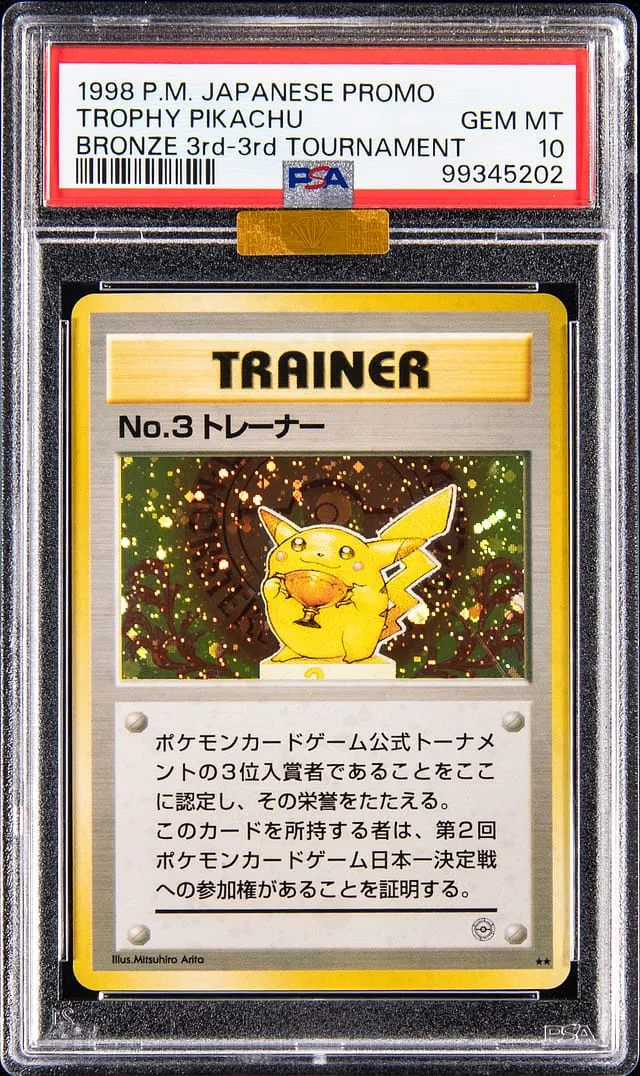
1998 Trophy Pikachu Bronze PSA 10 Sells for $1.77M
Breakdown of the $1,769,000 Goldin sale of the 1998 Japanese Trophy Pikachu Bronze 3rd Place PSA 10 Pop 1, and what it means for Pokémon collectors.
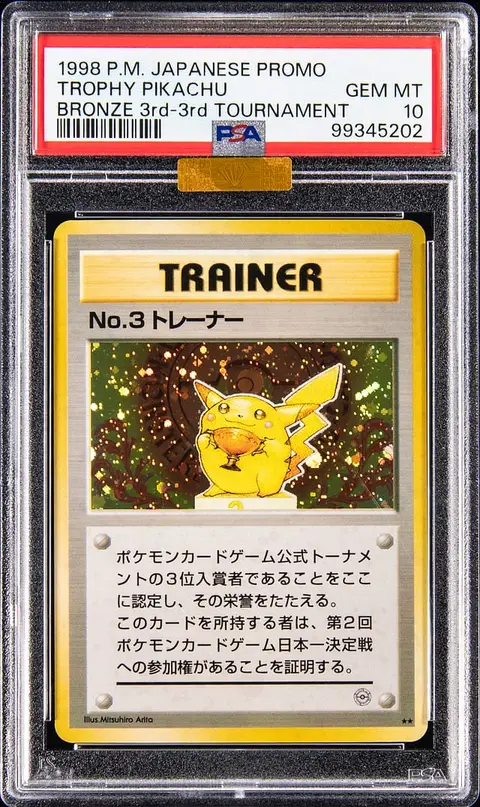
Sold Card
1998 Pokemon Japanese Promo Bronze 3rd Place 3rd Tournament Trophy Pikachu - PSA GEM MT 10 - MBA Gold Diamond - Pop 1
Sale Price
Platform
Goldin1998 Pokemon Japanese Promo Bronze 3rd Place 3rd Tournament Trophy Pikachu - PSA GEM MT 10 - MBA Gold Diamond - Pop 1
On May 18, 2026, Goldin sold a 1998 Pokémon Japanese Trophy Pikachu for $1,769,000. For many collectors, that headline alone signals how far the trophy card segment of the hobby has come.
This article walks through what this card is, why it matters, and how this sale fits into the broader market for high‑end Pokémon.
Card ID: What Exactly Sold?
Card: 1998 Pokémon Japanese Promo Bronze 3rd Place 3rd Tournament Trophy Pikachu
Character: Pikachu
Year: 1998
Type: Japanese tournament prize promo ("Trophy Pikachu")
Placement: Bronze – 3rd Place award
Event: 3rd Tournament (early Japanese Pokémon tournament circuit)
Era: Early WotC-era Japanese (often treated as “vintage” Pokémon)
Grading company: PSA
Grade: GEM MT 10
Label note: MBA Gold Diamond
Population: PSA Pop 1 in GEM MT 10 at time of sale
This is a Trophy Pikachu, one of the earliest and most respected prize cards in the Pokémon TCG. These cards were awarded to top finishers in official Japanese tournaments in the late 1990s. They were never sold in packs or at retail; they were earned.
Within the Trophy Pikachu family, collectors usually distinguish them by:
- Placement: Gold (1st), Silver (2nd), Bronze (3rd)
- Tournament iteration: First, second, third, etc.
- Language/region: Japanese only for this run
The card here is the Bronze 3rd Place card from the 3rd Tournament, making it a specific and very small slice of an already tiny trophy-print run.
The PSA GEM MT 10 grade means PSA judged the card as virtually flawless on corners, edges, surface, and centering. In a low‑print, hand-awarded trophy card, this is especially meaningful, because these cards were not distributed in typical sealed product.
The listing also references MBA Gold Diamond – a separate high‑end authentication/encapsulation service. In practice, for market value analysis, the PSA grade and population count tend to be the primary drivers.
How Rare Is This Card?
Trophy Pikachu cards are widely understood to be extremely scarce. While exact print-run numbers have never been officially confirmed, the structure of the tournaments (limited winners, limited events) points to extremely low totals – likely in the tens, not hundreds.
On top of that, this specific copy is:
- PSA Pop 1 in GEM MT 10: At the time of the sale, PSA’s population report (a count of how many copies have been graded at each grade level) shows this as the only PSA 10 example for this exact variant.
- Condition-sensitive issue: Given that these were given directly to winners rather than pulled from packs, many copies show handling, storage, or transport wear.
For serious trophy collectors, a lone PSA 10 represents the best-known example in the market at grading time.
The Sale: $1,769,000 at Goldin
- Auction house: Goldin
- Sale date (UTC): 2026-05-18
- Realized price: $1,769,000
Goldin has become one of the primary venues for high‑end Pokémon, particularly for low‑population grails like trophy cards. A seven‑figure result at a major house like this is part of a larger trend where top‑tier Pokémon now regularly share catalog space with blue‑chip sports cards and memorabilia.
The figure itself places this card firmly in the upper tier of Pokémon prices, alongside other headline sales such as:
- Early trophy cards (1997/1998 Pikachu trophies, Kangaskhan Parent/Child promos).
- High‑grade first‑edition Charizard holos and unique art-based rarities.
- Illustrator-level cards and one‑off art or award pieces.
While exact previous comps (short for “comparable sales,” a term collectors use for recent similar auction results) for this precise variant in PSA 10 are essentially nonexistent – because this is a pop 1 – we can still place it broadly relative to the trophy market.
Market Context and Related Sales
Because this card is a population 1 in PSA 10 and a specific tournament/placement variant, there is no direct historical price series to chart. Instead, collectors tend to look at:
- Other Trophy Pikachu variants
- Other 1997–1999 Japanese trophy cards
- Highest‑grade, top‑pop examples of similar status cards
Across those segments, recent years have seen:
- Multiple six‑ and seven‑figure sales for top‑grade Japanese trophy cards.
- Strong results when cards combine early era + event pedigree + documented scarcity + top grade.
Within this framework, a $1,769,000 result for a 1998 Trophy Pikachu Bronze 3rd Place 3rd Tournament, PSA 10 pop 1 sits on the high end but not out of step with how the market has treated other elite trophy pieces.
Instead of looking for a perfect 1:1 comp (which does not really exist here), many advanced buyers approach these auctions as unique opportunities, where the clearing price simply reflects the highest level serious collectors and institutions are prepared to pay at that moment. That dynamic makes each trophy auction an event rather than a routine transaction.
Why Collectors Care About Trophy Pikachu
Several factors make this card important to the hobby:
1. Early Pokémon history
Issued in 1998, this card comes from the earliest organized play period in Japan. That places it near the very beginning of the Pokémon TCG’s competitive ecosystem, well before English sets like Base Set exploded worldwide.
For many collectors, early Japanese trophies are the true origin pieces – artifacts from when Pokémon was primarily a Japanese phenomenon.
2. Tournament trophy, not pack-issued
Unlike set cards pulled from booster packs, Trophy Pikachu was awarded, not opened. To own one is to own something that originally belonged to a top competitor in an official event.
That tournament provenance – a card that literally stands in for a trophy – gives it a different feel than even the most iconic pack cards like Base Set Charizard.
3. Scarcity that is hard to replicate
Modern sets can manufacture scarcity through serial numbering or short printing, but the hobby tends to value organic, event-based scarcity differently. Trophy Pikachu’s supply was constrained by:
- The number of tournaments run.
- The number of top finishers awarded.
- How many copies survived intact over nearly three decades.
That path to rarity is part of why vintage trophies sit in their own tier.
4. Pikachu as a franchise icon
Pikachu is still the face of Pokémon. For character-focused collectors, a Pikachu trophy combines the franchise mascot with one of the hardest-to-obtain formats (trophy promos), creating a strong “character + card type + era” alignment.
How This Fits into Today’s Pokémon Market
The broader Pokémon market has gone through several phases:
- Original late‑90s/early‑2000s boom and fade
- Steady collector base through the 2010s
- Massive surge in 2020–2021, followed by price discovery and normalization
By 2026, the market had largely moved past the sharp swings of the pandemic era. Prices in many segments have stabilized, while true rarities – especially those with strong stories and provable scarcity – have held or built on their status.
Within that environment, this Goldin sale underscores a few ongoing themes:
- Top-end Pokémon is now an established category. High‑end Pokémon lots, particularly early Japanese items, continue to attract deep-pocketed collectors.
- Trophy cards function more like fine art than like standard set cards. Their value is less about a price chart and more about occasional, thinly traded results when a top example surfaces.
- Grade separation matters more as you go higher. Being the only PSA 10 for this card sharply differentiates it from lower grades when elite buyers focus on “best in the world” type pieces.
Reading This Sale as a Collector or Small Seller
This result is notable, but it does not mean every rare card is now a seven‑figure asset. A few practical takeaways:
Segment your expectations by tier.
Trophy Pikachu cards occupy a very narrow top tier of the market. Their behavior doesn’t always translate directly to regular promos or set cards, even when those are scarce.Pay attention to provenance and context.
Tournament award cards with a clear story and limited distribution often behave differently from cards that are scarce only because of grading difficulty.Use comps thoughtfully.
For most cards, finding recent “comps” (similar recent sales) gives a good sense of current market ranges. For true one‑of‑one scenarios, comps will be limited or nonexistent, and each sale can reset the reference point.Grade scarcity is real, but not everything.
Being Pop 1 in PSA 10 matters a lot here because of the underlying card’s significance. For less central cards, pop counts alone don’t guarantee demand.
Final Thoughts
The $1,769,000 sale of the 1998 Pokémon Japanese Promo Bronze 3rd Place 3rd Tournament Trophy Pikachu PSA GEM MT 10 (Pop 1) at Goldin on May 18, 2026 is another data point in a story that has been building for years: the maturation of high‑end Pokémon collecting.
For collectors, this card represents a convergence of:
- Early competitive history
- Genuine rarity
- PSA top population status
- The franchise’s flagship character
Whether you are a long‑time trophy specialist or someone just now learning about these cards, results like this show how the hobby continues to recognize and reward pieces that sit closest to the origins of the game.
As always, these sales are best understood as historical signals, not guarantees. They highlight how a small number of ultra‑scarce cards can command exceptional prices when they finally surface, especially at a major auction house like Goldin on a global stage.