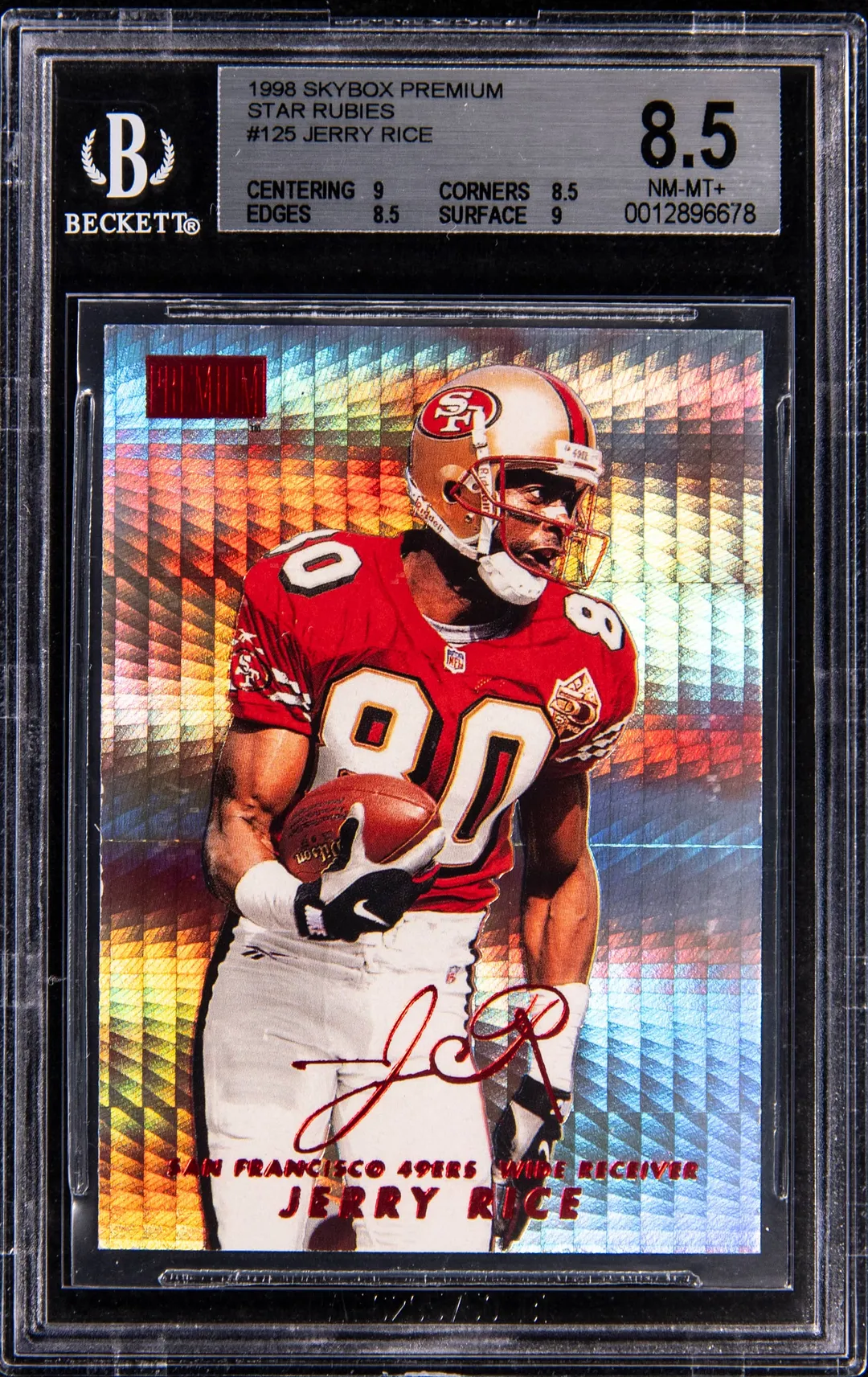
1998 Star Rubies Jerry Rice /50 BGS 8.5 sale
Goldin sold a 1998 SkyBox Premium Star Rubies #125 Jerry Rice /50 BGS 8.5 (Pop 3) for $13,648. A key 90s parallel result for an all-time great.
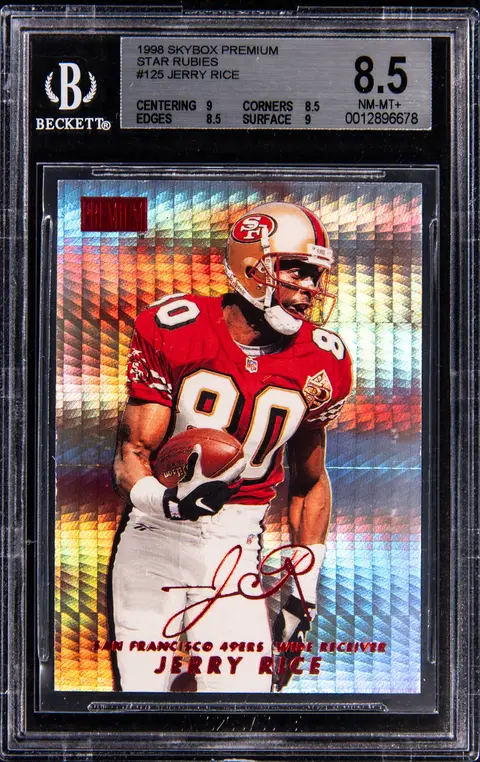
Sold Card
1998 SkyBox Premium Star Rubies #125 Jerry Rice (#39/50) - BGS NM-MT+ 8.5 - Pop 3
Sale Price
Platform
Goldin1998 SkyBox Premium Star Rubies #125 Jerry Rice (#39/50) - BGS NM-MT+ 8.5 - Pop 3
On February 8, 2026, Goldin sold a key 90s parallel for one of football’s all-time greats: a 1998 SkyBox Premium Star Rubies #125 Jerry Rice, serial numbered 39/50, graded BGS NM-MT+ 8.5. The final price was $13,648.
For collectors who focus on 90s football inserts and parallels, this sale is a useful data point in an area of the market that often trades privately and infrequently.
Card overview
Card details
- Player: Jerry Rice
- Team: San Francisco 49ers (listed team on the card / era context)
- Year: 1998
- Set: SkyBox Premium
- Parallel: Star Rubies
- Card number: #125
- Serial numbering: 39/50 (only 50 copies produced)
- Grading company: Beckett Grading Services (BGS)
- Grade: 8.5 (NM-MT+)
- Population: Pop 3 in BGS 8.5 according to the auction listing
- Autograph / memorabilia: None – this is a premium parallel, not an auto or patch card.
This is not a rookie card (Rice’s rookies are from 1986), but it is a key parallel from the late 90s insert/parallel boom. For many 90s collectors, Star Rubies runs are near the top of the hierarchy of non-rookie, non-auto cards.
Why 1998 SkyBox Premium Star Rubies matter
For newer or returning collectors:
- A parallel is a version of a base card printed with different colors, foil, or numbering, usually in smaller quantities.
- Star Rubies are among the more respected football parallels from this era due to their design, low print runs, and the difficulty of finding clean copies today.
Key points about 1998 SkyBox Premium Star Rubies:
Low serial numbering for the era
Serial numbering to 50 copies was still relatively aggressive scarcity for 1998 football. This isn’t modern 1/1 printing-plate scarcity, but for 90s cards it’s firmly in “chase card” territory.Condition sensitivity
1998 SkyBox Premium uses foil and colored borders that show chipping, edge wear, and surface marks. That makes high grades tougher, and it also means that even mid-to-high grades (like BGS 8.5) can be strong results for this issue.90s insert and parallel renaissance
Over the last several years, collectors have re-focused on 1990s inserts and parallels across all major sports. Sets like PMG (Precious Metal Gems), Star Rubies, and E-X / Credentials have become reference points for “true” scarcity before the low-numbered parallel explosion of the 2010s.Jerry Rice’s place in the hobby
Jerry Rice is widely regarded as the greatest wide receiver in NFL history and holds multiple long-standing records. His mainstream rookie cards (especially 1986 Topps) are accessible, but his late-90s serial-numbered parallels are a different lane: they sit at the intersection of all-time player, low print runs, and 90s design.
All of that means that when a Star Rubies Rice surfaces at auction in a solid grade, collectors pay attention.
Grading, pop report, and scarcity
A population report (or “pop report”) is a count of how many copies of a specific card have been graded at each grade level by a grading company.
For this card:
- BGS grade: 8.5 (NM-MT+)
- BGS 8.5 population: Pop 3 per the auction listing
- Total print run: 50 copies
Not every copy is graded, and graded populations are split across BGS, PSA, and possibly SGC, so any single pop number only tells part of the story. But combining the serial number (50 total) with a pop 3 in 8.5 gives you:
- Very limited overall supply by design (only 50 exist)
- A relatively thin supply in strong mid–high grades
- Some of the run likely locked away in long-term collections, further limiting what actually comes to market
Because of surface and edge issues on many 90s foiled cards, BGS 9s and PSA 9s are not automatic. An 8.5 can be a realistic “collector grade” when centering or minor chipping holds a card back from gem status.
Market context and recent sales
Public sales data for 1998 SkyBox Premium Star Rubies Jerry Rice is limited, which is typical for low-serial 90s parallels. These cards rarely appear on fixed-price marketplaces like eBay in high grade and more often surface in larger auctions or via private deals.
When looking at comps (short for “comparables,” recent sale prices used for reference), collectors often widen the net to include:
- The same card in different grades (BGS 8, BGS 9, PSA 8/9)
- Other 1990s Jerry Rice serial-numbered parallels of similar scarcity (e.g., low-numbered Flair, E-X, or Premium Metal-type parallels)
- Star Rubies from the same year for other Hall of Famers, as a rough benchmark
Within that framework, the $13,648 result on February 8, 2026 through Goldin sits in what looks like a strong but not unrealistic band for an all-time player, a print run of /50, and a respected parallel brand. High-end 90s non-rookie Rice parallels have established a track record of four- and sometimes five-figure sales, especially in well-centered, eye-appealing copies.
Because this exact card and grade do not trade frequently in public:
- It’s more accurate to view this as a snapshot of current appetite rather than a definitive “market price.”
- Small changes in eye appeal, subgrades, or auction timing can move realized prices noticeably from one sale to the next.
How this sale fits into the 90s football landscape
A few broader takeaways from this Goldin result:
Continued strength for non-rookie parallels of GOAT-level players
Jerry Rice’s rookie cards remain the entry point for many collectors, but this sale reinforces that serious money continues to flow into later-year, low-serial parallels of established legends—especially from iconic 90s sets.Star Rubies remain a targeted lane for 90s specialists
In 90s basketball, Star Rubies and PMGs have long been established chase cards. Football is a bit more under the radar, but the pattern is similar: collectors who know the lane are willing to pay up when a strong copy of a big-name player appears.Condition and presentation still matter
Even within the same numerical grade, centering, color pop, and overall eye appeal can influence bidding. While the individual BGS subgrades for this copy aren’t detailed in the summary, a solid 8.5 on a 90s foil-heavy release often indicates a visually strong card with one or two technical dings.Thin supply leads to noisy pricing
With only 50 copies ever produced and an even smaller number graded by any major company, pricing can be “lumpy”: a few hungry bidders can push a result higher, while an off-timed listing might finish lower. For that reason, advanced collectors tend to treat each result as a reference point, not a fixed rule.
What collectors can take away
If you are:
A newer collector:
This sale is a reminder that not all valuable cards are rookies or autographs. Low-serial 90s parallels of historically great players occupy an important, and often more nuanced, part of the hobby.A returning 90s collector:
If you remember opening 1990s wax, you might have passed over parallels like this without realizing how small the print runs were. Today, scarcity, design, and player legacy combine to put these cards in a clearly premium tier.A small seller or trader:
Use results like this one as part of a broader pricing picture. Check multiple data points (other grades, similar parallels, same set different players) and remember that low-pop, low-serial cards can swing significantly from sale to sale.
Summary
The 1998 SkyBox Premium Star Rubies #125 Jerry Rice (#39/50) – BGS 8.5 (Pop 3) closing at $13,648 at Goldin on February 8, 2026 (UTC) underscores three things:
- 90s premium parallels of all-time players remain a focused, resilient segment of the football card market.
- Serial numbering to /50 in this era, combined with condition sensitivity, creates real scarcity in strong grades.
- For serious 90s collectors, Star Rubies continue to sit near the top tier of non-rookie, non-auto cards.
As always, any single result is just one data point—but for Jerry Rice’s 1998 Star Rubies, this is a meaningful one for the long-term story of 90s football parallels.