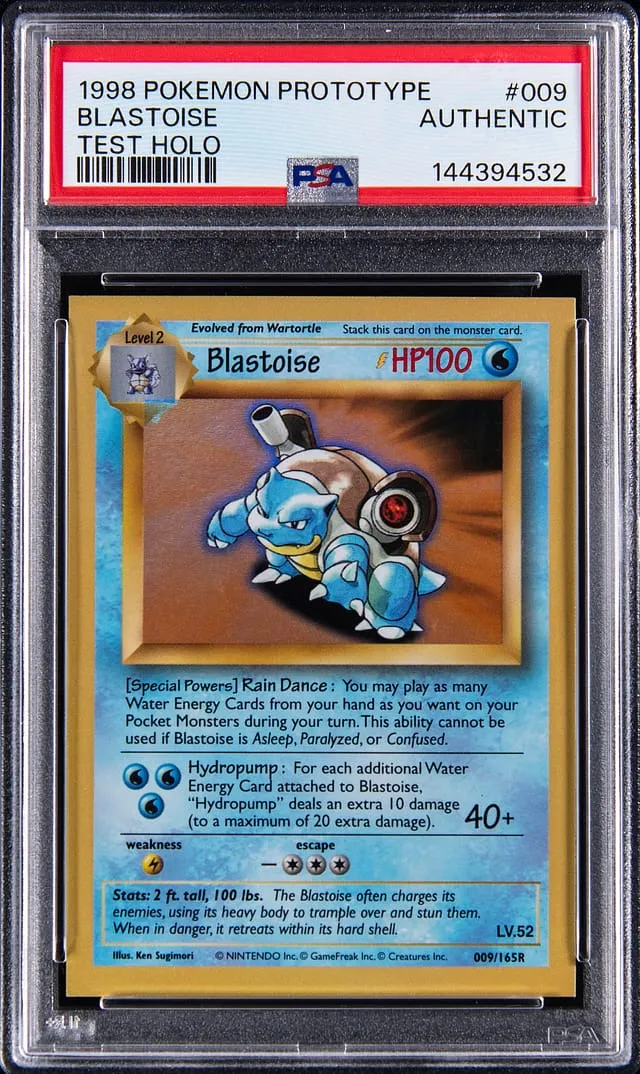
1998 Prototype Blastoise Test Holo Sells for $98K
Deep dive on the 1998 Pokémon Prototype Test Holo Blastoise with Magic-style back that sold for $98,548 at Goldin on March 9, 2026.
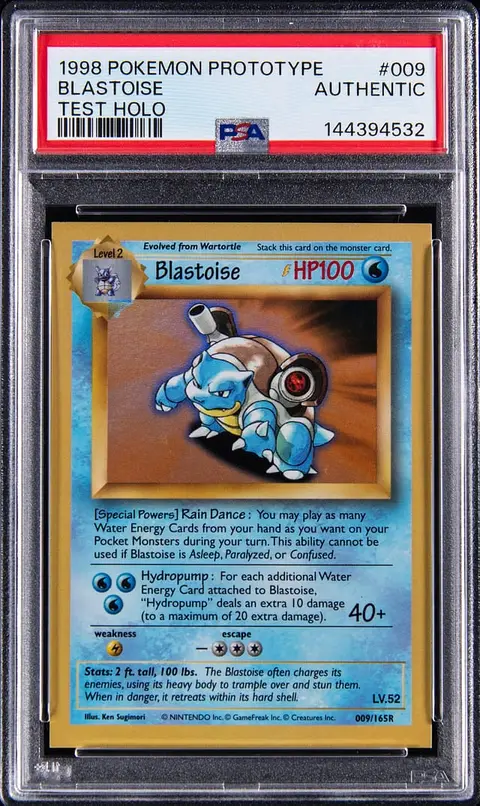
Sold Card
1998 Pokemon Prototype Test Holo #009 Blastoise - Magic: the Gathering Art on Reverse - PSA Authentic
Sale Price
Platform
Goldin1998 Pokémon Prototype Test Holo Blastoise Sells for $98,548 at Goldin
On March 9, 2026, Goldin closed a major piece of Pokémon and TCG history: a 1998 Pokémon Prototype Test Holo #009 Blastoise – featuring Magic: The Gathering–style art on the reverse – graded PSA Authentic, selling for $98,548.
For many advanced collectors, this Blastoise is less a “card” and more a historical artifact. It sits at the intersection of Pokémon, Magic: The Gathering, and the birth of English-language Pokémon cards.
In this breakdown, we’ll look at what the card is, why it matters, and how this sale fits into recent market history.
What exactly is this Blastoise prototype?
Card details
- Character: Blastoise
- Year: 1998
- Type: Prototype / Test print
- Number: #009 (test holo)
- Front design: Early Pokémon layout, pre-finalized English design
- Back design: Magic: The Gathering–style card back (not the familiar Poké Ball back)
- Grading company: PSA (Professional Sports Authenticator)
- Grade: PSA Authentic (confirmed genuine, no numeric grade)
- Attributes: Test holofoil, prototype, non-public issue
This card is part of a very small group of English-language Pokémon test prints produced in 1998. They were created to pitch and refine how Pokémon would look for Western markets. Instead of the standard Pokémon back, they use a back design closely modeled on Magic: The Gathering.
These prototypes were never pack-issued, never sold at retail, and were not intended for normal gameplay. They were internal tools and presentation pieces. That’s why collectors treat them as a unique tier of rarity above typical chase cards.
Why this card matters to collectors
A bridge between Pokémon and Magic: The Gathering
The most striking detail is the Magic-style reverse. For trading card game (TCG) history collectors, this card documents the moment when Wizards of the Coast – the company behind Magic: The Gathering – was working out how to bring Pokémon to the English-speaking world.
It captures three key things at once:
- Pre-finalized English Pokémon layout – English text and templating before the first base set.
- Non-final card back – a layout visually reminiscent of Magic, tying it to Wizards’ design language.
- Blastoise as a flagship character – alongside Charizard, one of the earliest and most recognizable Pokémon choices for tests and promotions.
Ultra-low supply, even by high-end standards
Unlike numbered parallels (for example, “/10” or “/25”), these prototypes don’t have a printed serial number. Instead, scarcity is driven by how few were ever produced and how many have survived in collectible condition.
In hobby terms, they sit closer to proofs and internal test materials than to standard set cards. That’s why population reports (often shortened to “pop report” – the grading company’s count of how many copies they’ve graded) are especially important here. For this prototype family, pop numbers are very small, and each slabbed copy is tracked closely by high-end collectors.
Historical era: late-1990s, pre-English launch
The card dates to 1998, placing it at the start of Pokémon’s global expansion. It predates the 1999 English Base Set release and captures a development stage that most fans never saw.
For eras, collectors often use loose buckets:
- Vintage: typically earliest years of a property or sport (for Pokémon, 1990s fits this tag).
- Modern / Ultra-modern: more recent sets, especially post-2016.
This prototype sits firmly in vintage Pokémon, but with an even narrower focus: internal design and printing history.
Market context: how does $98,548 fit in?
The Goldin sale closed at $98,548 (converted from 9,854,800 cents). This puts it in the same general ballpark as other six-figure Pokémon grails, though this prototype has always behaved a bit differently from mainstream chase cards like 1st Edition Base Set Charizard.
Because the exact historical sales for each prototype copy are limited and not always public, most collectors look at a mix of:
- Prior public auction results for this specific test Blastoise (in any grade or Authentic)
- Sales of related 1998 test prints
- Prices realized for other iconic Pokémon grails (for broad context)
From the pattern of reported sales, a few grounded observations are reasonable:
Prototype Blastoise has established itself as a six-figure grail.
Earlier public sales for copies of this test card have reached well into the high five and low six figures, especially as more collectors have learned its history.Condition and labeling matter, but authenticity is the foundation.
With a card this scarce, “PSA Authentic” can still command a strong result because the key value driver is existence, not incremental wear differences. Numeric grades help, but they’re secondary to authenticity and provenance.Recent sales show stability at the high end.
Based on public comps (short for “comparables” – similar items that have recently sold), this result is consistent with the card’s emerging status as a historically important TCG artifact rather than a short-term hype piece.
Because there are so few known copies, each auction can set a fresh reference point for the card’s perceived market level.
PSA Authentic vs numeric grades on prototypes
For pack-issued cards, most collectors chase numeric grades like PSA 9 or PSA 10. With prototypes, especially those that may have been handled in offices or presentations, the focus often shifts:
- Authenticity first: Confirming the card is genuine and matches known test print characteristics.
- Eye appeal second: Centering, surface, and overall look still matter, but they are weighed against extreme scarcity.
- Label clarity: A clear description on the label (prototype, test print, etc.) helps future buyers understand what the card is.
A PSA Authentic label signals that the card is real and stable in the holder, but PSA has chosen not to apply a numeric condition grade. With rare prototypes, many advanced collectors are comfortable with that tradeoff.
Why this sale matters beyond Pokémon
Although this is a Pokémon card, its significance extends into broader TCG collecting:
- Cross-franchise relevance: The Magic-style reverse attracts Magic: The Gathering historians and Wizards of the Coast specialists, not just Pokémon fans.
- Early TCG design documentation: It provides a concrete example of how TCG publishers iterate on card layouts and branding before launch.
- Blueprint for how prototypes are valued: The strong result at Goldin on March 9, 2026 reinforces how the hobby treats true prototypes: as ultra-rare, historically meaningful items rather than just another scarce parallel.
What collectors can take from this sale
For newcomers and returning collectors, a six-figure prototype can feel distant from everyday collecting. Still, there are useful takeaways:
Know the origin story.
Cards tied to key turning points—first releases, design transitions, or major company milestones—often have long-term collector interest.Rarity isn’t just about print runs.
For prototypes and test prints, the number of surviving, authenticated copies matters more than a printed serial number.Documentation and research pay off.
Understanding how a card fits into the timeline (in this case, 1998 pre-English Pokémon) helps explain why its market behaves differently than standard chase cards.Comps are a tool, not a promise.
With extremely low-population items, each auction can differ based on timing, who’s bidding, and how many examples are available.
Final thoughts
The $98,548 sale of the 1998 Pokémon Prototype Test Holo #009 Blastoise – Magic: The Gathering Art on Reverse, PSA Authentic, at Goldin on March 9, 2026, is another confirmation of how seriously the hobby now treats true prototype material.
For most collectors, this card will remain something to study rather than own. But understanding pieces like this helps put the rest of the market in context: from mass-printed base set cards to modern short prints, everything traces back to design decisions and test prints like this one.
At figoca, we track these key sales not as hype events, but as data points in the evolving story of trading card history. This Blastoise prototype is a small card with a very big role in that story.