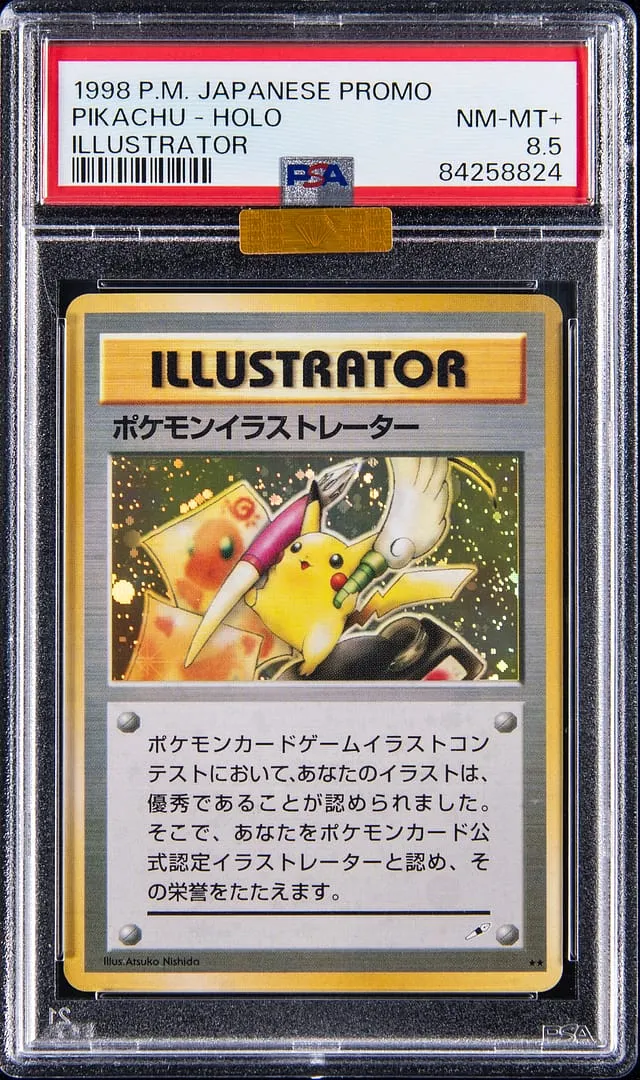
1998 Pokémon Illustrator Pikachu PSA 8.5 sells for $727K
Goldin sold a 1998 Japanese Promo Illustrator Pikachu PSA 8.5 with MBA Gold Diamond 9 review for $727,120 on March 9, 2026. Here’s the market context.
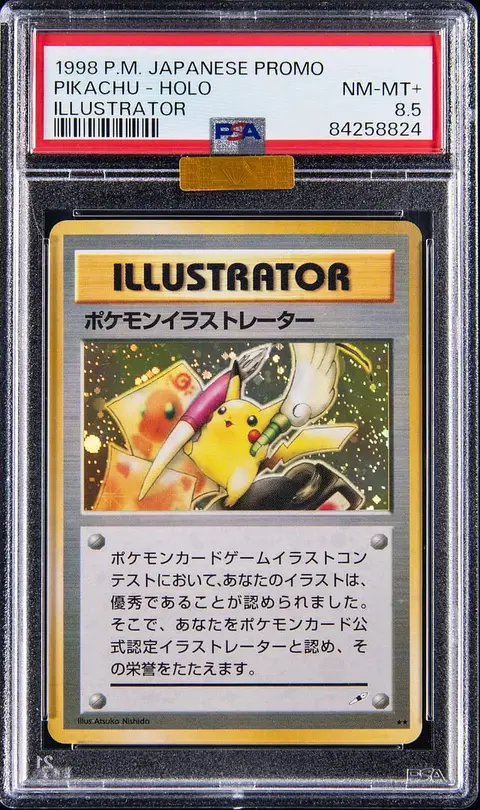
Sold Card
1998 Pokemon Japanese Promo Holo Illustrator Pikachu - PSA NM-MT+ 8.5 - MBA Gold Diamond Certified 9
Sale Price
Platform
Goldin1998 Pokémon Japanese Promo Holo Illustrator Pikachu in PSA 8.5 is not a card you see every day. On March 9, 2026, Goldin sold a copy for $727,120, certified PSA NM-MT+ 8.5 with an MBA Gold Diamond Certified 9 review.
For a card that already sits near the top of the Pokémon hobby, this is an important data point for collectors, investors, and small sellers trying to understand the ultra‑high end of the market.
What exactly is this card?
- Card: 1998 Pokémon Japanese Promo Holo Illustrator Pikachu
- Language/Region: Japanese, CoroCoro Comic promo
- Year: 1998
- Character: Pikachu (illustrated by Atsuko Nishida)
- Type: Trophy promo / prize card
- Rookie or key issue? Not a “rookie” in the sports sense, but widely regarded as one of the key, grail‑level Pokémon cards
- Grading company: PSA (Professional Sports Authenticator)
- Grade: NM-MT+ 8.5
- Additional review: MBA Gold Diamond Certified 9 (a third‑party review of the PSA‑slabbed card’s eye appeal)
The Illustrator Pikachu was originally awarded to winners and select participants of illustration contests run through Japan’s CoroCoro Comic magazine in 1997–1998. That prize‑card origin, combined with extremely low distribution, is the foundation of its mystique.
Why the Illustrator Pikachu matters
Within the Pokémon TCG, this card sits in a very small group of true “trophy” pieces. Collectors often view it alongside other top‑tier promos and prize cards rather than standard set cards.
A few reasons it’s so important:
- Historical moment: It comes from the late 1990s, at the dawn of the Pokémon TCG. It celebrates the creativity of fan illustrators and prominently features Pikachu, the franchise mascot.
- Distribution: It was never sold in packs. It was awarded through a specific contest, so supply was constrained from day one.
- Condition difficulty: Surviving examples in strong condition are scarce. Many were handled like normal cards by kids in the late 1990s.
- Cultural status: Among high‑end Pokémon collectors, the Illustrator Pikachu is often discussed as one of the hobby’s “grail” cards—an ultimate chase piece.
Taking all of that together, PSA 8.5 is a serious grade on an already scarce card.
Understanding the grade: PSA 8.5 + MBA Gold Diamond 9
PSA 8.5 (NM-MT+)
PSA’s NM-MT+ 8.5 grade sits between 8 (Near Mint–Mint) and 9 (Mint). It usually indicates a card that is extremely clean overall but with one or two minor flaws that keep it out of a straight 9.
For ultra‑scarce 1990s promos, the jump from PSA 8 to 8.5 to 9 often corresponds to very large differences in price. The pop report (short for “population report,” which is PSA’s count of how many copies exist in each grade) for this card is low across the board, so every half‑grade step matters.
MBA Gold Diamond Certified 9
MBA (Memorabilia Authentication and Grading/Review) is a third‑party review service that evaluates eye appeal of already‑slabbed graded cards. Their Gold Diamond Certified 9 label suggests that, in MBA’s view, this PSA 8.5 presents visually closer to what they consider a 9 in terms of centering, color, and overall look.
For some high‑end buyers, this extra layer of review can be a differentiator between two cards with the same PSA grade.
Market context: how does $727,120 fit in?
On March 9, 2026, Goldin closed this card at $727,120. To understand what that means, it helps to compare it with:
- Other Illustrator Pikachu sales in different grades
- Other copies of the same grade, when data is available
- Broader trends in high‑end Pokémon trophy cards
Comparing to other grades
Over the past several years, the strongest public results for the Illustrator Pikachu have usually come from:
- PSA 9 and PSA 10 copies, which sit at the very top of the condition ladder
- Notable provenance (famous prior owners, early publicized private sales)
These top‑grade copies have achieved multi‑hundred‑thousand‑dollar, and at times multi‑million‑dollar, price levels in headline‑making sales. Lower grades (PSA 7 and below) tend to come in substantially below the finest examples, reflecting both condition scarcity and demand from collectors focused strictly on top‑tier condition.
The PSA 8 to 9 band has historically been a key battleground for both collectors and capital‑driven buyers who are trying to balance condition, scarcity, and total outlay. This PSA 8.5 result sits logically in that band: clearly positioned as a high‑end, elite copy, but at a discount to the very best PSA 9 and PSA 10 examples.
PSA 8.5 pricing context
True, direct comps (short for “comparables,” or recent sales of the same card and grade) for PSA 8.5 Illustrator Pikachu are limited. Population is small, and copies do not come to public auction frequently. When a card trades only occasionally at this level, each sale becomes an important reference for the next.
In that sense, this $727,120 sale acts as a fresh benchmark for PSA 8.5 with premium eye appeal. Collectors and auction houses will likely use it as a reference point when discussing future offerings in 8, 8.5, and 9.
How scarcity and era shape the value
The Illustrator Pikachu is a late‑1990s Japanese promo, which places it squarely in what many collectors call the early Pokémon era. That era’s key traits:
- Print runs were smaller than later mass‑market sets.
- Card care was inconsistent, especially for children’s prize cards that weren’t always stored in sleeves.
- Grading came much later, so many copies may have been lost, damaged, or never submitted.
Unlike mainstream English‑language sets from the early 2000s (sometimes grouped loosely with the “modern” era), this card draws from a pool of survivors that is inherently limited and, in some grades, essentially capped.
That scarcity is a central part of why even mid‑to‑high grades can command prices comparable to (or higher than) the very best cards from more common sets.
Collector significance in 2026
This sale lands in a period where the Pokémon market has generally matured from the spikes and volatility seen earlier in the decade. For many collectors:
- Grails and trophies (like Illustrator Pikachu) are increasingly viewed as long‑term cornerstones of collections rather than short‑term flips.
- Condition nuance matters more: distinctions like 8 vs. 8.5 vs. 9, and eye‑appeal reviews such as MBA’s, influence bidding more than they did a few years ago.
- Provenance and certification layers—PSA grade plus MBA review plus a major auction house like Goldin—help buyers feel more confident at the six‑ and seven‑figure level.
At the same time, it’s important not to read any single sale as a guarantee of future direction. High‑end results can vary based on timing, bidder pool, and how strong competition happens to be in a particular auction.
What this means for different types of collectors
Even if a $727,120 card is out of reach, the data around it is still useful.
For newcomers
- This card is a clear example of why origin, scarcity, and condition matter.
- Understanding why a trophy promo like this commands a premium can help you evaluate more affordable promos and early‑era cards.
For returning collectors
- The Illustrator Pikachu shows how much depth there is beyond standard booster‑pack cards.
- Exploring Japanese promos, contest cards, and magazine inserts can be a way to connect with the hobby’s history without needing a seven‑figure budget.
For active hobbyists and small sellers
- High‑end results like this can support broader interest in late‑1990s Japanese promos and prize cards.
- When you evaluate your own inventory, it can be helpful to:
- Check pop reports and recent sales for comparable promos.
- Look closely at centering, edges, and surface before grading.
- Consider how condition tiers (for example, PSA 7 vs. 8 vs. 9) affect value ranges.
Key takeaways from the Goldin sale
- Sale: 1998 Pokémon Japanese Promo Holo Illustrator Pikachu
- Grade: PSA NM-MT+ 8.5 with MBA Gold Diamond Certified 9
- Auction house: Goldin
- Date (UTC): March 9, 2026
- Price: $727,120
This result reinforces the Illustrator Pikachu’s position at the very top of the Pokémon TCG market. For anyone studying the long‑term trajectory of high‑end Pokémon, it’s a sale worth bookmarking and comparing against future offerings in PSA 8.5 and above.
As always, treat this as context, not a forecast. The best way to use a sale like this is as one piece of a larger picture—combining multiple recent sales, population data, and your own collecting goals to decide what makes sense for you.