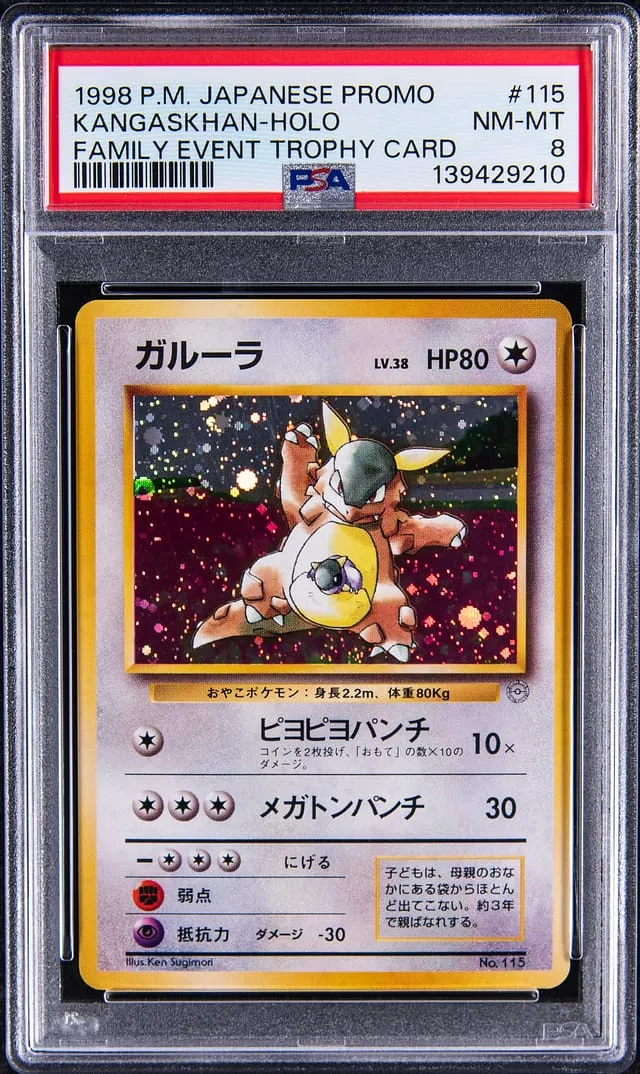
1998 Kangaskhan Trophy PSA 8 Sells for $64,480
Breakdown of the 1998 Japanese Kangaskhan Family Event trophy card PSA 8 that sold for $64,480 at Goldin on February 16, 2026.
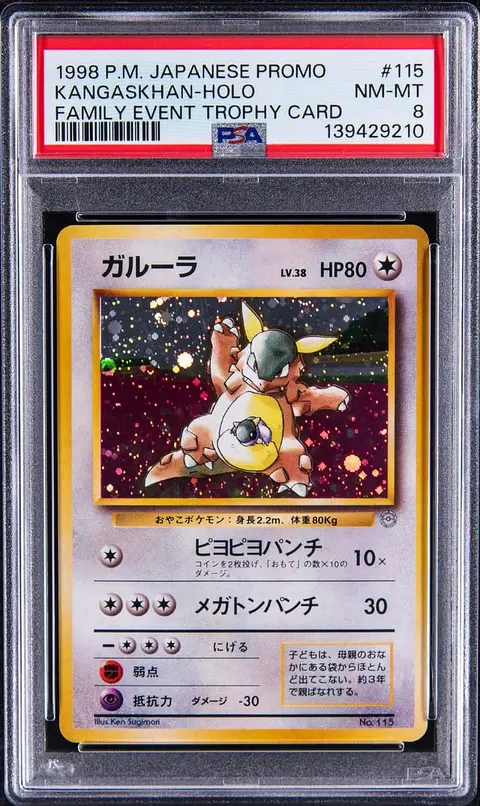
Sold Card
1998 Pokemon Japanese Promo Family Event Trophy Card Holo #115 Kangaskhan - PSA NM-MT 8
Sale Price
Platform
Goldin1998 Pokémon Japanese Family Event Trophy Kangaskhan PSA 8 Sells for $64,480
A 1998 Pokémon Japanese Promo Family Event Trophy Card Holo #115 Kangaskhan, graded PSA NM-MT 8, sold for $64,480 at Goldin on February 16, 2026 (UTC). For many collectors, this card sits at the intersection of early Pokémon history, true scarcity, and the evolving high-end market for trophy cards.
In this breakdown, we’ll walk through what the card is, why it matters, how this sale fits into recent price context, and what collectors might take away from it.
What exactly is this Kangaskhan trophy card?
Card details
- Title: 1998 Pokémon Japanese Promo Family Event Trophy Card Holo #115 Kangaskhan
- Language / Region: Japanese
- Year: 1998
- Type: Trophy promo (not a pack-pulled set card)
- Character: Kangaskhan
- Number: #115
- Finish: Holographic
- Grading company: PSA (Professional Sports Authenticator)
- Grade: PSA 8 – NM-MT (Near Mint–Mint)
- Auction house: Goldin
- Sale date (UTC): 2026-02-16
- Sale price: $64,480
This Kangaskhan is a trophy card, meaning it was awarded as a prize rather than pulled from booster packs. Specifically, it comes from the 1998 Parent/Child Mega Battle (often referred to as the Pokémon “Family Event”), a Japanese tournament where parent–child teams competed together.
Because of that origin, it is not only early-era—pre-dating the global Pokémon TCG explosion—but also structurally scarce. Very few copies were ever awarded, and even fewer have survived in high grade.
Why collectors care about the 1998 Family Event Kangaskhan
Several factors make this card important in the hobby:
1. Early, pre-2000 Japanese trophy history
The late 1990s Japanese trophy promos form the backbone of high-end Pokémon collecting. Cards from events like the Parent/Child Mega Battle, early tournaments, and illustration contests are often among the rarest Pokémon cards in existence.
The 1998 Family Event Kangaskhan sits firmly in that group:
- It’s from 1998, just two years after the TCG’s launch in Japan.
- It was tied to a specific, one-time tournament format (parent and child teams), which will never be replicated exactly the same way.
Collectors often view these early Japanese trophies as “historical documents” of the game’s competitive beginnings.
2. True scarcity vs. print-to-demand
Unlike modern chase cards, where rarity is manufactured through low serial numbers or short prints, this Kangaskhan’s scarcity is event-based:
- It was only given to participants who reached certain performance thresholds at the Family Event.
- Estimates in the hobby typically place the total number of copies at a very low figure compared with mass-produced set cards.
While exact original print quantities aren’t publicly documented in a way that would satisfy scientific scrutiny, population reports (PSA’s publicly available counts of how many copies of a card they’ve graded and at what grades) confirm that there are very few graded copies overall.
3. A family-themed, character-appropriate design
Kangaskhan is thematically linked to the event: the Pokémon is known for carrying its baby in its pouch, making it a natural fit for a parent–child tournament. That alignment of card art, event theme, and distribution story adds narrative appeal for collectors.
4. Trophy card tier within the Pokémon hierarchy
In Pokémon, collectors often talk about different “tiers” of desirability:
- Mass-market set cards (Base, Neo, EX, etc.)
- Special promos (magazine inserts, movie promos, etc.)
- Trophy and prize cards (awarded at events, extremely limited)
The 1998 Family Event Kangaskhan is almost always discussed in the trophy / grail tier, alongside cards like early Pikachu trophy promos and other late-90s Japanese prize cards. Those cards form a small subset of the overall Pokémon market, but they attract dedicated, long-term collectors.
Where a PSA 8 fits in the condition ladder
PSA grades cards on a 1–10 scale. A PSA 8 (NM-MT) implies:
- Sharp overall eye appeal
- Minor wear that keeps it out of the PSA 9 or 10 range (small edge or corner touches, very light surface issues)
With event-issued trophy cards, many copies were handled, stored in less-than-ideal conditions, or kept as mementos rather than investments. That can make high grades disproportionately scarce compared to mass-produced set cards.
For this Kangaskhan, the top of the grading ladder—PSA 9 and PSA 10—tends to be extremely thin in the population report. PSA 8 sits in that upper-middle zone where the card is still considered high grade, but accessible to more bidders than the true top few copies.
Market context: how does $64,480 compare?
Because this is a niche trophy card with very low supply, sales are infrequent. That makes traditional “comps” (short for comparables—recent sale prices of the same or similar items) harder to assemble than for, say, a Base Set Charizard.
From a broad view of prior public sales in the hobby:
- Higher grades (PSA 9, PSA 10): When they appear, they have historically commanded strong six-figure prices, reflecting both rarity and demand from advanced collectors.
- PSA 8 range: Past public PSA 8 sales have typically landed in the mid–five-figure to low–six-figure range, depending on timing, venue, and market conditions.
At $64,480, this February 16, 2026 Goldin result sits comfortably within the established high-end range for PSA 8 examples in recent years rather than representing a clear outlier spike or collapse. It reflects:
- Ongoing willingness from bidders to commit significant capital to early, true trophy pieces.
- A preference for well-graded copies in a thinly traded population.
Because confirmed public sales of this exact grade and card are spaced out over time, any single result should be viewed as one data point, not a definitive price anchor. But this Goldin sale supports the idea that the Kangaskhan trophy card continues to be treated as a serious blue-chip piece within the Pokémon segment.
How this sale fits into the broader Pokémon market
1. Trophy cards vs. mainstream nostalgia
Over the last several years, the Pokémon market has seen waves of interest:
- Broad nostalgia cycles around Base Set and key characters like Charizard, Pikachu, and the original starters.
- More specialized demand in rare promos, test prints, and trophies.
This Kangaskhan sale sits in the specialized category. It doesn’t move the needle on everyday sealed product or WOTC-era set holo prices, but it does:
- Reinforce that serious collectors continue to allocate funds toward historically significant, low-population cards.
- Provide a visible benchmark for how the market values an early trophy card in solid but not top-pop grade.
2. Japanese-language premiums
As more collectors dive deeper into the TCG’s history, there has been growing appreciation for early Japanese-language releases:
- They often pre-date their English counterparts.
- Many of the most important trophy and prize cards exist only in Japanese.
The Kangaskhan Family Event card is a good example: its story is inseparable from Japanese tournament culture, and that’s a major part of why it commands a premium.
What collectors and small sellers can take from this
A single $64,480 sale is not a roadmap for every card in the hobby, but it does offer a few useful lessons:
Story matters. Trophy and event cards with a clear, documented origin and a strong thematic tie (like Kangaskhan and a family event) can maintain collector attention over long periods.
Scarcity is multi-layered. It’s not just about how many copies exist, but how many high-grade copies are available, and how often they actually come to market.
Comps need context. For thinly traded cards, looking at a small handful of past results, the grade distribution, and the timing (early boom vs. later consolidation) is more informative than fixating on a single headline sale.
High-end and mid-tier markets can behave differently. A stable or strong result for a rare trophy card doesn’t automatically translate to mass-printed cards—and vice versa.
Final thoughts
The February 16, 2026 Goldin sale of the 1998 Pokémon Japanese Promo Family Event Trophy Card Holo #115 Kangaskhan – PSA 8 at $64,480 is another data point reinforcing how the hobby continues to value early Japanese trophy pieces.
For advanced collectors, it serves as a fresh marker for PSA 8 pricing. For returning or newer collectors, it’s a reminder that behind the familiar pack-art and set releases, there is a small, historically rich tier of cards that were never meant for the general public—and still shape the high end of the market today.
As always, individual collecting decisions should be grounded in personal enjoyment, comfort with risk, and a clear understanding of how rare and thinly traded cards behave over time.