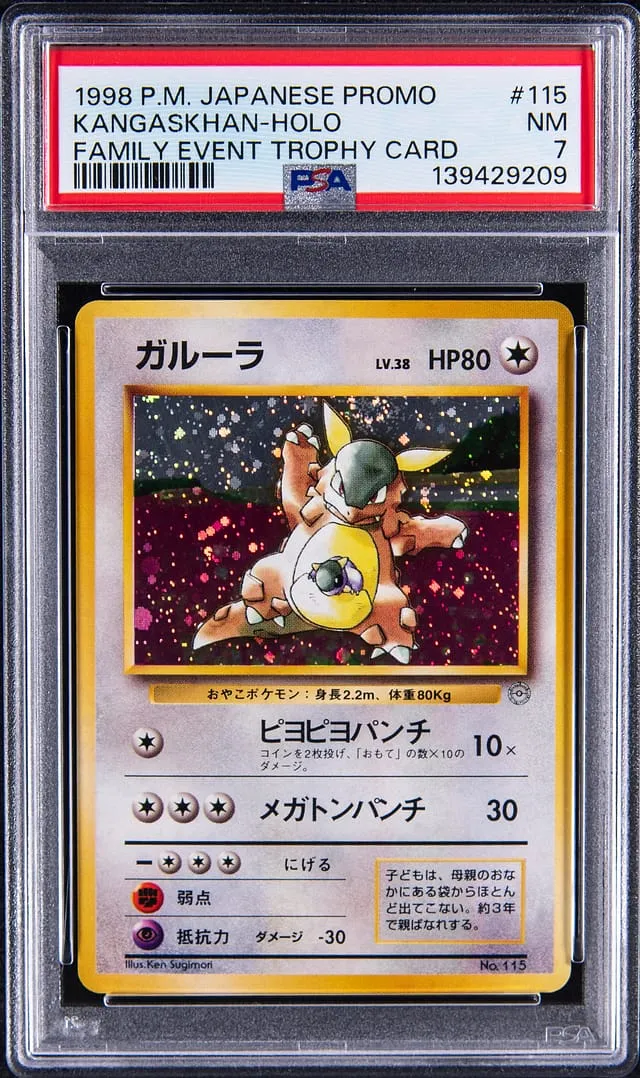
1998 Kangaskhan Trophy PSA 7 Sells for $57,660
A 1998 Pokémon Japanese Family Event Trophy Kangaskhan PSA 7 sold for $57,660 at Goldin. Here’s what this means for collectors and the market.
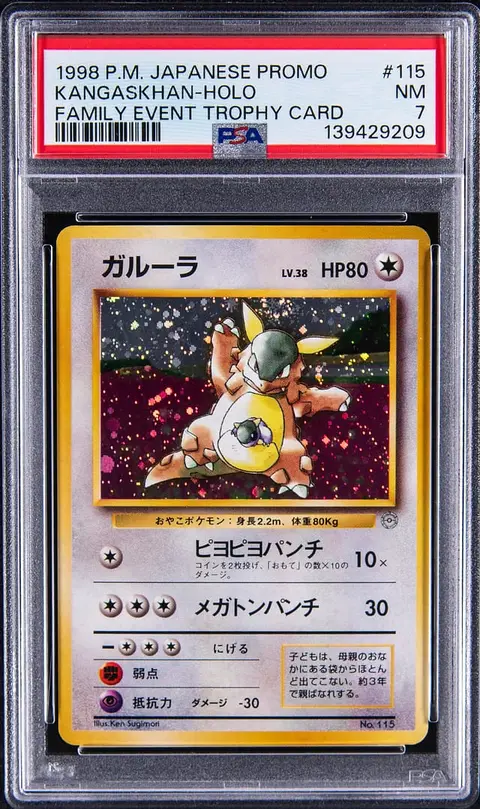
Sold Card
1998 Pokemon Japanese Promo Family Event Trophy Holo #115 Kangaskhan - PSA NM 7
Sale Price
Platform
Goldin1998 Pokémon Japanese Promo Family Event Trophy Holo #115 Kangaskhan (PSA 7) is one of those cards that quietly sits at the intersection of hobby history, rarity, and modern market attention.
On February 16, 2026, Goldin reported a sale of this card in PSA NM 7 for $57,660. For a late‑1990s Pokémon promo, that is a meaningful number, and it fits into a longer story that started almost three decades ago.
What exactly is this Kangaskhan trophy card?
Let’s break down the basics of the card involved in this sale:
- Character: Kangaskhan
- Year: 1998
- Origin: Japanese promo
- Event: Pokémon “Parent/Child Mega Battle” (often called the Family Event)
- Type: Trophy card prize (not a pack-pulled card)
- Card number: #115
- Finish: Holofoil
- Grading company: PSA (Professional Sports Authenticator)
- Grade: NM 7 (Near Mint)
This is not a standard set card. It was awarded at a family-focused tournament in Japan where teams consisted of a parent and child. That family context is part of why collectors often call it the “Family Event” or “Parent/Child” Kangaskhan trophy.
Because it was a prize card rather than something you could buy in packs, the print run was extremely low compared with normal 1990s Pokémon issues. Only a small number of copies were ever given out, and even fewer have survived in high grade.
Why collectors care about this card
Several factors make the 1998 Family Event Kangaskhan a key issue in early Pokémon history:
Early trophy status
This is part of the first wave of Japanese trophy cards from the late 1990s. Trophy cards are ultra‑limited cards awarded at official events or tournaments rather than sold in stores. In the Pokémon world, these include things like the early Pikachu Trophy cards, No. 1/2/3 Trainer cards, and this Kangaskhan.Historical context
1998 sits at the beginning of organized Pokémon play in Japan. Cards from this era tie directly into the franchise’s competitive roots and early fan culture. The parent/child tournament is a snapshot of how Pokémon was consciously marketed as a cross‑generational game.True scarcity
While exact print runs have never been officially confirmed, the known PSA population (the “pop report” – the grading company’s census of how many copies they’ve graded and in what grades) is very small. Compared with mass‑produced WotC (Wizards of the Coast) cards from the same period, this Kangaskhan is in another category of rarity.Distinctive artwork and theme
The artwork, featuring Kangaskhan in a celebratory setting with its baby, fits the family theme of the event. For collectors focused on narrative and artwork, that connection to the parent/child tournament is a major draw.
The PSA 7 grade in context
PSA uses a 1–10 scale, where 10 is Gem Mint. A PSA 7 is Near Mint, meaning the card is still quite clean, but may show moderate wear, a few visible scratches, light edge chipping, or slightly more noticeable centering issues.
For ultra‑scarce 1990s trophy cards, collectors often adjust their expectations compared with more common mass‑produced cards:
- Supply is thin across all grades. Even low grades can be tightly held.
- High grades (PSA 9–10) are exponentially harder to find. Surviving copies often show handling wear from being awarded and stored outside of sleeves and top loaders in that era.
So while a PSA 7 is not top‑of‑the‑scale, it still sits in the “collector grade” zone where eye appeal and rarity combine into strong demand.
Recent sales and price context
When people talk about “comps” in the hobby, they mean comparable sales: recent auction or marketplace results for the same card, or as close as possible (e.g., same card in a different grade). For a card as rare as the Family Event Kangaskhan, true comps are limited and sales can be spaced months or years apart.
Looking at public auction results and major marketplace archives for the 1998 Family Event Kangaskhan across grades, a few trends emerge:
- Higher grades (PSA 9–10) have historically commanded very strong five‑ and six‑figure results, especially during peak modern Pokémon interest in the early 2020s.
- Mid grades (PSA 5–7) have also realized substantial prices, reflecting the fact that some collectors prioritize just owning any authentic copy over chasing the absolute top grade.
- Sales are sporadic. Owners of this card tend to hold long term, so available data points are limited.
Within that framework, $57,660 for a PSA 7 in February 2026 sits comfortably in the tier of serious trophy‑card pricing, but not in the absolute record territory occupied by the very highest‑graded examples. For this specific grade, it aligns with what you’d expect from a thin market where even one determined underbidder can affect the final number.
Because sales are infrequent, each public result helps reset expectations. This Goldin sale becomes a new reference point for:
- Future Family Event Kangaskhan offerings in similar grades
- Pricing spreads between PSA 7 and higher or lower grades
- The broader hierarchy of 1990s Pokémon trophy cards
How this sale fits the broader Pokémon market
The ultra‑premium Pokémon segment — early trophy cards, first‑print promos, and historically important tournament issues — has developed its own lane, somewhat independent of the swings in more common modern chase cards.
A few relevant patterns:
Mature collector base
Many trophy collectors are long‑time hobbyists or early adopters. Their focus is on checking off historically significant pieces, not chasing the newest release cycle.Low turnover
Because so few copies exist, and many sit in strong hands, any sale can be more about who happened to participate in that auction than any broader macro trend.Separation from mass‑market volatility
While broader Pokémon prices have gone through noticeable boom‑and‑cool phases since 2020, truly rare 1990s trophies have seen fewer forced sales and more deliberate listings.
Within that environment, a PSA 7 Family Event Kangaskhan trading hands at $57,660 in early 2026 suggests continued respect for the card’s place in the hierarchy of Japanese promos. It doesn’t rewrite the record book, but it does reinforce that this card remains a cornerstone piece for serious Pokémon historians.
What this means for different types of collectors
This kind of sale resonates differently depending on where you are in the hobby.
New and returning collectors
- Educational value: This card is a great case study in how rarity, history, and event provenance can matter more than pack odds or serial numbers.
- Starting point: You don’t need to chase a trophy card to enjoy the hobby. But learning why cards like this matter can help you recognize other meaningful promos and event cards at more accessible price points.
Active hobbyists
- Reference comp: If you collect high‑end Japanese promos, this Goldin result is one more data point for mapping out the relative ranking of top‑tier cards.
- Grade spreads: Watching where a PSA 7 lands helps refine expectations about how much of a premium high‑grade examples might reasonably hold over more worn copies.
Small sellers and hobby entrepreneurs
- Storytelling: Sales like this highlight the importance of explaining context in your own listings: event history, print scarcity, and how a card fits into a set or era.
- Research habits: When working with promos or oddball issues, getting comfortable with pop reports, archive searches, and old tournament documentation can greatly improve how you position your inventory.
Final thoughts
The sale of the 1998 Pokémon Japanese Promo Family Event Trophy Holo #115 Kangaskhan – PSA NM 7 for $57,660 at Goldin on February 16, 2026 (UTC) is another reminder that early Japanese trophy cards remain a cornerstone of serious Pokémon collecting.
For most collectors, this card will always be something to study rather than own, but understanding why it commands this level of attention can sharpen how you look at everything else in your collection — from casual binder sets to the next rare promo that crosses your path.
As more data points emerge and additional copies surface in varying grades, this result will sit as an important marker in the evolving price history of one of Pokémon’s most charming and historically significant trophy cards.