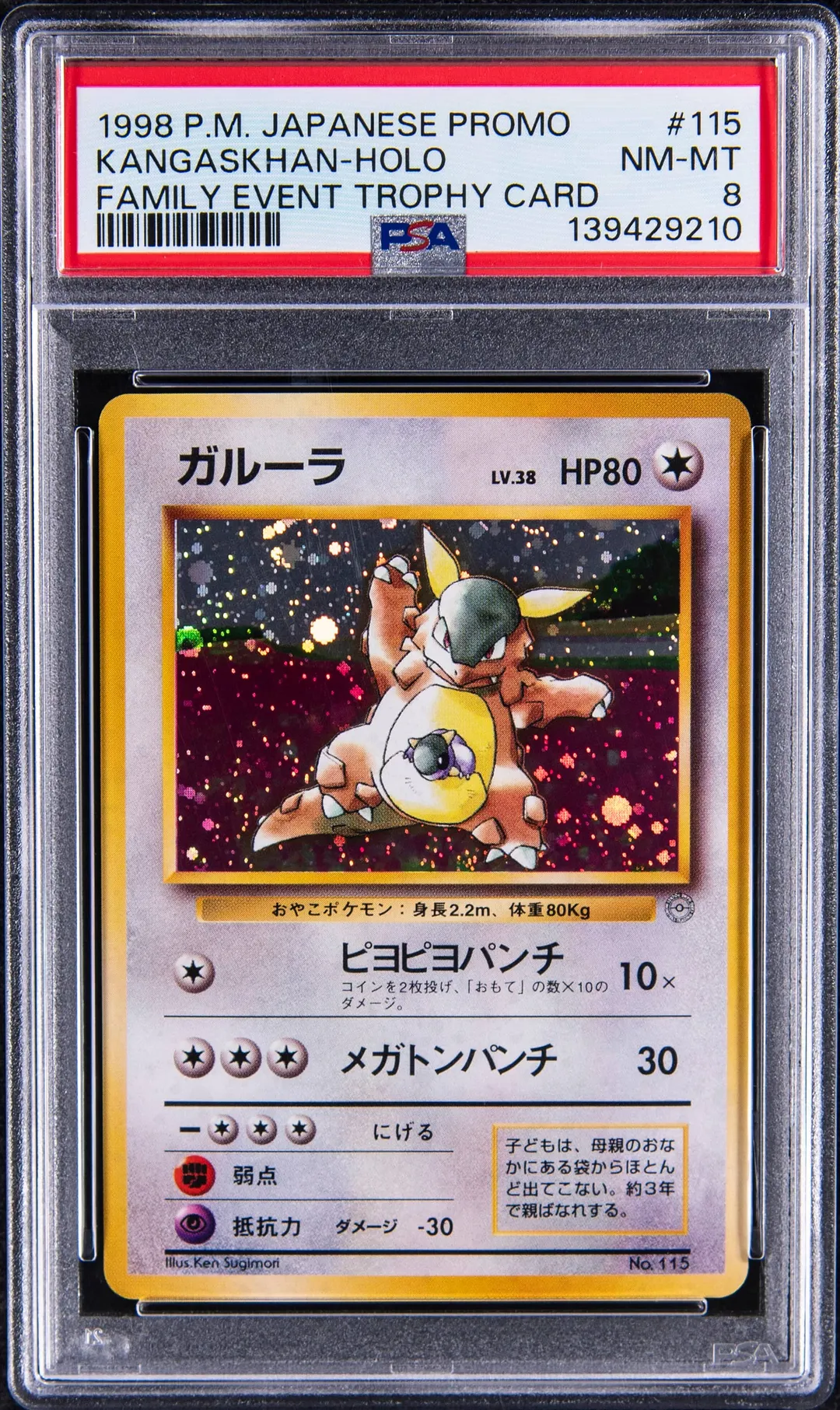
1998 Japanese Trophy Kangaskhan PSA 8 Sells for $64K
Goldin’s 2/16/26 sale of a 1998 Japanese Family Event Trophy Kangaskhan PSA 8 for $64,480 offers fresh insight into high-end vintage Pokémon promos.
Sold Card
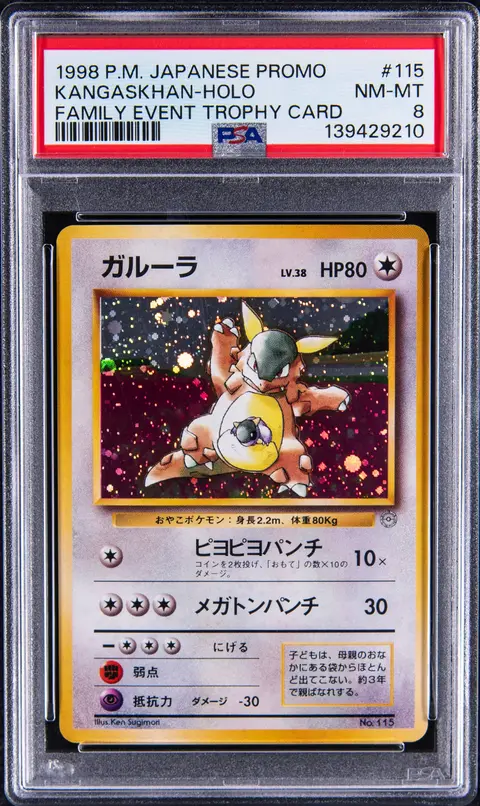
1998 Pokemon Japanese Promo Family Event Trophy Card Holo #115 Kangaskhan - PSA NM-MT 8
Sale Price
Platform
Goldin1998 Pokémon Japanese Family Event Trophy Kangaskhan in PSA 8 Sells for $64,480
On February 16, 2026, Goldin sold a 1998 Pokémon Japanese Promo Family Event Trophy Card Holo #115 Kangaskhan in a PSA NM-MT 8 for $64,480. For a niche, pre-2000 Japanese trophy card, this is an important data point that helps clarify where high-end vintage Pokémon promos are currently settling.
In this breakdown, we’ll walk through what the card is, why it matters, how this sale fits into recent price history, and what collectors might take away from it.
The card at a glance
- Card: 1998 Pokémon Japanese Promo Family Event Trophy Card Holo #115 Kangaskhan
- Language / Region: Japanese
- Year: 1998
- Type: Trophy / Event promo (not a pack-pulled card)
- Character: Kangaskhan
- Number: #115
- Finish: Holofoil
- Grading company: PSA
- Grade: NM-MT 8 (Near Mint–Mint)
- Auction house: Goldin
- Sale date (UTC): February 16, 2026
- Sale price: $64,480
This is not a standard set card. It was distributed at a family-focused event in Japan, generally understood to be the Parent/Child Pokémon Tournament in the late 1990s. Cards like this are often grouped under “trophy cards” – ultra-limited prizes or participation awards given at tournaments rather than pulled from booster packs.
What makes the Family Event Kangaskhan important?
Early, true trophy-era promo
The 1998 Family Event Kangaskhan sits in the same broader era as the famous Pikachu and University Magikarp promos: early Japanese tournament promos from the late 1990s, produced in very low quantities and given out under strict conditions.
Key points about its significance:
- Early competitive history: It comes from the first years of organized Pokémon play in Japan, when tournament infrastructure and promos were still experimental and small-scale.
- Family-specific origin: This promo was reportedly awarded at a parent/child event, which adds a distinct story compared to standard championship-only trophies.
- Non-pack issue: Unlike a base set holo, this card was never available in regular booster packs. You had to be there.
- Holo artwork and unique stamp: The artwork and design are distinctive compared to the core sets of the time, and the promo treatment gives it a clear identity as an event card.
Within the hobby, this card is considered one of the key vintage Japanese promos, though it trades hands far less frequently than flagship set cards like 1st Edition Base Charizard.
Population and scarcity
When collectors talk about a card’s “pop report” (population report), they mean how many copies have been graded by a company like PSA, and how many exist at each grade.
For the 1998 Family Event Kangaskhan:
- The overall graded population is extremely small relative to mainstream vintage Pokémon.
- PSA 9 and PSA 10 examples are notably scarce; these historically achieve the highest prices.
- PSA 8 sits in a middle ground: clearly collectible, still difficult to find, and accessible to high-end collectors who do not want to pay the premium for a top-pop grade.
Even though exact live population numbers can shift as more cards are submitted and regraded, the broader reality is stable: this is a low-pop, event-only promo with structural scarcity.
Recent market context and comps
In the hobby, “comps” (comparables) are past sales of the same or similar card – usually from marketplaces like Goldin, Heritage, PWCC, eBay, and other auction platforms. Collectors use comps to understand where current prices sit.
For the Family Event Kangaskhan (#115), the market is thin, meaning:
- The card does not appear in auctions very often.
- When it does, higher-grade examples (PSA 9 or 10) tend to attract outsized attention and headline prices.
Broad price context based on recent years and related public sales:
- PSA 10: Historically, this grade has brought very high five-figure to six-figure results when copies surface, reflecting both rarity and condition demand.
- PSA 9: Typically trails PSA 10 but still commands strong premiums versus lower grades.
- PSA 8: Has traded substantially below 9s and 10s but still well above most non-trophy vintage holos due to event scarcity.
Against that backdrop, the February 16, 2026 Goldin sale at $64,480 for a PSA 8 is notable:
- It aligns this mid-high grade copy with earlier high-end trophy and early promo pricing tiers.
- It narrows the gap between PSA 8 and the traditionally more chased PSA 9/10 levels, at least for this specific auction.
- It reinforces that demand for rare Japanese promos remains present even amid broader market fluctuations in modern and ultra-modern product.
Because this is a relatively infrequent auction card, each public sale tends to become an anchor reference point for future negotiations and listings.
Why this sale matters to collectors
1. Confidence signal for vintage Japanese promos
As modern sealed products and chase cards have gone through more visible price swings, early Japanese promos like the Family Event Kangaskhan have often been treated as a more historically grounded part of the Pokémon market.
A PSA 8 reaching $64,480 in 2026 suggests:
- Collectors are still willing to allocate serious budgets to low-pop, story-rich promos.
- There is continued respect for pre-2000 Japanese trophy and event cards, not just for mainstream English set hits.
2. Clarifying the grade curve
For a card with such a small population, the price curve by grade (how much each grade level tends to command) can be uneven and driven by just a handful of auctions.
This sale helps:
- Give a more defined point for PSA 8 pricing relative to higher grades.
- Provide sellers and buyers with a recent, public benchmark when negotiating private deals or setting reserves.
3. Benchmark for other rare promos
Collectors who track other 1990s Japanese promos – such as University Magikarp, Trophy Pikachu variants, and other event-specific holos – often look across this category for signals.
A strong result for Kangaskhan may not directly set prices for other promos, but it can:
- Reinforce the narrative that early competitive-era promos remain a core segment of the market.
- Encourage renewed attention toward similar cards with comparable scarcity and story.
The broader era: late-90s Japanese Pokémon
The 1998 Family Event Kangaskhan lives in what many consider the “vintage” era of Pokémon:
- Print runs: Generally much smaller than modern or ultra-modern sets.
- Distribution: Highly event-specific, especially for trophy cards.
- Condition sensitivity: Many surviving copies show handling or storage wear, making higher PSA grades hard to achieve.
While modern high-end Pokémon often revolves around low-serial, alternate-art, or special set releases, this card belongs to a time when rarity primarily came from availability (who actually received the card) rather than pack odds or serial numbering.
Takeaways for different types of collectors
For newcomers and returning collectors
- This sale is a reminder that not all Pokémon cards are created equal.
- Event-only promos like this are a different lane entirely from mass-printed set cards.
- When you research a card, look at:
- How it was distributed (pack vs. promo vs. trophy)
- Population reports (PSA/BGS/CGC data)
- Past public sales (comps across multiple auction houses)
Even if this price point is far above your budget, understanding why a card like this is valued highly can help you better evaluate more accessible vintage promos.
For active hobbyists and small sellers
- This Goldin result at $64,480 suggests that demand for historically meaningful, low-pop promos remains intact.
- It can serve as a reference when pricing or trading other premium Japanese promos, especially from the 1997–2000 window.
- Because the market for this specific card is thin, it’s wise to treat this as an anchor point rather than a guaranteed expectation for the next sale.
As always, prices can and do move over time. Single auction outcomes should be viewed as part of a trend, not as guarantees.
Final thoughts
The 1998 Pokémon Japanese Promo Family Event Trophy Card Holo #115 Kangaskhan in PSA NM-MT 8 reaching $64,480 at Goldin on February 16, 2026, reinforces the status of early Japanese trophy and event cards as a core, historically important segment of the Pokémon market.
For collectors, it’s another data point showing that scarcity plus story still command attention – even in a market that has broadened to include countless modern chase cards and products.
If you’re tracking this segment, logging this sale alongside past trophy and promo results will help you build a clearer picture of how the high-end vintage Pokémon landscape is evolving over time.