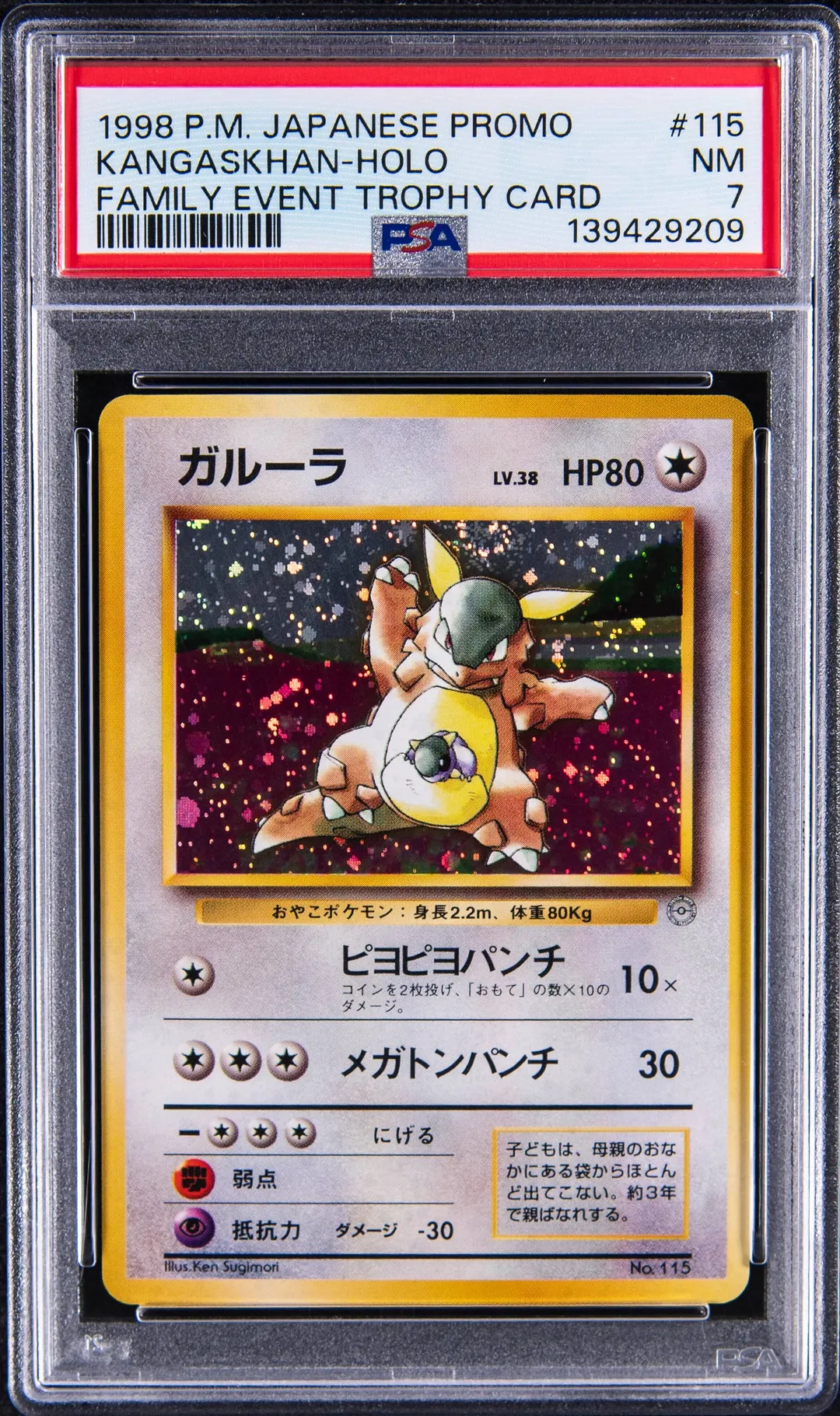
1998 Japanese Kangaskhan Trophy PSA 7 Sells for $57K
Goldin sold a 1998 Pokémon Japanese Family Event Trophy Kangaskhan PSA 7 for $57,660. Here’s how this early trophy card fits in today’s market.
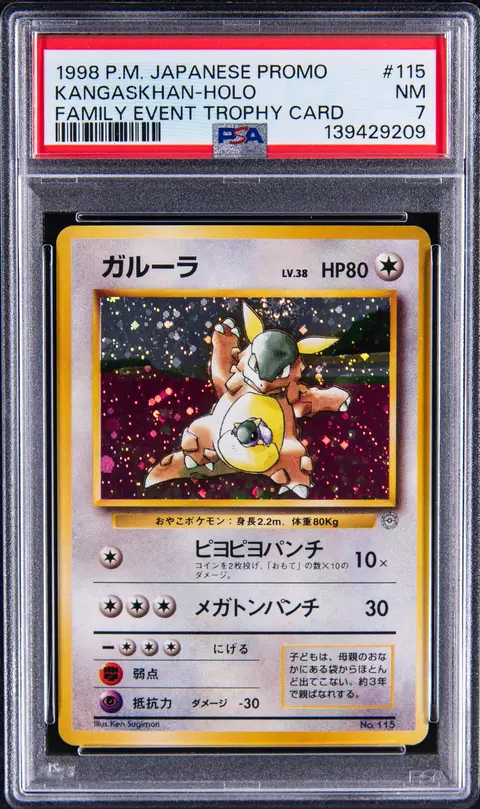
Sold Card
1998 Pokemon Japanese Promo Family Event Trophy Holo #115 Kangaskhan - PSA NM 7
Sale Price
Platform
Goldin1998 Pokémon Japanese Family Event Trophy Kangaskhan PSA 7 Sells for $57,660
On February 16, 2026, Goldin closed a notable sale for a cornerstone Pokémon trophy card: a 1998 Pokémon Japanese Promo Family Event Trophy Holo #115 Kangaskhan graded PSA NM 7, finishing at $57,660.
For many collectors, this card sits near the top of the non‑TCG‑tournament trophy hierarchy. It blends true scarcity, early‑era nostalgia, and a unique origin story tied to the Japanese parent‑child league.
Card Profile: What Exactly Sold?
- Card: 1998 Pokémon Japanese Promo Family Event Trophy Holo Kangaskhan
- Card number: #115
- Language: Japanese
- Type: Trophy promo (not pack‑pulled)
- Distribution: Awarded at a family (parent‑child) tournament event in Japan
- Character: Kangaskhan
- Year: 1998 (very early Pokémon era)
- Set / release: Parent/Child Mega Battle / Family Event promotional trophy card
- Grading company: PSA (Professional Sports Authenticator)
- Grade: PSA NM 7 (Near Mint)
- Serial‑numbered? No
- Autograph / patch / case hit? None – the value is driven by rarity, history, and condition
- Rookie / key issue? Effectively a key early‑era Pokémon trophy card rather than a conventional “rookie”
This card was never available in booster packs. It was awarded at a small, specific event, which is what the hobby calls a “trophy card” – a card given as a prize or reward, often in very low numbers.
Why the 1998 Kangaskhan Trophy Matters
The 1998 Japanese Family Event Kangaskhan sits in the same general conversation as other high‑end, event‑only Pokémon cards:
- Early Pikachu trophy cards
- 1998 University Magikarp
- Tropical Mega Battle promos
- Other late‑1990s Japanese prize cards
A few attributes make this Kangaskhan especially interesting:
1. Early‑Era, Pre‑Boom Rarity
Released in 1998, this promo predates the explosion of global Pokémon TCG popularity in 1999–2000. Production and distribution for these family event cards were extremely limited compared with pack‑issued sets like Base Set.
The card’s art and layout are distinct from standard releases, and the event‑specific origin adds a layer of story that collectors of niche promos care about.
2. Family Event Provenance
Unlike many trophy cards tied only to competitive tournaments, the Kangaskhan promo is associated with a parent‑child event. That detail resonates with collectors who see it as representing Pokémon’s original spirit: something shared between generations.
Because it was awarded at a specific, time‑bound event, the supply is effectively fixed. No more are being created, and most copies likely entered collections directly in the late 1990s.
3. Trophy Tier Scarcity and Pop Reports
In hobby terms, a pop report (population report) is the grading company’s census: how many copies of a card exist in each grade. Trophy cards, including this Kangaskhan, typically have very low pops compared to pack‑pulled chase cards.
High‑grade examples (PSA 9 and PSA 10) of the 1998 Kangaskhan trophy are especially sparse, and even mid‑grade copies like PSA 7 rarely hit the open market. That combination of low population and infrequent auction appearances is one of the key reasons this card consistently draws attention when it surfaces.
Market Context: How $57,660 Fits In
The Goldin result of $57,660 for a PSA 7 Kangaskhan trophy fits into a broader pattern of strong, but measured, demand for this card over the last several years.
When collectors talk about “comps”, they mean recent comparable sales used to gauge current market levels. For a card this rare, comps can be sporadic and sometimes years apart.
While precise, up‑to‑the‑day figures vary by source and are not always publicly reported, the general pattern for this card has been:
- Higher grades (PSA 9–10): These have reached significantly higher price points in past marquee auctions, reflecting the very small number of top‑grade copies.
- Mid‑grades (around PSA 6–7): Past public sales have typically landed well below the very top end, but still far above most standard 1990s holos due to the trophy status and limited supply.
Within that framework, a PSA 7 at $57,660 in early 2026 sits as a serious but not unprecedented result for a key 1990s Pokémon trophy. It aligns with the idea that the market now differentiates sharply between:
- Pack‑issued nostalgia cards (Base Set Charizard, etc.)
- True ultra‑scarce promos and trophies like the Kangaskhan
The realized price reflects both the significance of the card and the reality that the ultra‑high‑grade tiers still command the very top of the market.
Grade Perspective: PSA 7 in a Trophy Card World
In modern, mass‑printed cards, PSA 7 is often seen as mid‑tier. For 1990s Japanese trophy cards, the grading context is different:
- Many copies were handled at events, sometimes by children, and not stored with long‑term condition in mind.
- Surface wear, edge whitening, and minor print defects are common.
That makes even clean mid‑grade copies desirable for collectors who simply want an authentic, graded example of a historically important card.
In this lane, a PSA 7 Kangaskhan trophy often functions less like a “compromise grade” and more like an accessible doorway into a card whose top grades may never appear or may be priced far beyond the reach of most collectors.
Where This Fits in the Broader Pokémon Market
Zooming out, this sale lines up with a few longer‑term themes in the Pokémon TCG hobby:
Separation between true rarity and nostalgia‑only items
As the market matures, collectors differentiate between cards that are simply beloved (e.g., pack‑pulled holos with large populations) and cards that are genuinely scarce and historically important, like event trophies.Steady interest in late‑1990s Japanese promos
From University Magikarp to the Kangaskhan family trophy, early Japanese promos remain a focus for long‑term collectors and niche specialists. They combine low print runs with direct ties to the era when the game was still young and mostly Japan‑centric.Selective strength at the top end
Even when broader hobby sentiment cools or cycles, truly scarce, culturally important pieces often continue to find buyers. The Goldin sale shows there is still willingness to pay for early trophy cards when they appear.
Takeaways for Collectors and Small Sellers
This sale does not mean every late‑1990s promo will command five‑figure results, but it does underline a few practical points:
- Event provenance matters. Cards that can be traced to specific tournaments or family events often carry more long‑term interest than generic promos.
- Population and availability drive behavior. For a card that surfaces rarely, a new public sale can reset expectations, but also may not be easily repeatable.
- Condition is important, but context is everything. In a trophy card, PSA 7 is not equivalent to PSA 7 in a mass‑printed ultra‑modern set.
If you’re a newer collector:
- Use sales like this as a reference point, not as a price guarantee.
- Learn the story behind trophy cards and promos before chasing them.
- When researching, combine auction records, population reports, and set history rather than relying on a single headline number.
The Goldin Sale in Context
- Auction house: Goldin
- Sale date (UTC): February 16, 2026
- Realized price: $57,660 for a PSA NM 7
For figoca users tracking the evolution of high‑end Pokémon, this result is another data point reinforcing how the market continues to recognize and separate the earliest, most historically rooted trophy pieces from the rest of the field.
It is less a surprise spike and more a confirmation that the 1998 Pokémon Japanese Promo Family Event Trophy Kangaskhan remains a fixture in the conversation around top‑tier, non‑tournament trophy cards from the franchise’s formative years.