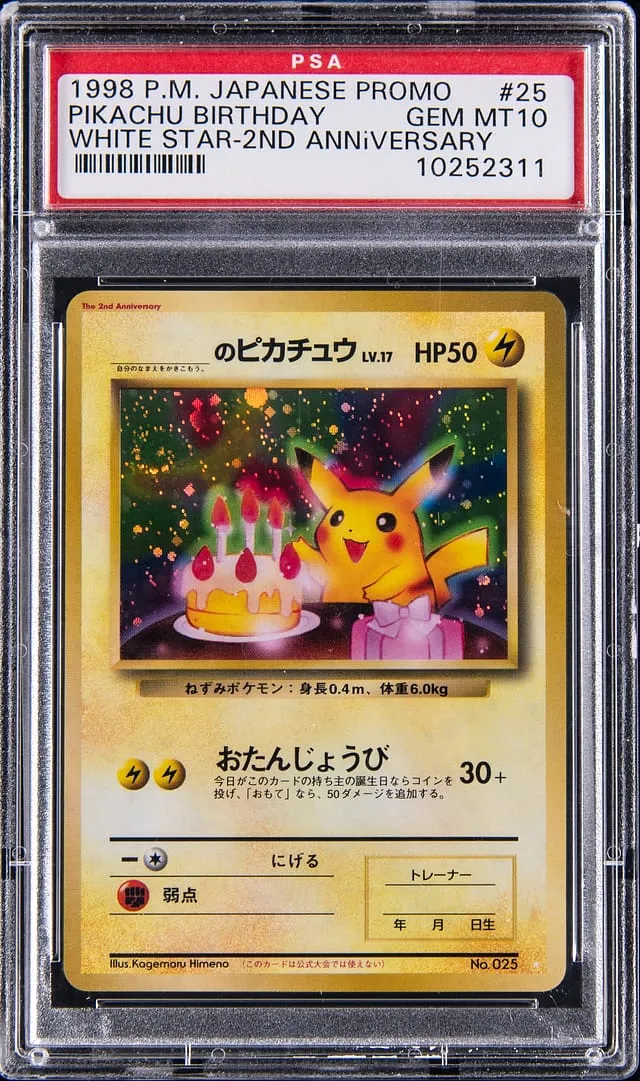
1998 Japanese Birthday Pikachu PSA 10 Sells for $13K
Goldin sold a 1998 Japanese White Star 2nd Anniversary Birthday Pikachu PSA 10 for $13,435 on March 9, 2026. Here’s what it means for collectors.
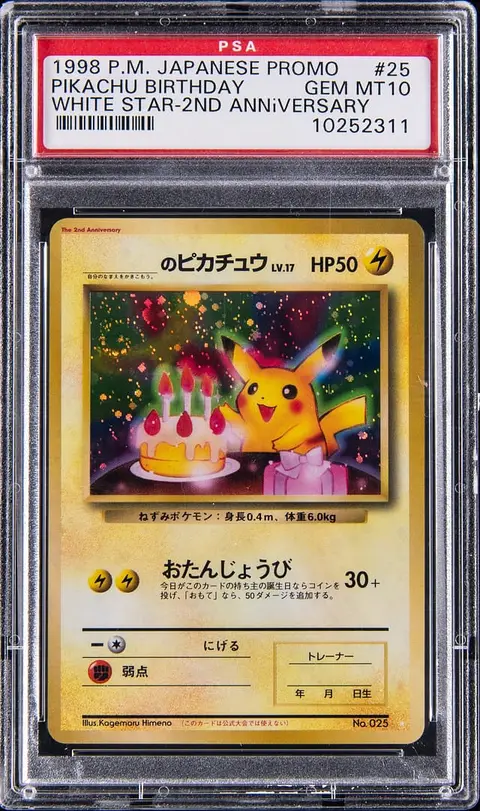
Sold Card
1998 Pokemon Japanese Promo White Star 2nd Anniversary Holo #25 Birthday Pikachu - PSA GEM MT 10
Sale Price
Platform
Goldin1998 Pokémon Japanese Promo White Star 2nd Anniversary Holo #25 Birthday Pikachu in PSA GEM MT 10 sold at Goldin on March 9, 2026 for $13,435. For a promo that started life as a fun birthday tie‑in, that is a serious data point for the high‑end Pokémon market.
In this post, we’ll walk through what this card is, why collectors care about it, and how this sale fits into recent price action.
Card overview
- Character: Pikachu
- Year: 1998
- Region/Language: Japanese
- Card type: Pokémon TCG promotional card
- Title: White Star 2nd Anniversary Holo "Birthday Pikachu"
- Card number: #25
- Promo stamp: White star 2nd Anniversary
- Grading company: PSA (Professional Sports Authenticator)
- Grade: GEM MT 10 (PSA’s highest standard grade)
This is not a rookie card in the sports sense, but it is a key issue Pikachu promo from the late 1990s, an era that many collectors view as the core of vintage‑era Pokémon.
What makes this Birthday Pikachu promo special?
Birthday Pikachu has always stood slightly apart from standard set cards. The concept of writing your own name on the card for the attack text made it memorable for kids and created an interesting condition challenge for grading.
Key points collectors tend to focus on:
Late‑90s Japanese promo status
The 1997–1999 Japanese promos are widely seen as a cornerstone run for serious Pokémon collectors. They were often distributed in limited, event‑based, or mail‑in ways rather than simple booster packs.2nd Anniversary tie‑in
The white star 2nd Anniversary marking connects this card directly to the early growth phase of the Pokémon TCG. Cards that mark anniversaries, tournaments, or special programs often age well from a collector interest standpoint because they anchor specific moments in hobby history.Condition difficulty
Many copies were handled by children, written on, or stored casually. Clean, unmarked, well‑centered examples surviving long enough to be graded are relatively scarce, and getting all the way to a PSA 10 (GEM MT) is even tougher.Pikachu factor
Pikachu is the face of the franchise. For character‑collectors (people who focus on one character across sets and eras), key 1990s promos often sit right next to trophy cards and early set holos on their priority lists.
Grading and population context
The card in this sale received PSA GEM MT 10, which is PSA’s top standard grade and usually commands a strong premium over PSA 9 and below.
Population reports (often called "pop reports") show how many copies of a card have achieved each grade at a grading company. While population numbers for this exact promo can change as new submissions are graded, the general pattern for late‑90s Japanese holos is consistent:
- A noticeable drop‑off from the total graded population to PSA 10.
- A much larger cluster in PSA 8 and PSA 9, where light handling, surface scratches, or edge wear keep cards out of gem mint.
This scarcity in high grade is one of the core reasons a PSA 10 commands such a big jump in price.
Market context and recent sales
This specific copy sold at Goldin on March 9, 2026, for $13,435.
Looking at recent public sales for similar 1990s Japanese Pikachu promos in PSA 10 across major auction houses and marketplaces, a few patterns stand out:
- High‑grade late‑90s Pikachu promos frequently clear the low five‑figure range when they combine character popularity, recognizable artwork, and tougher distribution.
- PSA 9 examples of comparable promos often land in the mid‑four‑figure range, sometimes less, emphasizing how steep the premium can be for a true gem.
- Older headline sales for top‑tier 1990s Pikachu promos (trophies or very limited event cards) sit far above this result, but they also represent a different tier of rarity.
Within that context, the $13,435 result sits in line with the growing willingness of collectors to pay up for:
- Late‑90s Japanese origins
- A marquee character (Pikachu)
- A less common, historically anchored promo
- The top grade available from PSA
Rather than an outlier, this sale is better read as reinforcing the premium that the market already assigns to strong 1990s Pikachu pieces in PSA 10.
How this sale fits into the broader Pokémon market
Several broader hobby trends intersect in this result:
Mature demand for 1990s Japanese promos
Early on, many collectors focused primarily on English base set holos. Over the past several years, attention has steadily expanded to Japanese promos, which often feature:- Earlier print dates
- Distinct artwork
- Smaller effective print runs or more complex distribution
Character‑driven collecting
As the market matures, more collectors specialize. Pikachu is one of the main characters where that specialization is strongest, and high‑end promos are natural targets for those focused collections.Condition as a main driver of value
The gap between PSA 9 and PSA 10 for late‑90s holos has continued to hold, especially when supply of PSA 10s is thin. For many collectors, a top‑grade example of a favorite 1990s card is a final‑destination piece, not inventory.Steady interest rather than short‑term hype
This result aligns more with long‑term appreciation for nostalgia and historical significance than it does with a short‑term news cycle. There is no single event or headline around Pikachu driving demand; it is a slow‑burn, franchise‑anchor character.
Takeaways for collectors and small sellers
For anyone watching the market or considering their own grading and selling strategy, this sale offers a few practical points:
Quality matters disproportionately at the top. A truly clean copy that has a realistic shot at PSA 10 can justify grading fees much more than a borderline card, especially for 1990s promos.
Not all promos are equal. Anniversary, event, and program‑linked promos from the late 1990s continue to separate themselves from more common handout cards.
Character plus era is a strong combination. Pikachu + late‑90s Japanese is a lane where demand has been consistent across multiple market cycles.
Use comps, but read them carefully. "Comps" (comparable recent sales) are a helpful price reference, but always pay attention to:
- Grade (PSA 10 vs PSA 9 is crucial).
- Timing (market mood when the sale happened).
- Auction house (audience size and visibility).
- Card attributes (any differences in stamp, language, or version).
Final thoughts
The 1998 Pokémon Japanese Promo White Star 2nd Anniversary Holo #25 Birthday Pikachu – PSA GEM MT 10 crossing $13,435 at Goldin on March 9, 2026 underscores how much respect the market has developed for well‑preserved, historically rooted Japanese promos.
For collectors, it is a reminder that some of the most meaningful long‑term pieces are not always the loudest or most famous at first glance—they are often cards like this: tied to a specific moment, beloved character, and an era that many in the hobby now see as foundational.
As always, any price is just one data point. Taken together with other recent sales, though, this one supports a clear story: top‑grade, late‑90s Pikachu promos remain a focused, resilient corner of the Pokémon market.