1998 Japanese Birthday Pikachu PSA 10 Himeno Sketch Sale
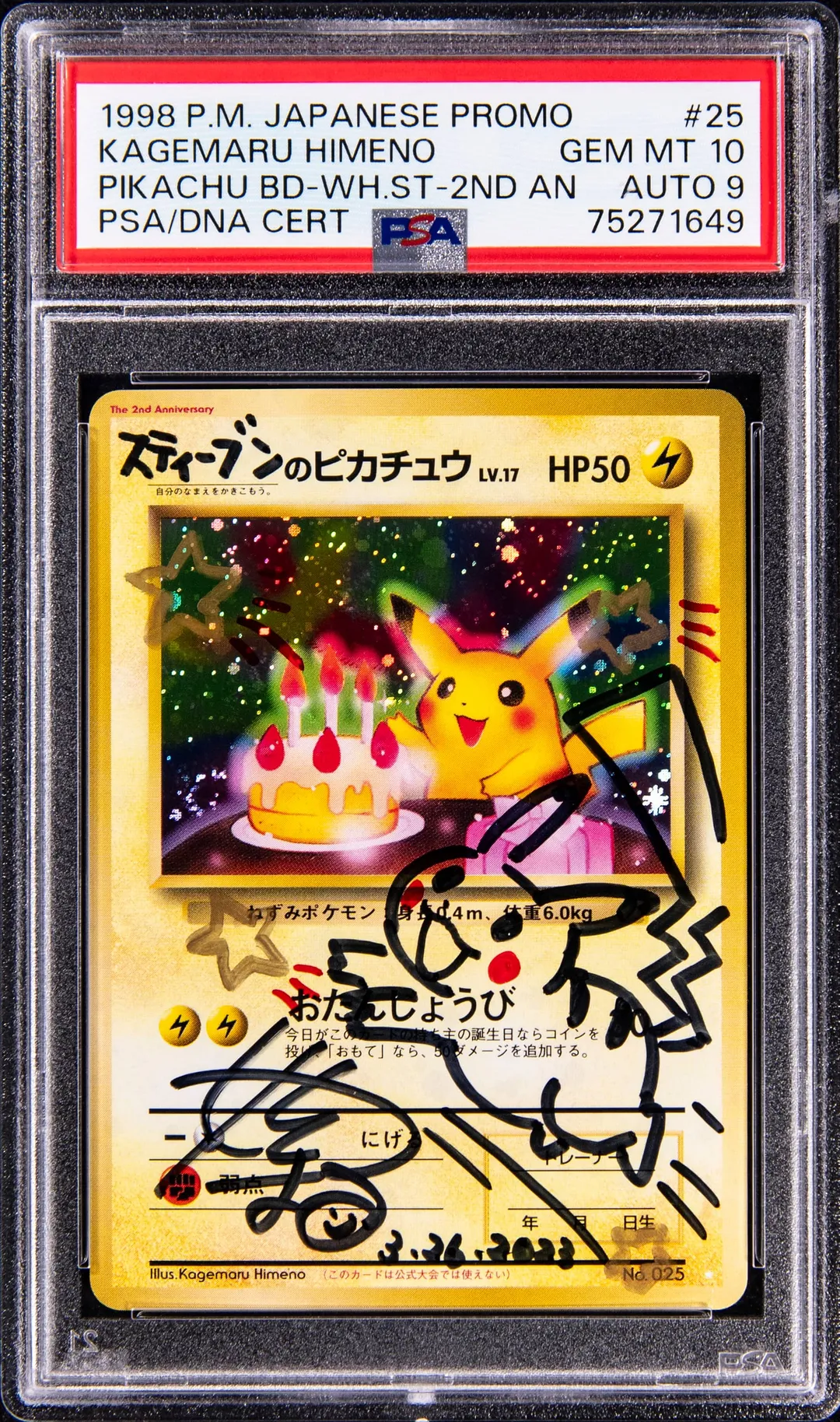
Goldin sold a 1998 Japanese 2nd Anniversary Birthday Pikachu PSA 10 with Kagemaru Himeno sketch and PSA/DNA 9 auto for $32,306 on Jan 19, 2026.
Sold Card
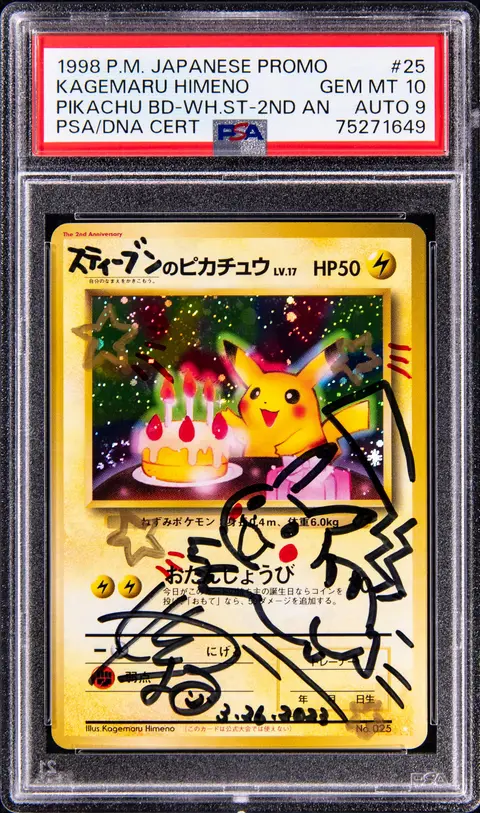
1998 Pokemon Japanese Promo White Star 2nd Anniversary #25 Birthday Pikachu Signed, Sketched by Kagemaru Himeno - PSA GEM MT 10, PSA/DNA MINT 9
Sale Price
Platform
Goldin1998 Pokémon Japanese Promo White Star 2nd Anniversary #25 Birthday Pikachu Signed, Sketched by Kagemaru Himeno – Market Review
On January 19, 2026, Goldin sold a 1998 Pokémon Japanese Promo White Star 2nd Anniversary #25 Birthday Pikachu for $32,306. This copy carries two high-end grading labels: PSA GEM MT 10 for the card and PSA/DNA MINT 9 for the autograph and sketch by illustrator Kagemaru Himeno.
For a niche but highly studied lane of the Pokémon market—vintage Japanese promos and illustrator-signed cards—this result is an important data point. Below, we’ll break down why this card matters, how it fits into the broader Pokémon landscape, and what the price tells us about current demand.
Card overview: what exactly sold?
• Year: 1998
• Card: Pokémon Japanese Promo White Star 2nd Anniversary Birthday Pikachu
• Card number: #25
• Language: Japanese
• Category: Promo (not pack-pulled; distributed as a special promotion)
• Variant: “White Star” 2nd Anniversary promo issue
• Autograph: On-card signature and sketch by Kagemaru Himeno
• Grading:
– Card: PSA GEM MT 10 (PSA’s highest standard grade for a standard-issue card)
– Autograph: PSA/DNA MINT 9
This card is not a rookie card in the sports sense, but in Pokémon it is viewed as a key issue within the Birthday Pikachu and Japanese promo lanes. The 2nd Anniversary White Star promos are considerably harder to source than later mass-printed English Birthday Pikachu releases, and signed/illustrated copies elevate that scarcity even further.
Why collectors care about this card
- Early Japanese promo era
The late 1990s Japanese promos occupy a similar space to “pre-war” or early vintage issues in sports: lower print runs, narrower distribution, and heavier attrition over time.
The 2nd Anniversary White Star series comes from a period when the Pokémon TCG was still consolidating its fanbase in Japan. Promos of this era were often tied to events, campaigns, or mail-in programs, which means surviving copies are fewer and more condition-sensitive than modern chase cards.
- Birthday Pikachu as a character card
Birthday Pikachu is one of the more recognizable character-centric promo concepts in the Pokémon hobby:
• The theme invites personalization (writing the owner’s name and birthday on the card), which is charming but often kills condition.
• Early Birthday Pikachu variants are closely associated with late-90s Pokémon nostalgia and with Pikachu as the franchise mascot.
Among collectors, Birthday Pikachu sits alongside cards like CoroCoro promos, University Magikarp, and other early promo Pikachu issues as “character PC” (personal collection) staples. The 2nd Anniversary White Star variant is not as widely discussed as the classic English Birthday Pikachu, but within Japanese promo circles it is a known and respected piece.
- Kagemaru Himeno autograph and sketch
Kagemaru Himeno is one of the longest-tenured and most recognizable Pokémon illustrators, with decades of card artwork across multiple generations.
Key points for collectors:
• Illustrator-signed cards occupy a different niche than pack-pulled autographs in sports. They are typically obtained in person at events or signings, often in small, untracked quantities.
• A hand-drawn sketch in addition to the autograph materially changes the card’s profile. Sketches require more time and effort per card, so they are much less common than signatures alone.
• PSA/DNA authentication gives the signing third-party verification and a separate grade, which matters for collectors who want standardized, tradable pieces rather than raw signed cards.
Within the Pokémon market, signed and sketched copies from early illustrators (Himeno, Mitsuhiro Arita, etc.) have become a defined sub-collecting lane over the last several years. This sale is a strong, public example of value ascribed to that niche.
- Dual high grades: PSA 10 card, PSA/DNA 9 auto
Condition is a major driver of value, and it becomes even more critical with:
• Older, more fragile promos, and
• Cards that have physically been handled to be signed.
A PSA GEM MT 10 grade on a 1998 promo already speaks to exceptional preservation: sharp corners, clean surfaces, strong centering, and no notable print defects under PSA’s standards. Add the fact that the card left its original storage context to be signed and sketched, and the chance of flaws goes up.
A PSA/DNA MINT 9 auto grade indicates the signature and sketch are both strong, with only minor imperfections. For collectors who try to assemble the very highest-end copies, that dual label (10 card / 9 auto) pushes this example toward the top of the available population.
Market context and price comparison
The Goldin sale closed at $32,306 on January 19, 2026.
Because this is a specific combo—1998 Japanese White Star 2nd Anniversary #25 Birthday Pikachu, PSA 10, signed and sketched by Kagemaru Himeno with PSA/DNA MINT 9—direct comparables (“comps,” meaning recent comparable sales) are limited. In segments like this, collectors often look at a blend of:
• Unsigned copies of the same card in high grade
• Signed-only copies (no sketch) of similar era Pikachu promos
• Illustrator-signed sketch cards from the same artist on comparable vintage promos
Unsigned high-grade promos
Publicly available sales data for unsigned PSA 10 copies of similar late-90s Japanese Pikachu promos typically show a significant gap between PSA 9 and PSA 10, with 10s often multiplying 9 prices several times over. For the rarer White Star 2nd Anniversary promos, high-grade pops tend to be small, and when copies surface, they often sell privately or infrequently.
Illustrator-autographed cards
In recent years, signed and sketched Pokémon promos—especially from Arita and Himeno—have shown:
• A substantial premium over unsigned versions, even in lower card grades.
• An additional premium when sketches are present, particularly full or detailed sketches rather than quick doodles.
• Stronger performance when authenticated and graded by PSA/DNA or similar services.
Without a deep stack of identical sales to line up, it’s safer to describe this $32,306 result as a high-end, but not irrational, outcome for the intersection of three factors:
- Vintage Japanese promo scarcity
- PSA 10 condition on the base card
- PSA/DNA-graded Himeno autograph and sketch
From a market-structure standpoint, this kind of card lives in the “trophy/collector piece” category rather than the “high-liquidity modern chase” category. That often means:
• Lower sales frequency
• Wider price ranges between appearances
• A heavier influence of individual bidders who are building very specific collections
Population and scarcity
Population report (“pop report”) data—grading company counts of how many copies exist at each grade—are one of the few structured tools collectors have to estimate supply.
For this card, the relevant supply layers are:
• All graded copies of the 1998 White Star 2nd Anniversary #25 Birthday Pikachu
• PSA 10 examples of the card
• PSA 10 examples that are also PSA/DNA-authenticated Kagemaru Himeno signatures, with or without sketches
• The much smaller subset with both a sketch and a PSA/DNA MINT 9 autograph grade
The last category is typically tiny. Illustrator signings were not done with future population reports in mind, and there is no standardized record of how many were signed or sketched. Because of that, signed/sketched PSA 10 examples tend to function more like unique art pieces than like fungible commodity cards.
Era context: late-90s Japanese promos vs modern
Compared to modern, ultra-modern, and current booster-era chase cards, late-90s Japanese promos have several distinct traits:
• Smaller, more regionally confined print runs
• Less careful long-term storage from original recipients
• Limited reprints or alternative versions, so specific promos hold unique art and history
• Lower raw supply available for grading today
Modern collectors used to serial-numbered sports parallels and guaranteed case hits sometimes underestimate how tough it is to find clean, authentic, signed-and-sketched Japanese promos from the 1990s.
The $32,306 result signals that a core segment of the market continues to value provenance, age, and illustrator significance alongside the more familiar drivers like grade and character popularity.
What this sale suggests for collectors
A few measured takeaways for hobbyists, whether you’re new to Pokémon or returning after a long break:
- Niche lanes can be deep
Illustrator-signed and sketched cards are a specialized lane, but as this sale shows, it is a well-developed one. Collectors who care about art, artist history, and one-of-a-kind pieces often gravitate here rather than toward mass-chased modern sets.
- Condition and authentication matter even more with signatures
If you are collecting signed vintage promos, third-party authentication and grading help:
• Confirm the signature and sketch are legitimate
• Standardize condition so future buyers can compare apples to apples
• Protect the card and ink long term with tamper-evident holders
The dual PSA 10 / PSA-DNA 9 labels on this Birthday Pikachu compress a lot of that assurance into a single, easily understood package.
- Pricing will not be uniform
Because comps are thin, prices on similar pieces can vary significantly sale to sale. The Goldin result on January 19, 2026, gives collectors a fresh benchmark, but it should be viewed as one datapoint in an illiquid segment—useful for context, not as a rigid reference.
- Provenance and story are part of the value
For a piece like this, the appeal isn’t just:
• Early promo
• Pikachu
• High grade
It is also the fact that:
• The card was handled by the original illustrator
• A unique sketch was added
• The whole package has been preserved and documented at a top auction house
Those elements make the card a conversation piece in a collection, not just a line item.
How small sellers and newer collectors can use this info
Even if a $32,306 PSA 10 Birthday Pikachu is outside your buying range, the same principles scale down:
• Look for early promos, especially those tied to an event, milestone, or campaign.
• Pay attention to who illustrated the card; some artists have dedicated fanbases.
• When you see signatures and sketches, think about authenticity and condition first, then price.
Over time, tracking sales like this Goldin auction helps you understand how the market values age, art, artist involvement, and condition together—not just chase rarity or modern hype.
Final thoughts
The 1998 Pokémon Japanese Promo White Star 2nd Anniversary #25 Birthday Pikachu that sold at Goldin on January 19, 2026, is a concentrated snapshot of several trends in the hobby: reverence for early Japanese promos, growing attention to illustrator-signed art, and continued premium for top-condition vintage pieces.
For serious Pikachu collectors and Japanese promo specialists, this sale is another reference point when assessing future high-end offerings. For everyone else in the hobby, it’s a useful reminder that some of the most interesting—and enduring—cards sit slightly off the mainstream path, where character, history, and artwork intersect.