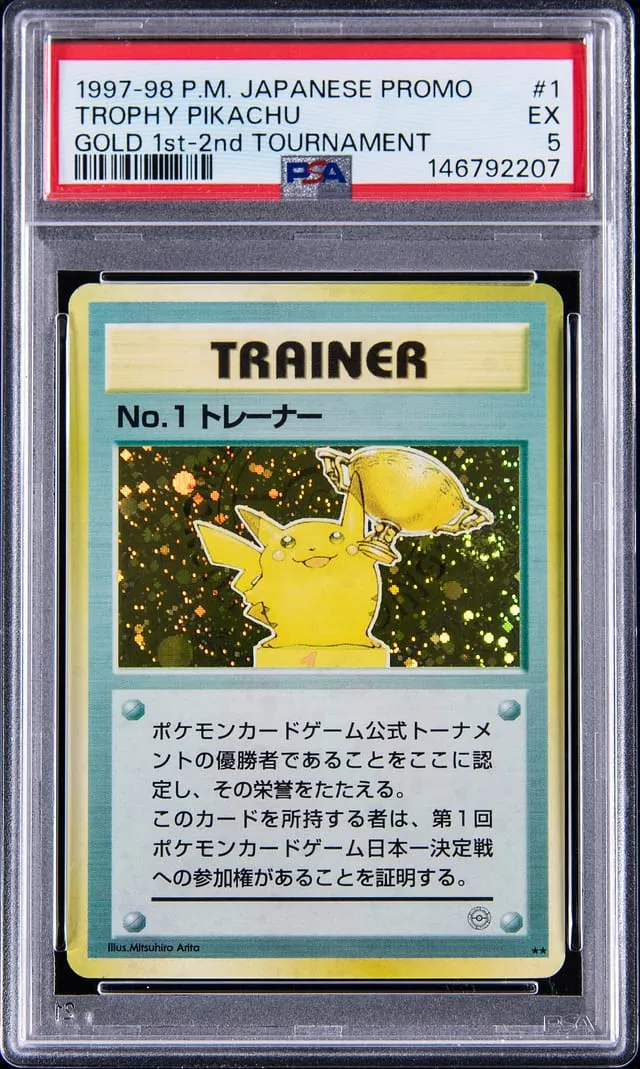
1998 Gold 1st Place Trophy Pikachu Sells for $268K
Goldin sold a PSA 5 1998 Gold 1st Place Trophy Pikachu with plaque and extras for $268,400 on Feb 23, 2026. Here’s what it means for Pokémon collectors.
Sold Card
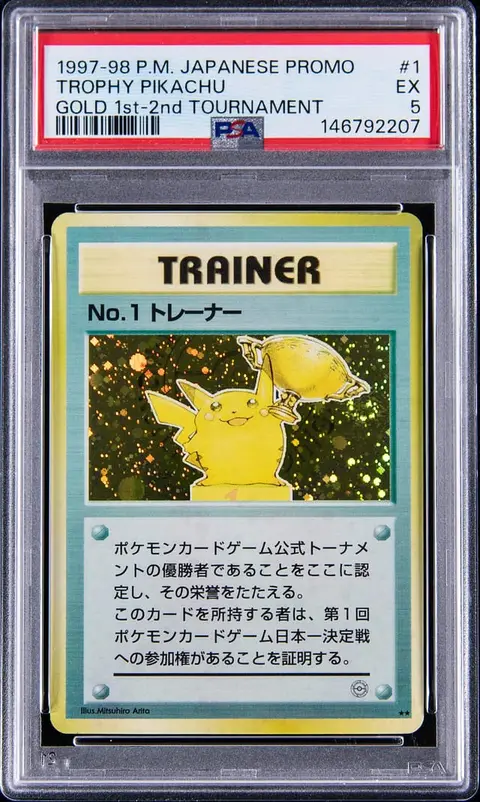
1998 Pokemon Japanese Promo Gold 1st Place 2nd Tournament #1 Trophy Pikachu - PSA EX 5 - Includes Plaque, Hat, Red Parka, Gold Chansey Coin
Sale Price
Platform
Goldin1998 Pokémon Japanese Promo Gold 1st Place 2nd Tournament #1 Trophy Pikachu – Market Breakdown
On February 23, 2026, Goldin sold a 1998 Pokémon Japanese Promo Gold 1st Place 2nd Tournament #1 Trophy Pikachu for $268,400. The card was graded PSA EX 5 and included its original winner’s bundle: the plaque, hat, red parka, and a Gold Chansey coin. For serious Pokémon historians, this is one of the purest snapshots of the game’s earliest organized play era you can still hold in your hands.
In this piece, we’ll walk through what this card is, why it matters, and how this sale fits into the broader market for Trophy Pikachu and top-end vintage Pokémon promos.
Card ID: What Exactly Sold at Goldin
Here’s how this card breaks down in hobby terms:
- Character: Pikachu (Trophy Pikachu artwork)
- Year: 1998
- Origin: Japanese Pokémon promo
- Event: 2nd Official Pokémon Card Game Tournament (Japan)
- Placement: Gold 1st Place prize
- Card number: #1 (Trophy Pikachu)
- Type: Ultra-limited event trophy card, not a regular pack-pulled card
- Era: Early vintage Pokémon (pre–English base expansion boom)
- Grading company: PSA (Professional Sports Authenticator)
- Grade: EX 5
- Extras included:
- 1st Place trophy plaque
- Tournament hat
- Red parka
- Gold Chansey coin
Trophy Pikachu cards are not “rookie cards” in the sports sense, but for many collectors they are among the earliest and most important Pikachu issues ever created. They represent the top finishers at some of the first officially sanctioned Pokémon card tournaments in Japan.
Why Trophy Pikachu Is So Important to Collectors
Trophy Pikachu sits in a very small category of cards: true event trophies from the late 1990s that were only awarded to tournament winners. These weren’t sold in stores or pulled from booster packs.
Key reasons collectors care:
Extreme scarcity
Print numbers are believed to be in the very low double digits per placement and event. Unlike mass-produced set cards, each copy is tied to a specific tournament and podium finish.Historical weight
These promos are tied to the formative years of organized Pokémon play in Japan. For collectors focused on history, that connection often matters as much as condition.Pikachu as the franchise face
As the mascot of Pokémon, Pikachu is the most globally recognized character in the TCG. Top-tier Pikachu cards, especially pre-2000 promos, sit near the top of many long-term collections.Award provenance and ephemera
This particular sale included the non-card items: plaque, hat, red parka, and the Gold Chansey coin. These pieces help verify and preserve the story of the original tournament prize distribution and are rarely still paired with the card decades later.Vintage promo era
The late 1990s Japanese promo landscape (trophies, CoroCoro promos, early league cards) remains one of the most studied segments of Pokémon. Many of these cards were never intended for broad circulation.
Grade, Condition, and Why PSA EX 5 Still Commands Attention
A PSA EX 5 grade means the card shows clear signs of wear—noticeable edge/corner wear and surface defects—but retains strong structural integrity. For mainstream set cards, a 5 might be considered more of a mid-grade placeholder. Trophy Pikachu is a different story.
For ultra-scarce trophy cards, collectors often prioritize:
- Existence over perfection: Many copies were handled by young players, not stored as investments.
- Provenance and completeness: Having the original plaque and related items is extremely desirable.
- Relative condition: Even mid-grade examples may be among only a handful known to exist publicly.
In short, an EX 5 grade on this card does not push it out of the high-end category. Instead, it offers a more accessible condition tier compared with the very small population of higher-grade copies, while still preserving the story.
Market Context: How $268,400 Fits In
The Goldin sale on February 23, 2026, at $268,400 places this copy firmly in the top tier of vintage Pokémon outcomes, but within a range that makes sense when you consider the broader Trophy Pikachu and trophy-card landscape.
Because true Trophy Pikachu copies surface infrequently, most “comps” (comparable sales, used to gauge value) come from:
- Different placement awards (e.g., 2nd or 3rd place)
- Different tournament years (1st, 2nd, or later official tournaments)
- Different grades (from low to the very rare high grades)
While exact dollar amounts fluctuate with each appearance, historical patterns show:
- High-grade Trophy Pikachu examples can push well into the upper six-figures and, at times, challenge seven-figure territory when rarity, condition, and provenance align.
- Mid-grade copies, particularly those with strong provenance or full award bundles, often land in the solid six-figure range.
Placed in that context, $268,400 for a PSA EX 5 with the matching plaque, hat, parka, and Gold Chansey coin is best understood as:
- A strong but defensible price in line with past premium trophy sales.
- Reflective of both the mid-grade card condition and the completeness of the award package.
- Another data point confirming that serious demand persists for historically important Japanese trophies even outside the absolute top grading tier.
The Role of the Full Award Bundle
One detail that sets this sale apart is the inclusion of:
- The original trophy plaque
- The hat and red parka given to winners
- A Gold Chansey coin
For collectors used to modern serial-numbered parallels, this may seem like an extra. For hardcore promo historians, it is central to the item’s appeal. Together, these elements:
- Strengthen confidence that the card is tied to an actual 1st Place winner.
- Provide museum-quality context for display.
- Are themselves scarce; many were separated or lost over the years.
That completeness likely underpins part of the price achieved in this Goldin auction.
How This Sale Fits the Current Pokémon Landscape
A few broader hobby threads help frame this result:
Mature demand for top-end vintage
Even as modern and ultra-modern sets go through cycles of attention, the highest-tier vintage pieces—especially event trophies—have tended to show more stable long-term interest.Growing focus on provenance
Collectors are increasingly attentive to who owned an item, how it was awarded, and how complete its historical context is. Trophies with original accompanying items line up well with that trend.Narrow but deep buyer pool
The audience for a $200k+ Pokémon card is small but highly committed. Auction results like this suggest that when a notable Trophy Pikachu surfaces at a major venue such as Goldin, there is still enough competition to support strong outcomes.
Takeaways for Collectors and Small Sellers
For most collectors, this Trophy Pikachu sale is not a purchase target but a market reference point:
- It reinforces the gap between true event trophies and even rare pack-pulled chase cards.
- It highlights how provenance and completeness (plaque, apparel, coin) can materially influence desirability.
- It shows that mid-grade does not automatically mean “mid-tier” when the supply is this limited.
If you collect or sell within the higher end of the Pokémon market, especially Japanese promos:
- Keep tracking trophy and award-card results across major houses like Goldin, Heritage, PWCC, and others to build a sense of long-term ranges, not just single spikes.
- When evaluating rare promos, consider the full picture: card, story, paperwork, and any original award items.
And if you are newer to the hobby, this sale is a useful reminder that the Pokémon TCG is not only about set collecting. Event history, competitive play, and early promotional distribution created a parallel ecosystem of cards—like this 1998 Gold 1st Place Trophy Pikachu—that tell the story of the game in a very different way.
For figoca users tracking market data, the $268,400 Goldin sale on February 23, 2026 is another anchor point in the evolving price history of one of the hobby’s most historically significant Pikachu cards.