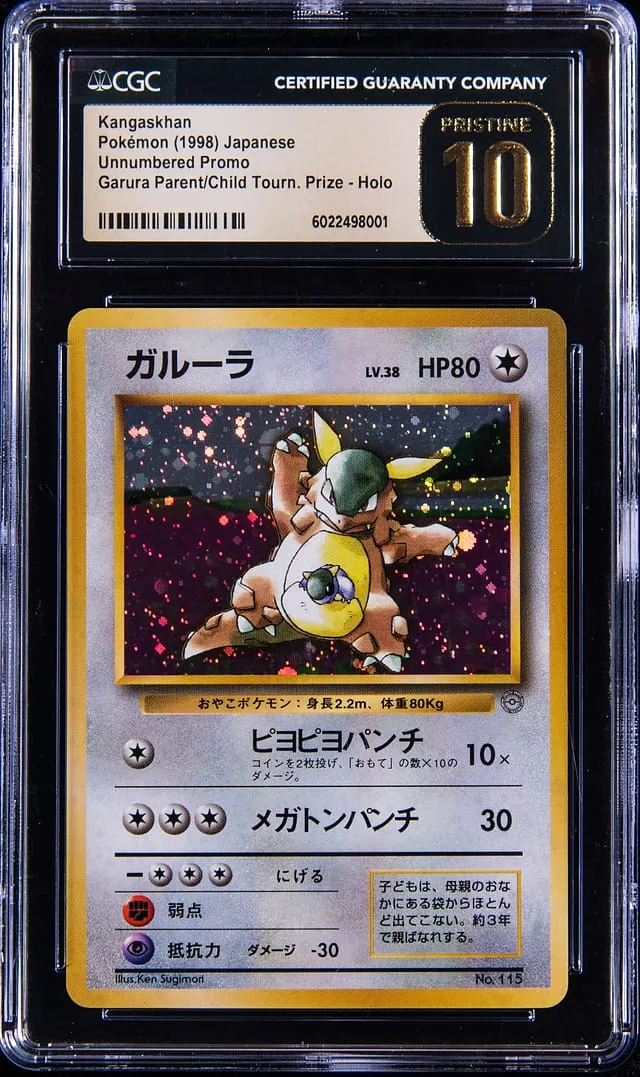
1998 Garura Kangaskhan CGC 10 Sells for $640k
A CGC Pristine 10, pop 1, 1998 Japanese Garura Parent/Child Kangaskhan promo just sold for $640,507 at Goldin. Here’s what it means for collectors.
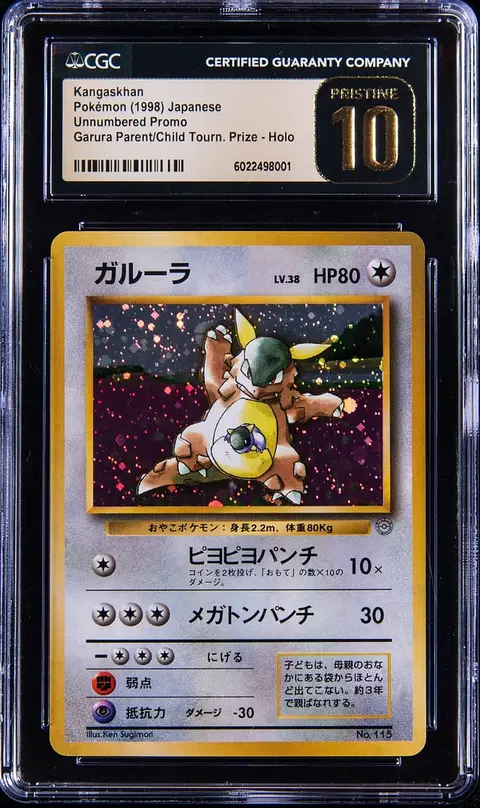
Sold Card
1998 Pokemon Japanese Promo Garura Parent/Child Tournament Prize Holo Kangaskhan - CGC PRISTINE 10 - Pop 1
Sale Price
Platform
Goldin1998 Pokemon Japanese Promo Garura Parent/Child Tournament Prize Holo Kangaskhan - CGC PRISTINE 10 - Pop 1 Sells for $640,507
On March 9, 2026, Goldin closed a landmark Pokémon sale: a 1998 Pokémon Japanese Promo Garura Parent/Child Tournament Prize Holo Kangaskhan graded CGC Pristine 10 realized $640,507. For collectors who follow rare Japanese promos and early Pokémon history, this is a significant data point for one of the hobby’s most elusive cards.
In this article, we’ll walk through what this card is, why it matters, and how this result fits into the broader market context.
Card overview: what exactly sold?
Card: 1998 Pokémon Japanese Promo Garura Parent/Child Tournament Prize Holo Kangaskhan
Character: Kangaskhan ("Garura" in Japanese)
Year: 1998
Type: Japanese promotional card
Event: Parent/Child Tournament (often called Garura Parent/Child Tournament)
Finish: Holographic
Grading company: CGC
Grade: Pristine 10
Population: Pop 1 (only one example with this grade in CGC’s census at the time of sale)
Special attributes: Extremely limited prize promo, distributed only to tournament participants in Japan
This is not a pack-pulled set card. It was awarded as a prize at early Pokémon leagues in Japan where a parent and child competed together as a team. That event-specific origin is part of what makes the Garura Kangaskhan promo so important to collectors of trophy-style and early promo cards.
Why the Garura Parent/Child Kangaskhan matters
The 1998 Parent/Child Tournament Kangaskhan promo is widely viewed as one of the key non-trophy Japanese promos of the late 1990s. A few reasons collectors care:
Early-era history (1998)
This card sits right in the earliest chapter of organized Pokémon play in Japan. For collectors who prioritize “first years” and foundational events, Parent/Child tournament promos are high on the list.Event-tied distribution
This card was reportedly only awarded to participants at specific Parent/Child tournaments, making the print run inherently small. Unlike mass-released set cards, supply was capped by event attendance.Trophy-adjacent appeal
While not a formal 1st/2nd/3rd place trophy card, the Garura Kangaskhan promo often gets grouped alongside trophy and prize cards because of its limited, invitation-style distribution and scarcity in high grade.Condition sensitivity and grading scarcity
As with many 1990s Japanese promos, surfaces and edges can be challenging. Achieving a top grade like CGC Pristine 10—which generally requires near-perfect centering, corners, edges, and surface—is extremely difficult.Pop 1 significance
“Pop” refers to the population report, the number of copies graded at each grade level by a grading company. A Pop 1 in CGC’s census means there is only one example in Pristine 10 at the time of this sale, underscoring true top-of-the-market scarcity.
Market context and historical comparisons
This sale: $640,507 at Goldin
- Auction house: Goldin
- Sale date (UTC): March 9, 2026
- Final price: $640,507 (converted from the reported 64,050,700 cents)
Within the niche of high-end Japanese promos and trophy-adjacent cards, the Parent/Child Kangaskhan has a track record of strong results, particularly in top PSA grades. This CGC Pristine 10 sale adds a new data point for the card in an alternative grading holder.
Recent and historical sales
Publicly reported past results (in PSA and other holders) have shown:
- High-grade examples (especially PSA 10) have historically sold in the high five-figure to low six-figure range, depending on timing and market conditions.
- Mid-to-high PSA 9 copies have typically sold for less, but still command a meaningful premium as event promos with limited supply.
This new CGC Pristine 10, Pop 1 result at $640,507 places the card in the very upper tier of Pokémon sales, near other historically important promos and early-era chase cards. While direct one-to-one comps ("comps" meaning comparable recent sales of the same card) in CGC Pristine 10 do not exist—because this is the only one with that grade—this price clearly reflects both scarcity and condition premium.
Because the population and sales data for this exact card and grade are thin, the safest way to read this result is as a premium outlier: a top-grade, unique population example that a dedicated collector or investor was willing to stretch for. It is less useful as a benchmark for raw or lower-grade copies.
How this fits into the broader Pokémon market
Vintage Japanese promo segment
The Garura Parent/Child Kangaskhan sits in the “vintage promo” segment:
- Era: Late 1990s (often grouped as vintage in Pokémon terms)
- Category: Prize/event promo
- Collector interest: High among advanced collectors focusing on the earliest years of the game, especially those building runs of trophy and prize cards
Over the last few years, the market for vintage Japanese promos has shown:
- Higher resilience compared to some speculative modern releases, especially for cards tied to historical events or early competitive play.
- Increased attention from international collectors who previously focused mostly on English sets.
This result reinforces the pattern: when a truly scarce, historically important promo appears in a top grade, it can attract deep bidding even if overall market sentiment is mixed.
Grade sensitivity and cross-holder dynamics
Most high-profile sales for this card in the past have involved PSA-graded examples, as PSA has historically been the dominant grading company for high-end Pokémon cards. This sale showcases:
- Demand for CGC’s top grade: A Pristine 10 label from CGC can command a notable premium when population is extremely low.
- Cross-holder comparability: While collectors sometimes try to line prices up across PSA, BGS, and CGC, population structures and grading scales differ. A Pop 1 Pristine 10 is not directly interchangeable with a PSA 9 or 10, so comparisons should be made cautiously.
Why collectors track this card
Collectors pay attention to cards like this Parent/Child Kangaskhan for a few key reasons:
- Historical importance – It’s part of the earliest wave of organized Pokémon play in Japan, which has long-term collecting significance.
- True scarcity – Limited event distribution and low surviving population, especially in high grade. This isn’t a card that appears in every major auction cycle.
- Condition ceiling – When a new “top of the pyramid” grade appears (like CGC Pristine 10, Pop 1), it often becomes a reference point for how the market values the absolute best example.
What this result does and does not mean
What this sale does suggest:
- There is still serious, targeted demand for top-end vintage Japanese promos.
- Unique, highest-graded examples can achieve prices far above more common grades, especially when populations are extremely small.
What this sale does not guarantee:
- It does not automatically reset prices for all lower-grade Parent/Child Kangaskhan copies.
- It does not promise future appreciation. It is one important—but still single—data point in a thinly traded niche.
For collectors, the most useful takeaway is how sharply the market differentiates between “high grade” and “the single best graded copy,” especially in historically important promos.
Takeaways for different types of collectors
Newer collectors
If you’re just starting out, this card is more a piece of hobby history than a practical target. It illustrates how early Japanese promos can become cornerstone items for advanced collections. Learning the stories behind these cards can help you understand why some promos are treated differently from set cards.
Returning collectors
If you collected in the 1990s and are now re-entering the hobby, this sale is a reminder that many of the Japanese promos you might have only heard about back then have grown into major blue-chip items. Understanding the difference between mass-released WOTC-era cards and event-only promos is key.
Active hobbyists and small sellers
This result strengthens the case that documenting provenance and condition matters. For rare promos, even small differences in centering, edges, or surface can mean large price differences once grading comes into play. It also underscores why following auction house archives and population reports is essential when setting expectations.
Final thoughts
The $640,507 Goldin sale of the 1998 Pokémon Japanese Promo Garura Parent/Child Tournament Prize Holo Kangaskhan – CGC Pristine 10 (Pop 1) is a clear marker in the ongoing story of high-end Pokémon. It confirms that truly scarce, historically anchored promos in the highest possible grade remain among the most pursued pieces in the hobby.
For most collectors, this card will be something admired from a distance rather than hunted directly. But understanding why it commands this level of attention can sharpen how you evaluate rarity, history, and condition in your own collecting path.
As more high-grade vintage promos surface across PSA, CGC, and BGS, each new sale will add another piece to the pricing picture. For now, this Garura Kangaskhan stands as one of the headline results in the Japanese promo space, and a useful reference point for how the market values the best of the best.