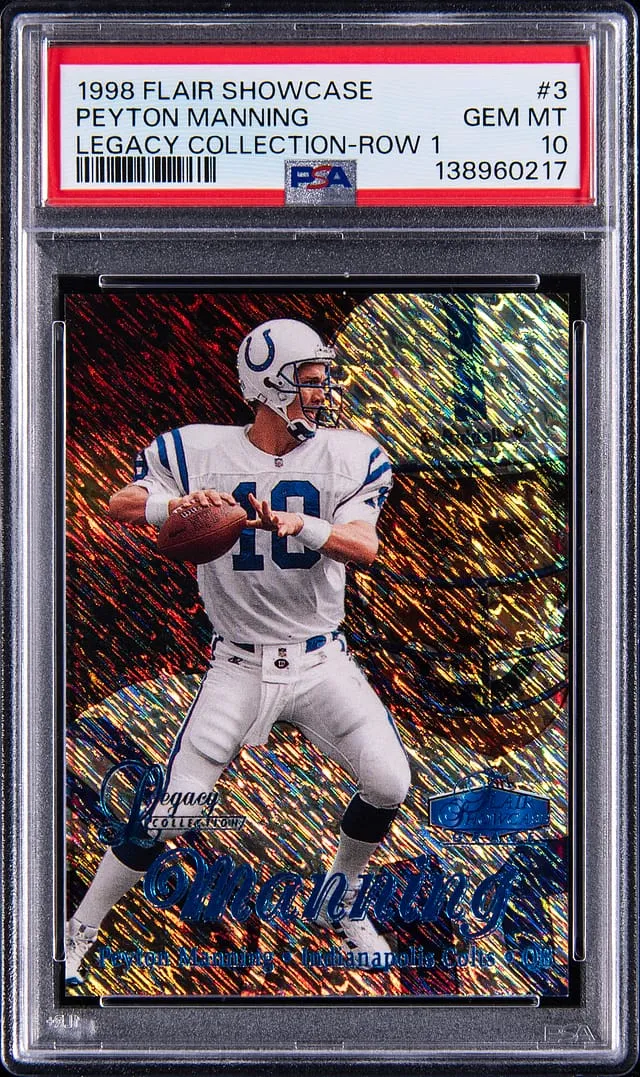
1998 Flair Legacy Peyton Manning RC PSA 10 Sale
Breakdown of the $19,642 Goldin sale of a 1998 Flair Showcase Legacy Row 1 Peyton Manning Rookie PSA 10 Pop 4, with market and collector context.
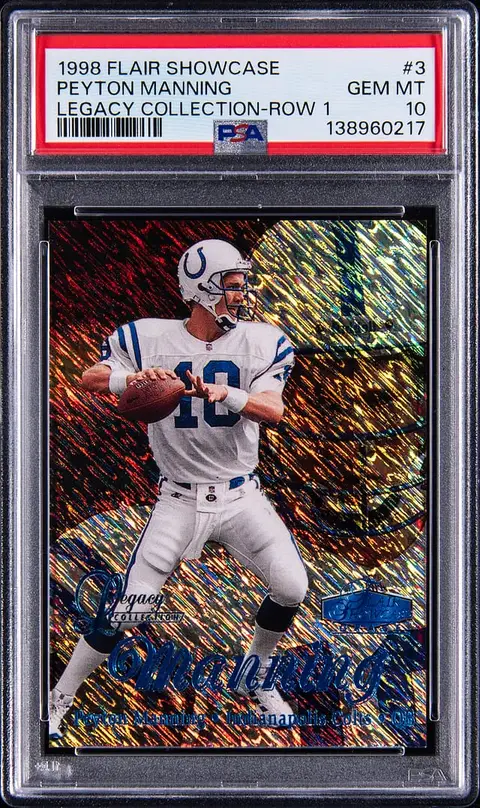
Sold Card
1998 Flair Showcase Legacy Collection Row 1 #3 Peyton Manning Rookie Card (#058/100) - PSA GEM MT 10 - Pop 4
Sale Price
Platform
GoldinA PSA 10 Peyton Manning Flair Showcase Legacy Rookie Sets a Quiet Benchmark
When a late-90s parallel of a Hall of Fame quarterback changes hands, it usually happens quietly, buried among modern color refractors and serial-numbered autos. The recent sale at Goldin on 2026-03-15 of a 1998 Flair Showcase Legacy Collection Row 1 #3 Peyton Manning Rookie Card (#058/100), graded PSA GEM MT 10 and confirmed as a Pop 4, is one of those quiet but important data points.
At figoca, we like to slow down and unpack what a sale like this actually means for collectors.
The card: a scarce, blue-foil rookie parallel
Let’s start by identifying the card clearly:
- Player: Peyton Manning
- Team: Indianapolis Colts
- Year: 1998
- Set: 1998 Flair Showcase
- Subset/Row: Legacy Collection, Row 1
- Card number: #3
- Serial numbering: #058/100 (only 100 copies printed)
- Rookie status: Yes – this is a true 1998 rookie-year card
- Grading company: PSA (Professional Sports Authenticator)
- Grade: GEM MT 10 (PSA’s highest standard grade for unaltered cards)
- Population (“pop”): 4 in PSA 10 according to the description
The Flair Showcase Legacy Collection parallels are known for:
- Distinctive blue foil and serial numbering to /100
- Multiple “Rows” (Row 0, Row 1, Row 2) that feature different photo treatments and relative scarcity in high grade
- Being one of the most chased 1990s parallels across both football and basketball
For Peyton Manning, a five-time MVP and two-time Super Bowl champion, his Legacy Collection rookies sit near the top of the non-autograph, non-patch ladder for serious 1990s football collectors.
The sale: $19,642 at Goldin
The sale price reported: 1,964,200 cents, which converts to $19,642.
- Auction house: Goldin
- Sale date (UTC): 2026-03-15
- Final price: $19,642
- Card: 1998 Flair Showcase Legacy Collection Row 1 #3 Peyton Manning RC #058/100 – PSA GEM MT 10 (Pop 4)
Any time you see a 90s Hall of Fame-level quarterback parallel, numbered to 100, in PSA 10, crack $10,000, it’s worth a closer look. For a Peyton Manning rookie of this caliber, just under $20,000 is a meaningful but not shocking result.
Market context: how does $19,642 fit in?
Because this is a low-pop, low-serial card, sales are infrequent. That makes exact pricing a moving target; we rely on a mix of:
- Direct recent comps (same card, same grade)
- Parallel or related comps (same card, different grade or different Row)
- Other high-end 1998 Peyton Manning rookies
Direct and close comps
Over the past few years, public sales of this exact card (Row 1 Legacy /100 in PSA 10) have been sparse. When they do appear, they often land at major auction houses rather than fixed-price marketplaces.
Recent public data and hobby tracking tools suggest:
- PSA 10 Legacy Row 1 Manning examples have tended to land in the mid- to high-teens in thousands of dollars, with occasional outliers depending on timing and auction strength.
- PSA 9 Legacy Row 1 copies generally trade for a noticeable discount to PSA 10, often in the mid four figures to low five figures when they appear, influenced by centering and eye appeal.
- Other Legacy Rows (Row 0 and Row 2) can show different patterns depending on photo preference and how set builders prioritize them.
Given that backdrop, $19,642 sits in what can be viewed as the upper but still reasonable band for this card in PSA 10:
- It acknowledges the scarcity of a Pop 4 90s parallel
- It stays within reach of known historical ranges for premium Manning rookies
- It doesn’t look like a sudden, disconnected spike that’s totally out of line with related cards
Because exact public sale logs for this specific card and grade are limited, it’s more accurate to treat this as a data point near the top of the current expected range for a PSA 10 rather than a clearly new all-time record.
Why collectors care about this card
For newer or returning collectors, it can help to break down why this card draws attention.
1. Peyton Manning’s hobby profile
Peyton Manning sits in a small group of quarterbacks with both:
- Elite on-field resume: multiple MVPs, multiple Super Bowl appearances, long-term passing records
- Stable legacy: long retired, Hall of Famer, widely respected
That combination tends to create steady, not volatile, demand for his key rookie issues. He’s not subject to the same hype cycles as active players, where one bad season can drastically shift demand.
2. 1998 Flair Showcase and the Legacy Collection
The late 1990s were a transition period between the “junk wax” era (overproduction) and the modern era of serial-numbered, premium parallels.
1998 Flair Showcase Legacy Collection parallels are important because they:
- Are serial-numbered to 100, which was meaningfully scarce for the time
- Feature a distinct visual identity (blue foil, premium card stock)
- Span star players across the checklist, making them attractive for both player collectors and set builders
Within the set, Legacy Collection parallels behave a lot like the forerunners of the modern “color parallel” chase: same base design, but numbered, foiled, and clearly defined as more scarce.
3. Rookie + low serial + top grade
This particular combination hits three powerful collector levers:
- Rookie-year card: Collectors often anchor value and focus around rookie cards, especially for Hall of Famers.
- Low-serial parallel: /100 from the late 90s remains tough to find in clean condition. These weren’t packed with the expectation they’d be graded a decade later.
- PSA GEM MT 10: With only 4 copies at this grade, the supply is effectively capped for collectors who insist on a top-pop example.
That mix creates a card that is:
- Scarce in raw form
- Even scarcer in high grade
- Competitive among advanced Manning or 1990s parallel collectors whenever one surfaces at auction
Grading and population: why Pop 4 matters
The PSA pop report (population report) tells us how many copies exist at each grade. With only four PSA 10s, every auction of this card in gem mint condition serves as a reference point.
For cards like this, pop matters because:
- Even if there are still ungraded copies in collections or unopened boxes, the likelihood that they’ll grade PSA 10 is low
- Many high-end copies disappear into long-term collections once they’re slabbed
When a Pop 4 card sells at a major auction house like Goldin, that price often becomes the anchor comp for future negotiations, even for lower grades.
Price context without promises
It’s important not to treat any one auction result as a guarantee of future value. Instead, this sale can be viewed as:
- A current benchmark for PSA 10 examples of this specific card
- A reference point for understanding the gap between PSA 9 and PSA 10
- A data point in the broader story of how the hobby is valuing 1990s, low-serial Hall of Fame rookies compared to modern ultra-rare inserts and parallels
For small sellers or collectors thinking about moving similar cards:
- Look at a basket of recent sales, not just this one
- Compare across auction houses and fixed-price platforms
- Adjust for grade, eye appeal, and timing (off-season vs in-season for active players)
For buyers eyeing high-end 1990s parallels:
- Use this sale as context, not a target you must match
- Pay attention to centering, surface, and overall presentation, especially if you’re considering crossing grades or cracking and resubmitting
What this sale quietly signals
The $19,642 result for a 1998 Flair Showcase Legacy Collection Row 1 Peyton Manning Rookie, PSA 10 (Pop 4), at Goldin on 2026-03-15 reinforces a few ongoing themes in the football card market:
- Hall of Fame, late-90s scarcity still commands respect. Even in an era dominated by one-of-ones and multi-color patches, a clean, low-serial rookie parallel remains competitive.
- Top grades magnify separation. The gap between PSA 9 and PSA 10 continues to be significant for 90s cards, especially when the gem pop is this small.
- Stable legends provide stability. While active-player markets can swing wildly, figures like Manning anchor a more measured, data-driven segment of the hobby.
As always, this is one sale, not a prediction. But for collectors building Peyton Manning portfolios, 1990s parallel runs, or simply trying to understand how the market values non-autographed, numbered rookies from this era, it’s a sale worth bookmarking.
At figoca, we’ll keep tracking results like this so you can see how these cornerstone 90s cards perform over time—without the noise, just the context.