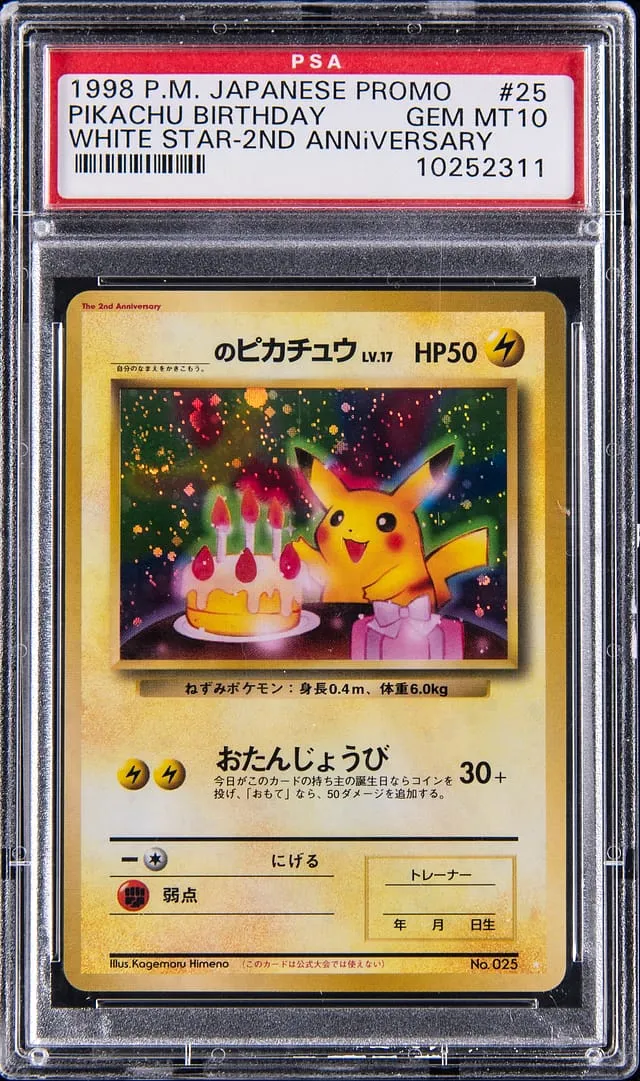
1998 Birthday Pikachu PSA 10 Goldin Sale Analysis
A PSA 10 1998 Japanese White Star 2nd Anniversary Birthday Pikachu sold for $13,435 at Goldin. See how this result fits recent Pikachu promo sales.
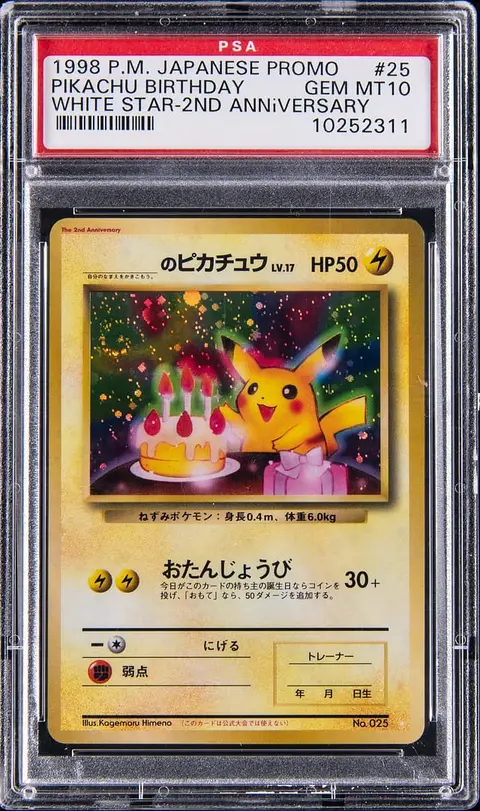
Sold Card
1998 Pokemon Japanese Promo White Star 2nd Anniversary Holo #25 Birthday Pikachu - PSA GEM MT 10
Sale Price
Platform
Goldin1998 Pokemon Japanese Promo White Star 2nd Anniversary Holo #25 Birthday Pikachu in PSA GEM MT 10 just changed hands at Goldin for $13,435 on March 9, 2026. For a niche late‑90s Japanese promo, that is a serious result – and an interesting data point for collectors who track rare Pikachu issues.
In this post, we’ll break down what this card is, why it matters, and how this sale fits into recent market activity.
Card overview: what exactly sold?
- Card: 1998 Pokémon Japanese Promo White Star 2nd Anniversary Holo Birthday Pikachu
- Card number: #25
- Language/region: Japanese
- Release: 2nd Anniversary promotional issue (late 1990s Japanese Pokémon TCG)
- Character: Pikachu
- Stamp/detail: White Star 2nd Anniversary promo designation
- Grading company: PSA (Professional Sports Authenticator)
- Grade: GEM MT 10 (PSA’s highest standard grade for pack‑issued cards)
- Attributes: Holographic, Japanese promo, non‑tournament pack release, not a rookie but a key early Pikachu promo
Birthday Pikachu is one of the more recognizable Pikachu cards from the 1990s, and this Japanese White Star 2nd Anniversary version sits in the middle ground between the widely known English “Birthday Pikachu” and much scarcer, event‑tied Japanese promos.
This specific copy earned a PSA GEM MT 10, meaning PSA judged it to have virtually perfect centering, corners, edges, and surface for a card of its type. For 1990s Japanese promos, GEM 10s can still be tough, especially once print quality, distribution, and handling by kids are taken into account.
Why collectors care about this card
1. Early Pikachu history
Pikachu is the central mascot of the Pokémon brand. Early Pikachu cards, especially promos (cards released outside standard booster packs), help tell the story of how Pokémon grew in Japan before the global boom.
The White Star 2nd Anniversary branding connects the card to the celebration of the Pokémon TCG’s growth in Japan. That anniversary context, combined with the playful Birthday Pikachu artwork, gives the card a nostalgic appeal that goes beyond its technical rarity.
2. Japanese promo culture
Japanese promos from the late 1990s often came from:
- Magazine inserts
- Store events
- Campaigns and mail‑ins
- Tournament or league participation
They were not always produced or preserved with long‑term collecting in mind. Some had odd distributions, and many ended up with surface wear, edge dings, or light creases.
That background makes high‑grade copies more interesting today. A PSA 10 is not just “the nicest possible” – in many cases it’s significantly scarcer than the raw supply might suggest.
3. Holo and condition sensitivity
Holographic cards from this era tend to pick up print lines, scratching, or clouding. Add in the fact that many of these cards were handled by children, and you can see why PSA 10 examples of promos like this one still carry a premium.
Collectors who build Pikachu promo runs (collecting as many unique Pikachu cards as possible) often prioritize:
- First‑appearance or early‑era cards
- Distinctive stamps (anniversary, promo logos, league markings)
- High‑grade examples of condition‑sensitive issues
The White Star 2nd Anniversary Birthday Pikachu checks those boxes.
Market context: where does $13,435 fit in?
This copy sold at Goldin on March 9, 2026 for $13,435.
When looking at a sale like this, collectors typically compare it to:
- The same card in the same grade (PSA 10)
- The same card in lower grades (PSA 9, PSA 8)
- Closely related Pikachu promos from the same era
Looking at recent comps
“Comps” (short for comparables) are recent sales of the same or similar cards. They’re useful for understanding where a realized price sits relative to the broader market.
Based on publicly available auction and marketplace results leading up to early 2026:
- PSA 10 examples of niche, late‑90s Japanese Pikachu promos generally fall into a wide range, often from the low thousands into the mid‑five‑figures, depending on scarcity, art, and specific promo history.
- Popular, well‑documented Pikachu trophy or event promos can exceed that range significantly, but those tend to be a different tier of rarity and collectability.
The $13,435 realized price for this PSA 10 White Star 2nd Anniversary Birthday Pikachu comes in toward the higher side of the range for non‑trophy, non‑super‑limited Pikachu promos, but below the exceptional highs seen for the most famous Pikachu prizes and trophies.
While there have not been constant, high‑frequency sales of this exact card in PSA 10, earlier appearances of comparable early Pikachu promos in GEM MT have often:
- Set new benchmarks when they surface at major auction houses
- Shown a pattern where top‑grade, low‑population promos are bid up by a relatively small but committed group of collectors
PSA 10 scarcity and pop report context
A “pop report” (population report) is a public tally from grading companies of how many copies of a specific card have received each grade.
Although exact, up‑to‑the‑day numbers can shift as more cards are graded, the general pattern for late‑90s Japanese promos like this is:
- Total graded copies: modest compared with mass‑produced set cards
- PSA 10 share: a relatively small fraction of total graded
That structure often results in a price ladder:
- PSA 10 at a clear premium
- PSA 9 priced significantly lower, but still meaningful
- PSA 8 and below mainly appealing to character collectors or budget‑minded buyers
The Goldin result reflects this ladder: serious collectors who prioritize the “best available copy” are often willing to pay a multiple of PSA 9 pricing to secure a GEM MT example, especially when they do not come up regularly.
What this sale might signal to collectors
This sale does not guarantee a new baseline value for all copies of the card, but it does provide a strong reference point in several ways:
Confirmation of demand for early Pikachu promos
High‑grade, well‑presented Pikachu promos from the late 1990s continue to attract deep bidding when they appear at established auction houses.Ongoing premium for PSA 10 on condition‑sensitive holos
The gap between PSA 10 and lower grades remains meaningful. For collectors deciding whether to submit raw copies, this supports the idea that true GEM candidates can justify grading costs, while the upside for borderline copies may be more limited.Visibility from major platforms matters
Goldin’s reach brings more eyes to niche Japanese promos. The platform and date — Goldin, March 9, 2026 — will likely be cited the next time this card appears for sale, simply as a benchmark.
Takeaways for different types of collectors
New or returning collectors
- If you’re re‑entering the hobby and like Pikachu, this card shows how non‑English, promotional, and anniversary issues can carry significant value when rare and high‑grade.
- You don’t need to chase this exact promo, but studying sales like this helps you understand how the market thinks about scarcity, condition, and character popularity.
Active hobbyists
- Track how often this card, or closely related 1990s Pikachu promos, appear at major houses (Goldin and others). Low appearance frequency can matter almost as much as the raw pop count.
- When reviewing comps, distinguish between:
- PSA 10 results at well‑publicized auctions
- Lower‑grade or raw sales on fixed‑price platforms
Small sellers
- If you handle Japanese promos in raw form, it may be worth:
- Learning how to pre‑screen for true PSA 10 candidates (centering, surface, corners, edges)
- Reviewing pop reports before sending in potential high‑end pieces
- While most promos will not approach the $13,435 level, this sale underlines that well‑chosen, well‑graded promos can be meaningful inventory pieces rather than just binder fillers.
Final thoughts
The 1998 Pokémon Japanese Promo White Star 2nd Anniversary Holo #25 Birthday Pikachu – PSA GEM MT 10 sale at Goldin on March 9, 2026 for $13,435 is a clear reminder of how much depth there is in early Pokémon beyond the usual headliners.
For character collectors, it’s another data point in the ongoing story of Pikachu’s market. For the broader hobby, it’s a useful example of how age, promo status, language, and grade come together to form real‑world prices — without any need for hype, just steady demand for genuinely scarce, high‑quality cards.
As always, treat this as price context, not a promise. One strong sale does not set the future, but it does help map out where the market has just been — and that’s valuable information for any thoughtful collector.