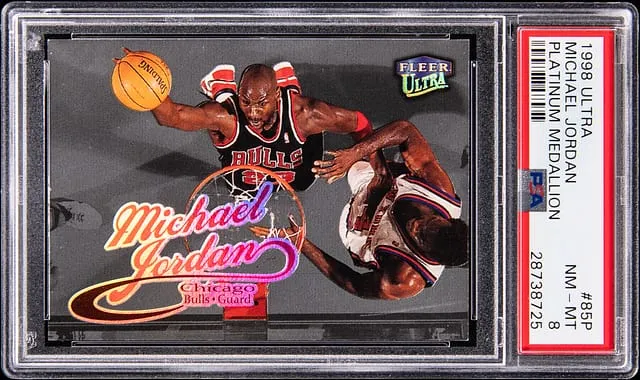
1998-99 Ultra Platinum Medallion Jordan PSA 8 Sale
Goldin sold a 1998-99 Fleer Ultra Platinum Medallion #85P Michael Jordan /99 PSA 8 for $22,570 on May 1, 2026. Here’s what that means for the market.
Sold Card
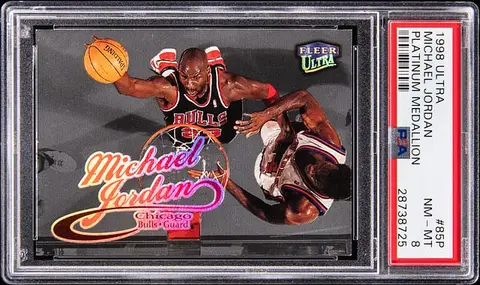
1998-99 Fleer Ultra Platinum Medallion #85P Michael Jordan (#57/99) - PSA NM-MT 8
Sale Price
Platform
Goldin1998-99 Fleer Ultra Platinum Medallion #85P Michael Jordan (#57/99) - PSA 8 Sells for $22,570
On May 1, 2026, Goldin closed a notable late‑90s Michael Jordan parallel: a 1998-99 Fleer Ultra Platinum Medallion #85P, serial numbered 57/99, graded PSA NM-MT 8, at a final price of $22,570.
For collectors who focus on Jordan, ‘90s inserts, or low‑numbered parallels, this is the kind of sale that helps anchor pricing for a thin and highly competitive segment of the market.
The card at a glance
- Player: Michael Jordan
- Team: Chicago Bulls
- Year: 1998-99
- Set: Fleer Ultra
- Parallel: Platinum Medallion
- Card number: #85P
- Serial numbering: /99 (this copy is #57/99)
- Grading company: PSA (Professional Sports Authenticator)
- Grade: NM-MT 8 (Near Mint–Mint)
- Attributes: low-serial parallel, late‑Bulls era Jordan, non-rookie but key ‘90s issue
This is not a rookie card; it’s a premium parallel from the tail end of Jordan’s second three‑peat era. Within ‘90s basketball, Fleer Ultra Medallion parallels—especially Gold and Platinum—are widely treated as cornerstone chase cards.
Why Platinum Medallion Jordan cards matter
Fleer Ultra’s Medallion parallels evolved into some of the most respected insert/parallel runs of the mid‑to‑late ‘90s:
- Bronze / Gold / Platinum structure: By 1998-99, Platinum Medallion sat at the top of the Medallion hierarchy and was the most difficult to pull.
- Low print: Numbered to 99 copies, the Platinum Medallion Jordan is significantly scarcer than most base ‘90s Jordan cards, which were produced in huge quantities.
- Era significance: 1998-99 captures Jordan just after the Bulls’ sixth title and around his second retirement. Cards from this stretch sit at the transition between the end of his Bulls dominance and the start of the modern insert/parallel boom.
- Collector reputation: Among ‘90s Jordan specialists, Ultra Medallion parallels are often discussed in the same breath as other premium, low‑print ‘90s chases (e.g., Metal Universe Precious Metal Gems), albeit generally at more accessible price points.
Because Platinum Medallion parallels are both numbered and visually distinct from the base card, they give collectors the combination of scarcity and recognizability that tends to hold long-term interest.
Understanding the PSA 8 grade
PSA’s NM-MT 8 (Near Mint–Mint) grade signals a card that shows minor wear visible under close inspection—perhaps light corner touches, slight edge flaws, or a faint print or surface issue—but still presents strongly.
For low‑serial ‘90s parallels, many collectors place slightly less emphasis on gem‑mint status than in modern ultra‑high-print sets. When a card is limited to 99 copies and many are lost, damaged, or mis‑handled, simply landing a clean graded copy can be the primary goal. In that context, a PSA 8 is often treated as a solid, collectible grade rather than a consolation prize.
Market context and recent pricing
This sale closed at $22,570 through Goldin on May 1, 2026.
Because population (the total number of graded copies in a given grade) is low and the card is numbered to 99, sales are infrequent. Infrequent sales make “comps” (short for comparable recent sales used as price references) more about ranges than exact matches.
Recent auction and marketplace data for this card and closely related versions show a few consistent patterns:
- Lower grades and raw copies (ungraded or graded below PSA 8) generally trade for noticeably less, reflecting condition risk and eye appeal differences.
- Higher grades (PSA 9 or BGS 9.5, where they appear) command a significant premium when they surface, but they show up rarely due to the inherent fragility and centering challenges of late‑90s inserts and parallels.
- Parallel hierarchy matters: Within the 1998-99 Fleer Ultra run, Platinum Medallion sits as a clear tier above base and lesser Medallion parallels in both desirability and realized prices.
When you compare prior known results for similar Jordan Platinum Medallion issues from adjacent years and grades, a mid‑five‑figure price for a strong PSA 8 example of a /99 Jordan parallel fits within the higher end of expected ranges, but not at an outlier “record shock” level. It’s a confident, data‑supported price in a part of the market where supply is thin and many collectors prefer to hold.
How this sale fits into the broader Jordan and ‘90s insert market
Several larger themes help frame this result:
Continued focus on true scarcity
Over the last few years, the market has tended to reward cards with real, verifiable scarcity—serial numbering, tough pack odds, or both. A /99 Jordan from a respected ‘90s parallel line checks that box.Mature demand for Jordan
Jordan’s status is fully established: no new championships, no new on‑court milestones. Yet his key inserts and low‑numbered parallels continue to see steady demand, especially from collectors who entered or re‑entered the hobby during recent boom cycles and then adjusted their focus toward rarer, higher‑quality pieces.Stabilization after volatility
Many Jordan cards experienced strong run‑ups and pullbacks earlier in the 2020s. The more recent trend has favored relatively stable ranges for genuinely scarce, historically respected issues. This $22,570 result sits within that more measured environment.Grade vs. eye appeal trade‑offs
In the ‘90s insert lane, collectors increasingly talk about eye appeal (how a card looks in hand) alongside the number on the label. A centered, clean‑looking PSA 8 Platinum Medallion can be preferred over a technically higher‑graded example with distracting flaws.
What collectors and small sellers can take from this
For active hobbyists, small sellers, and returning collectors, there are a few practical takeaways:
Know your tier within a player’s market. Not every Jordan card is comparable to a Platinum Medallion /99. Understanding where a card sits in the hierarchy (base, common insert, rare insert/parallel, truly elite issues) helps you interpret sales like this one.
Serial numbering is only part of the story. A card numbered to 99 from a respected late‑‘90s Jordan set is not the same as a /99 parallel from a modern, high‑output release. Set reputation and era matter.
Comps should be contextual. When sales are infrequent, it’s better to look at a band of results across nearby grades and years than to treat any single auction as a definitive benchmark. This Goldin sale is a strong data point, not an automatic reset for every related card.
Grading decisions are more strategic for rare ‘90s cards. For sellers holding raw Ultra Medallion or similar Jordan parallels, the choice to grade—or to cross from one grading company to another—should weigh both condition risk and how often the card realistically appears at auction.
Final thoughts
The May 1, 2026 Goldin sale of the 1998-99 Fleer Ultra Platinum Medallion #85P Michael Jordan (#57/99) in PSA NM-MT 8 at $22,570 reinforces the established status of low-numbered ‘90s Jordan parallels.
It does not radically change the Jordan market on its own, but it adds a clear, recent data point in favor of well‑regarded, truly scarce ‘90s inserts and parallels. For collectors interested in that lane—whether you already own similar cards or are still in the research phase—this result is a useful reference for how the market currently values a key piece of the era.
As always, the most sustainable approach is to use sales like this as information, not as promises—building your collection around cards and eras you understand and genuinely enjoy, with the data as a guide rather than a guarantee.