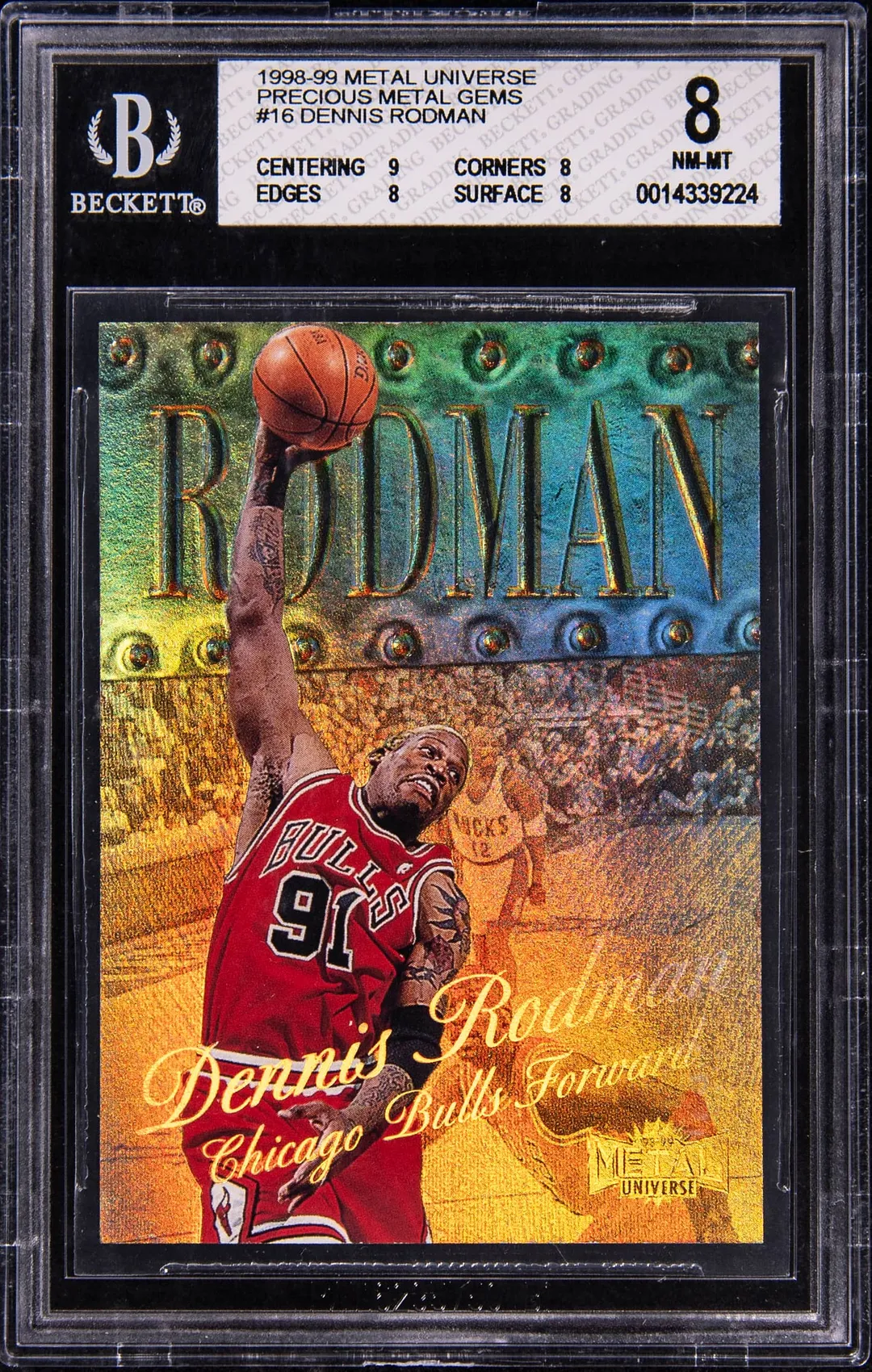
1998-99 Rodman PMG BGS 8 sells for $14,640
Goldin sold a 1998-99 SkyBox Metal Universe PMG Dennis Rodman BGS 8 for $14,640. See how this scarce /50 insert fits the 90s basketball market.
Sold Card
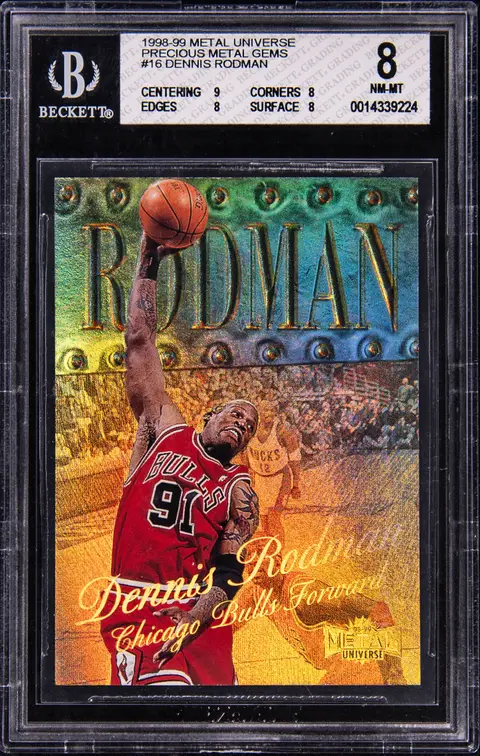
1998-99 SkyBox Metal Universe Precious Metal Gems (PMG) #16 Dennis Rodman (#27/50) - BGS NM-MT 8
Sale Price
Platform
Goldin1998-99 SkyBox Metal Universe Precious Metal Gems (PMG) has become a shorthand in the hobby for “grail-level 90s inserts.” When a big copy surfaces, collectors across eras tend to pay attention.
On February 8, 2026, Goldin sold a 1998-99 SkyBox Metal Universe Precious Metal Gems #16 Dennis Rodman, serial-numbered 27/50 and graded BGS NM-MT 8, for $14,640. For a non-Michael Jordan 90s PMG, that’s a meaningful data point for the market.
In this post, we’ll walk through what this card is, why collectors care, and how this sale fits into recent price trends.
Card at a glance
- Player: Dennis Rodman
- Team on card: Chicago Bulls
- Year: 1998-99
- Set: SkyBox Metal Universe
- Parallel: Precious Metal Gems (PMG)
- Card number: #16
- Serial number: 27/50
- Rookie or key issue? Not a rookie; a key 90s insert/parallel for Rodman
- Era: Late-90s insert era (post–“junk wax,” pre-modern)
- Grading company: Beckett Grading Services (BGS)
- Grade: BGS 8 (NM-MT – Near Mint to Mint)
- Attributes: Low serial-numbered, iconic parallel; no autograph or patch
The PMG line is one of the most recognized and chased parallel runs in basketball card history. While most of the hobby attention typically goes to the 1997-98 PMGs, the 1998-99 Metal Universe PMGs are still viewed as important centerpieces of any serious 90s insert collection.
Why this Rodman PMG matters to collectors
A defining 90s insert run
SkyBox Metal Universe, especially its PMG parallels, sits at the center of the 90s insert boom. These cards combined:
- Striking, sometimes wild, metal-inspired designs
- Tough pack odds relative to base cards
- Serial numbering that directly limited supply
For many collectors who grew up in the 90s, PMGs represent a shift from mass-produced base cards to genuinely scarce, chase-worthy parallels.
Rodman’s unique collector lane
Dennis Rodman occupies a different space than most Hall of Fame–level players:
- Rebounding and defense icon: Five-time NBA champion, seven-time rebounding champion, two-time Defensive Player of the Year.
- Cultural figure: His off-court persona, style, and stories broaden his appeal beyond just Bulls or Pistons fans.
Rodman doesn’t have the same price ceiling as Michael Jordan or Kobe Bryant, but he has a strong, very loyal collector base. That often shows up most clearly in his best 90s inserts and key parallels, where true supply is tight and many copies are locked away in long-term collections.
This 1998-99 PMG is one of Rodman’s more important late-career, Bulls-era parallels.
Understanding the 1998-99 Metal Universe PMGs
While 1997-98 PMGs are the best-known, the 1998-99 Metal Universe Precious Metal Gems run is still widely respected for a few reasons:
Low serial numbering: This Rodman is numbered 27/50. A print run of just 50 copies creates built-in scarcity. Once you factor in:
- Condition issues (chipping, edges, surfaces)
- Cards lost, damaged, or never graded the realistic available supply for serious collectors is even lower.
90s construction and condition sensitivity: Metal Universe cards are known for:
- Edge and corner wear
- Surface scratches, especially under strong lighting These factors help explain why a BGS 8, which might feel "mid-grade" in ultra-modern cards, can still be very respectable for late-90s inserts.
Era transition: 1998-99 sits at an interesting point:
- Post–Jordan Bulls dynasty end
- Pre-explosion of serial-numbered parallels in the 2000s That transition gives the set added historical relevance as a bridge between classic 90s inserts and modern parallel-heavy products.
The grade: BGS 8 (NM-MT)
Beckett’s BGS grading scale is commonly used in the 90s insert world. A BGS 8 (Near Mint–Mint) isn’t a gem mint grade, but for condition-sensitive 90s PMGs, it can still be quite desirable.
Why collectors still value an 8 on this type of card:
- Scarcity first, grade second: With only 50 copies ever produced, many collectors will prioritize owning a copy at all over holding out indefinitely for a 9 or 9.5.
- Eye appeal matters: A strong-looking BGS 8 with good centering and clean surfaces but minor edge or corner wear can still present very well in hand.
The actual BGS subgrades (centering, corners, edges, surface) can further influence value within the grade, but the headline point remains: a BGS 8 for a 1998-99 PMG is a serious card.
Market context and recent sales
This copy sold at Goldin on February 8, 2026 for $14,640.
When we talk about “comps” (short for comparables), we mean other recent sales of the same card, or very similar versions, that help us understand the current market range.
For this Rodman PMG, relevant comps include:
- Same card, different grades: Other BGS 7–9 or PSA equivalents
- Same player, different PMG years: 1997-98 PMGs, or other high-end 90s Rodman inserts
- Similar-tier 90s stars in 1998-99 PMG: Non-Jordan, non-Kobe players of similar hobby profile
Across major marketplaces and auction houses, copies of this exact card in a BGS 8 or similar grade appear infrequently. That’s a key point: with only 50 serial-numbered copies and many likely held long-term, true, up-to-date comps are limited.
From what is visible in public data:
- Sales frequency is low. Months or even years can pass between appearances of the same grade.
- Price tends to move in steps, not tiny increments. Because so few copies surface, each sale can reset expectations rather than just mildly adjust them.
Within that context, $14,640 for a BGS 8 feels like a serious, but not outlandish, figure for:
- A key 90s insert parallel
- Of a Hall of Fame, culturally significant player
- In a low, fixed serial run of 50
It aligns with the broader trend where high-end 90s inserts and PMGs for non-Jordan stars have established a clearly premium lane, separate from both typical base cards and most modern parallels.
Because public, same-grade, same-card transactions are sparse, it’s more accurate to treat this sale as:
- A fresh marker for what the market was willing to pay in early 2026
- A reference point rather than a precise price formula
How this sale fits broader 90s insert trends
Several longer-term hobby themes help explain results like this:
Mature appreciation of 90s inserts: The hobby has had years to:
- Understand true scarcity
- Identify which sets and parallels stand the test of time PMGs, along with a small group of other 90s brands and inserts, consistently sit near the top of that list.
Stable player legacy: Dennis Rodman’s Hall of Fame status, documentary exposure, and cultural footprint are already well established. There isn’t the same boom-and-bust cycle you might see in speculative modern players.
Focus on set pedigree: Collectors are increasingly valuing the reputation of the set itself:
- 1997-98 and 1998-99 Metal Universe PMGs have long-term recognition.
- That set-level prestige carries individual cards, especially for iconic names like Rodman.
This Goldin sale reflects those dynamics: not a speculative spike, but an example of focused demand for a specific lane—elite 90s inserts of major names in low serial runs.
Takeaways for collectors and small sellers
If you’re newer to 90s inserts or coming back to the hobby, this sale highlights several useful concepts:
Serial numbering and true supply: A card numbered to 50 isn’t just “rare” in theory. In practice, only a fraction will:
- Surface publicly
- Grade well
- Be available for sale at any given time
Set and era matter as much as the player: A mid- or high-tier Hall of Famer in a legendary set can sometimes outperform a bigger-name player in a forgettable or overproduced product.
Grades aren’t everything: On fragile 90s inserts, a BGS 8 or PSA 8 can still be a strong, highly liquid grade. Eye appeal and scarcity often matter as much as the number on the label.
Price context, not predictions: This $14,640 result from Goldin on February 8, 2026 doesn’t guarantee future values. It simply provides a recent, concrete data point for how the market currently views:
- 1998-99 PMG Rodman
- BGS 8 condition
- The broader lane of iconic 90s parallels
Final thoughts
The 1998-99 SkyBox Metal Universe Precious Metal Gems #16 Dennis Rodman (#27/50, BGS 8) sale at Goldin for $14,640 is a clean snapshot of where high-end 90s insert collecting stands in 2026:
- Collector demand remains strong for low-serial PMGs.
- Rodman’s best cards continue to carve out a distinct space, fueled by both on-court legacy and cultural relevance.
- Condition-sensitive 90s inserts in respectable mid-high grades command meaningful premiums, even outside the very top superstars.
For collectors building a focused 90s insert or Bulls PC (personal collection), or for small sellers trying to understand why certain 90s cards command five-figure results while others don’t, this Rodman PMG is a clear example of how era, set pedigree, serial numbering, and player story all converge into one key card.
As always, treat this sale as one piece of the puzzle. Track multiple sales over time, pay attention to condition and eye appeal, and collect the cards and stories that matter most to you.