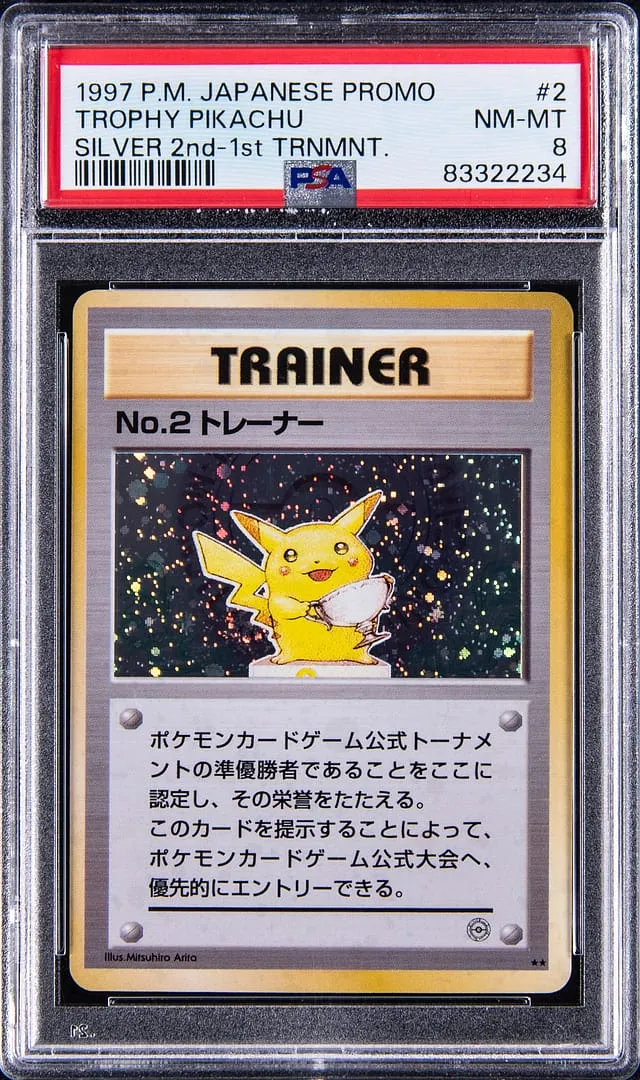
1997 Trophy Pikachu Silver PSA 8 Sells for $359,900
Goldin sold a 1997 Japanese Trophy Pikachu Silver 2nd Place PSA 8 for $359,900. See how this key promo fits into the high-end Pokémon market.
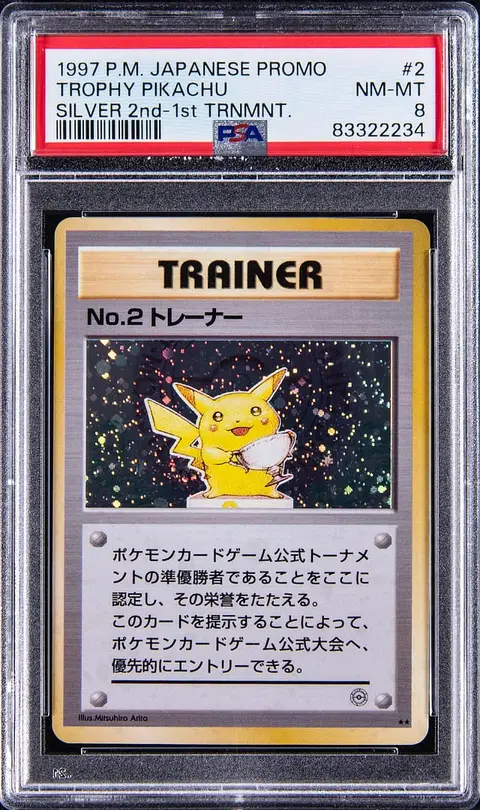
Sold Card
1997 Pokemon Japanese Promo Silver 1st Tournament #2 Trophy Pikachu, Silver 2nd Place - PSA NM-MT 8
Sale Price
Platform
Goldin1997 Pokemon Japanese Promo Silver 1st Tournament #2 Trophy Pikachu, Silver 2nd Place - PSA NM-MT 8: Market Review
On March 8, 2026 (UTC), Goldin sold a 1997 Pokemon Japanese Promo Silver 1st Tournament #2 Trophy Pikachu, Silver 2nd Place, graded PSA NM-MT 8, for $359,900. For a niche, late‑90s Japanese promo, that number immediately raises two questions for collectors:
- What exactly is this card?
- How does this sale fit into the broader Trophy Pikachu market?
Below is a structured look at the card, its context, and what this sale might mean for collectors following high‑end Pokémon.
Card overview
Card details
- Character: Pikachu (Trophy Pikachu artwork)
- Year: 1997
- Origin: Japanese promotional card
- Event: 1st Official Pokémon Card Game Tournament (Japan)
- Placement: Silver 2nd Place Trophy
- Card: Often cataloged as “1997 Japanese Promo Silver 1st Tournament #2 Trophy Pikachu”
- Category: Ultra‑rare tournament prize card, widely considered a key grail‑level issue
- Era: Early Pokémon era (pre‑English Base Set launch in many markets)
Grading details
- Grading company: PSA (Professional Sports Authenticator)
- Grade: NM‑MT 8 (Near Mint–Mint)
- Attributes: No serial numbering on the card itself, but functionally extremely low print and distribution; awarded only to top finishers at the 1997 event.
This is not a pack‑pulled card. It was awarded as a prize at an official Japanese tournament, which dramatically limits how many copies were ever produced and distributed. Within the hobby, Trophy Pikachu cards from the earliest Japanese events are treated less like standard chase cards and more like historical artifacts from the birth of competitive Pokémon.
Why collectors care about Trophy Pikachu
Early competitive Pokémon history
The 1997 Japanese Trophy Pikachu promos are among the earliest officially sanctioned Pokémon tournament prize cards. They sit at the intersection of:
- The very beginning of the Pokémon Trading Card Game
- Organized play and tournament culture
- Early, non‑pack‑pulled promos that were essentially unobtainable through normal collecting
For many collectors, this makes Trophy Pikachu one of the most important non‑set releases in the entire Pokémon hobby.
Extreme scarcity
Exact print figures are not publicly confirmed, but distribution was limited to a very small number of top‑finishing players. That means:
- Very few copies exist to begin with.
- Even fewer survived in high grade.
Population reports ("pop reports" – grading company counts of how many copies they’ve graded at each grade) for these cards are typically in the single digits or low double digits per variant and grade. That’s a different world from even most chase cards from the same era.
Distinction among variants
Within the 1997 Trophy Pikachu family, collectors distinguish between placements and years:
- Gold (1st Place)
- Silver (2nd Place)
- Bronze (3rd Place)
The Silver 2nd Place sits in the middle from a prestige standpoint. While Gold is the traditional top prize and usually carries the highest cachet, Silver is still an elite award from the same foundational event and commands major attention when it surfaces.
Market context and recent sales
Because this market is thin – meaning very few transactions occur – each sale can vary significantly in price depending on timing, visibility, and buyer competition. For this analysis, we can look at:
- Past sales of 1997 Trophy Pikachu cards across different placements
- Grade differences (PSA 7 vs 8 vs 9)
- Market conditions around each sale
Thin comp environment
“Comps” (short for comparables) are past sales of the same or similar items used to understand current price levels. In the case of the 1997 Trophy Pikachu Silver 2nd Place:
- Exact PSA 8 sales are very rare.
- Many past transactions, especially years ago, were private or through less‑visible channels.
What we can say from available public auction history across major houses (including Goldin, Heritage, and others) is that:
- Trophy Pikachu cards have achieved prices from the low six figures to well into the high six figures, depending on year, placement, and grade.
- Records have typically been set by the highest grades and/or most desirable placements (often Gold 1st Place, especially from the earliest years).
Positioning of this $359,900 sale
This Goldin result at $359,900 for a PSA 8 Silver 2nd Place aligns with the broader pattern of:
- Top‑tier trophy cards trading at substantial premiums to standard set cards, even key 1st Edition holos.
- Material price separation between:
- PSA 9 and 10 examples (where they exist) and
- Mid‑to‑high grades such as PSA 7–8.
Based on public information:
- This price is firmly in the high‑end range for early trophy cards, though some Gold 1st Place copies in higher grade have sold higher.
- The sale is consistent with the idea that even non‑Gold placements remain firmly entrenched in the six‑figure tier when they surface.
Because transaction data is sparse and dates/conditions vary, it’s more accurate to view $359,900 as part of a band of recent high‑end trophy outcomes rather than a clean “up” or “down” signal by itself.
Grade, condition, and population
What PSA 8 means here
PSA’s NM‑MT 8 grade indicates a strong card with only minor wear visible under close inspection. In many mass‑produced sets, PSA 8 would be considered a mid‑range grade. For early trophy cards, context matters:
- These cards were not packed out in protective sleeves or cases.
- They were awards, sometimes handled and stored like mementos rather than sealed collectibles.
As a result, a PSA 8 Trophy Pikachu from 1997 can be seen as:
- A high‑end representative condition for a card with such limited distribution.
- A more accessible (relative term) option than a hypothetical PSA 9 or 10, where populations are often extremely low or even non‑existent.
Population realities
While exact pop report numbers can change as new cards are graded or re‑submitted, the general picture remains:
- Very low populations in any grade
- Even lower in high grades like PSA 8 and above
Scarcity at the population level is one of the main reasons comps are so irregular. A single additional buyer or a single card coming to market can shift realized prices significantly in either direction.
How this sale fits into the broader Pokémon market
Early promo and trophy card segment
The Pokémon market can roughly be split into several segments:
- Pack‑pulled set cards (Base, Neo, EX era, etc.)
- Special promos (magazine inserts, movie promos, event promos)
- Trophy/prize cards (like Trophy Pikachu)
Trophy cards occupy the smallest, most specialized niche. This $359,900 sale reinforces a few ongoing themes in that niche:
- Historical cards from the late 1990s maintain deep collector interest. Even as attention moves across modern sets and new releases, truly early, important promos continue to command strong results.
- Event‑tied provenance matters. Cards linked to the earliest organized play events tend to be discussed in the same breath as some of the most historically important pieces in the hobby.
- Market depth is thin but committed. There may not be many active bidders at this level, but those who participate are typically very focused on specific grail cards.
Comparison with mainstream grails
When compared to widely recognized grails like:
- 1998 Japanese Promo Pikachu Illustrator
- 1st Edition Base Set Charizard in high grade
Trophy Pikachu sits in a similar tier of conversation, but with:
- Lower visibility to casual collectors
- Even tighter supply
The result is a market where public sales are notable events and each auction can reset expectations about what these cards can realistically achieve.
Takeaways for different types of collectors
New or returning collectors
If you’re newer to the hobby, a six‑figure Trophy Pikachu can feel distant from everyday collecting. Still, it provides useful perspective:
- Not all rarity is printed on the card (like serial numbers). Sometimes it comes from how the card was distributed.
- Early promos and event cards can be just as historically important as anything pulled from a pack.
Watching sales like this helps you learn the structure of the market, even if you’re collecting far more affordable pieces.
Active hobbyists and small sellers
For those more embedded in the hobby, this sale offers a few practical insights:
- Trophy and high‑end promo liquidity remains event‑driven. When a major auction house like Goldin brings a piece like this to market, it can draw out both existing and new bidders.
- Condition nuance is critical. For ultra‑rare cards, the difference between PSA 7, 8, and 9 can be meaningful but not necessarily linear; buyer preferences vary depending on how often they expect to see another copy at any grade.
- Price memory can be sticky. A sale at this level becomes a reference point for future negotiations, even in private sales.
Long‑term hobby perspective
Rather than reading one result as a directional call, it’s more useful to see this Goldin sale as another data point confirming:
- The continued recognition of early Japanese tournament promos as key pieces of Pokémon history.
- The willingness of collectors to allocate significant capital to historically important, ultra‑scarce cards even in a mature market environment.
Summary
The 1997 Pokemon Japanese Promo Silver 1st Tournament #2 Trophy Pikachu, Silver 2nd Place – PSA NM‑MT 8 that sold at Goldin on March 8, 2026 (UTC) for $359,900 sits near the peak of the Pokémon market’s historical tier.
With:
- Deep roots in the earliest days of organized Pokémon play
- Exceptionally low supply
- A strong PSA 8 grade in a category where any graded example is rare
this sale reinforces the status of Trophy Pikachu as one of the cornerstone cards for advanced Pokémon collectors. For the rest of the hobby, it’s a reminder that behind the booster packs and modern releases lies a small, tightly held group of cards that capture the very beginning of the game’s competitive history.
—
figoca tracks important trading card sales across sports, TCGs, and pop culture, helping collectors understand not just the headlines, but the context behind them.