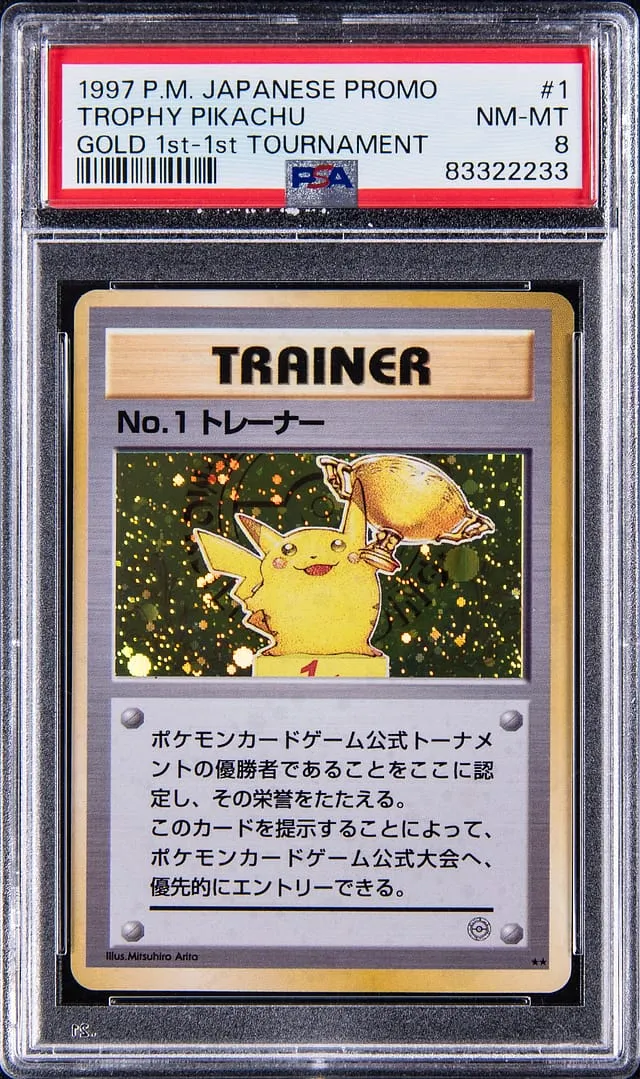
1997 Trophy Pikachu Gold 1st Place Sells for $982K
Breakdown of the $982,100 Goldin sale of a 1997 Japanese Gold 1st Place Trophy Pikachu PSA 8 and what it means for high-end Pokémon cards.
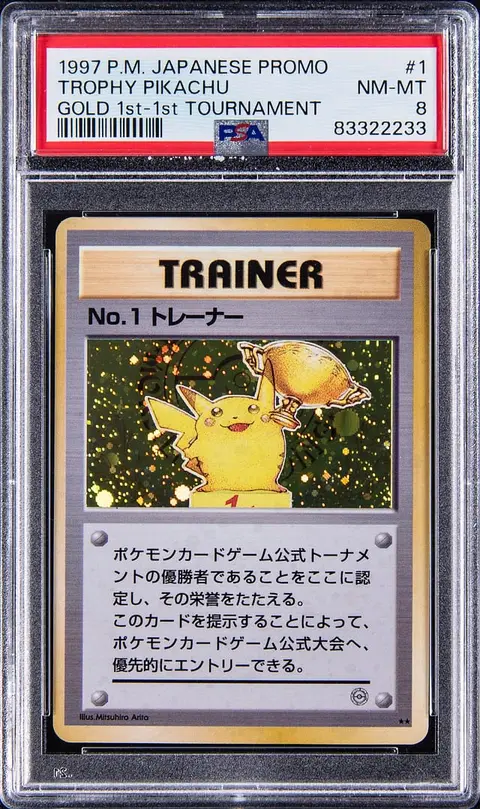
Sold Card
1997 Pokemon Japanese Promo Gold 1st Place 1st Tournament #1 Trophy Pikachu - PSA NM-MT 8
Sale Price
Platform
Goldin1997 Pokemon Japanese Promo Gold 1st Place 1st Tournament #1 Trophy Pikachu - PSA NM-MT 8 quietly changed hands at Goldin on March 8, 2026 for $982,100. For most collectors, this is the kind of card you read about, not one you expect to see on the open market.
In this article, we’ll walk through what this card actually is, why it matters, and how this sale fits into the broader Trophy Pikachu market.
What exactly is this Trophy Pikachu?
- Character: Pikachu
- Year: 1997
- Set / Issue: Japanese Promo – 1st Tournament Trophy Card
- Version: Gold 1st Place
- Card number: #1
- Type: Trophy / prize card (not pack-issued)
- Grading company: PSA
- Grade: NM-MT 8 (Near Mint–Mint)
The 1997 Trophy Pikachu cards were awarded at one of the earliest officially organized Pokémon tournaments in Japan. These are not traditional set cards; they were given as prizes to top finishers, which makes them true trophy cards – cards you could only obtain by actually winning or placing in a major event.
Among Trophy Pikachu variants, the Gold 1st Place version is at the very top of the hierarchy. It represents first place at the 1997 tournament, and hobby consensus is that only a small number were ever produced and awarded.
From a collector’s standpoint, this is not a “rookie card” in the sports sense, but it functions as an early, historically important Pikachu promo tied directly to competitive play. It sits in the “grail” category for high-end Pokémon collectors.
Grading and population context
This copy is graded PSA NM-MT 8.
- PSA’s 1–10 scale defines 8 as Near Mint–Mint: clean overall, with only minor wear.
- For ultra-rare trophy cards, even mid-to-high grades are extremely strong because so few exist to begin with.
Population reports (often called pop reports, or the census of how many copies exist in each grade) for 1997 Trophy Pikachu are extremely small compared to normal set cards. While exact numbers can shift as new submissions are graded, the key point is that the pool of graded examples is measured in single digits to very low double digits across all grades and variants, not hundreds or thousands.
In practice, that means:
- The market almost never has multiple copies available at the same time.
- Collectors generally evaluate each appearance on its own merits (grade, eye appeal, provenance) rather than comparing against a deep, active market.
The Goldin sale: $982,100 on March 8, 2026
This particular Gold 1st Place 1997 Trophy Pikachu #1, PSA 8, sold at Goldin on March 8, 2026 (UTC) for $982,100.
The result is striking on the surface, but to understand it, you need to place it in context with a very thin sales history.
How does this price compare to past sales?
For cards at this level, “comps” (comparable recent sales, often used as a reference point) are limited:
- 1990s Trophy Pikachu cards appear very infrequently at public auction.
- When they do sell, it is often:
- A different year’s trophy (e.g., 1998 or 1999),
- A different placing (2nd or 3rd place), or
- A different grade.
From public information about past high-end Pokémon auctions, we can say:
- Trophy Pikachu cards – especially 1997 copies – have previously sold in the hundreds of thousands of dollars range, with standout results occasionally approaching or exceeding the million-dollar mark for top examples.
- Higher or lower grades, and different variants (silver/bronze or later-year trophies), have naturally produced a spread of realized prices around those levels.
Within that framework, $982,100 for a Gold 1st Place 1997 Trophy Pikachu in PSA 8 sits toward the upper end of known public results for the broader Trophy Pikachu family, and firmly within the range that serious collectors would expect for a top-tier early Pokémon trophy.
Because public sales are so infrequent and the card is so unique, it is more accurate to say this result is a strong, but not out-of-line, confirmation of the card’s status rather than an obvious outlier.
Why collectors care so much about 1997 Trophy Pikachu
There are a few reasons this card has held a special place in the hobby.
1. It’s part of Pokémon’s competitive origin story
The 1997 trophy events belong to the very first wave of organized Pokémon competition in Japan. Cards awarded at these events are:
- Among the earliest official Pokémon promos tied to specific tournaments.
- Physical artifacts of the franchise’s transition from a new game to a competitive scene.
For collectors who focus on the history of the game itself, this is as foundational as it gets.
2. Extreme scarcity by design
Unlike mass-produced set cards, trophy cards were never meant for broad distribution.
- Only top finishers at a single event in 1997 could receive this specific Gold 1st Place card.
- Surviving copies depend on how winners stored or preserved their prizes.
That combination – low original print quantity and uncertain long-term survival – is what drives the scarcity. Population reports and auction histories both reinforce the idea that only a very small number are in collectors’ hands today.
3. Pikachu as the franchise icon
Pikachu is the face of Pokémon, which adds another layer of demand. For character-focused collectors, the 1997 Trophy Pikachu promos sit at the top of the Pikachu hierarchy, ahead of standard set cards and many later promos.
4. 1990s era appeal
In trading card terms, this is a late-1990s issue – essentially the vintage era for Pokémon.
- The older the card and the more central it is to the brand’s history, the more long-term interest it tends to attract.
- Condition expectations are different than for modern ultra-rare cards. A PSA 8 from 1997, especially for a trophy piece, is often viewed as very respectable.
What this sale tells us about the high-end Pokémon market
The Goldin result doesn’t rewrite the story of Trophy Pikachu, but it does provide a useful data point.
Confirmation of sustained demand
Nearly three decades after the card was issued, a sub-million population card tied to an early Japanese tournament still commands just under $1,000,000 in open bidding.
That suggests:
- There is still an active pool of serious collectors and institutions willing to compete for historically significant Pokémon pieces.
- Top-tier trophy cards remain in their own lane, separate from the more volatile segments of the hobby.
Thin but resilient price discovery
Because only a handful of these cards come to auction over many years, pricing is more about occasional checkpoints than continuous market tracking.
- Each sale, like this one at Goldin on March 8, 2026, becomes a reference point others will look back to.
- Future buyers and sellers of 1997 Trophy Pikachu – or comparable high-end trophies – will likely cite this result as a benchmark, while still adjusting for grade, eye appeal, and broader market conditions at the time.
Separation from broader market swings
Over the last few years, the Pokémon market has gone through phases of rapid growth, correction, and stabilization. Mass-produced set cards and newer chase cards have seen more day-to-day volatility.
High-end trophy cards like this one tend to:
- Trade hands much less often,
- Rely on a smaller, more targeted buyer base,
- Move more in response to individual collector priorities than to short-term speculation cycles.
The nearly $1M realized price at Goldin reflects that trophy pieces follow their own cadence, even as the broader hobby ebbs and flows.
Takeaways for different types of collectors
For new and returning collectors
You don’t need a Trophy Pikachu to enjoy the hobby, but understanding why this card matters can help you:
- See the historical backbone of the Pokémon market.
- Recognize the difference between mass-produced rares and truly limited tournament-issued promos.
When you see high prices for cards like this, you’re mostly seeing the impact of:
- Extremely low supply,
- Deep historical significance,
- Focused demand from a small set of advanced collectors.
For active hobbyists and small sellers
A sale like this is useful for market context:
- It reinforces the long-term importance of early Japanese promos and tournament cards.
- It highlights how provenance and story – who got the card, when, and why – can matter as much as raw aesthetics.
When evaluating your own cards, keep in mind:
- Scarcity isn’t just about pack odds. Distribution method (prize vs. pack vs. mail-in) can be critical.
- Population reports, sale histories, and the card’s role in the brand’s story are all key pieces of the puzzle.
Final thoughts
The 1997 Pokemon Japanese Promo Gold 1st Place 1st Tournament #1 Trophy Pikachu – PSA NM-MT 8 sale at Goldin on March 8, 2026 for $982,100 is another reminder of how deep the Pokémon market’s roots go.
It’s not simply a rare card; it’s a trophy tied to the earliest organized play era, featuring the franchise’s flagship character, surviving nearly three decades in high grade.
For most collectors, this card will remain something to study rather than to own. But understanding why it commands this level of attention can sharpen how you look at everything from low-pop promos to modern chase cards – and how you think about rarity, history, and demand across the hobby.