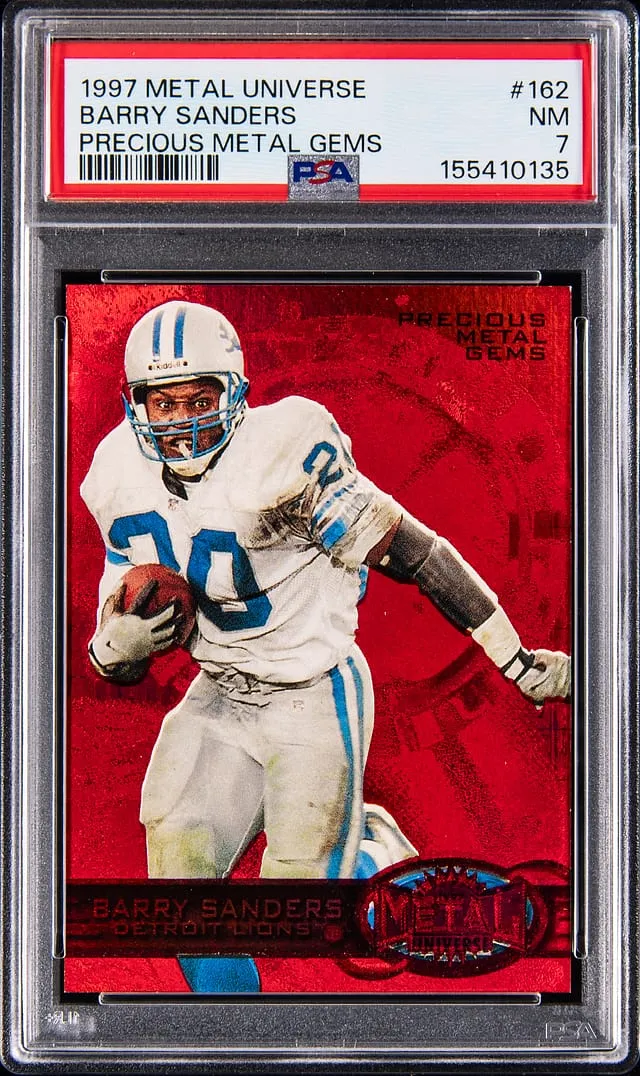
1997 PMG Red Barry Sanders PSA 7 sells for $34,167
Goldin sold a 1997 SkyBox Metal Universe PMG Red Barry Sanders PSA 7 for $34,167. See how this key 90s insert fits into the current football card market.
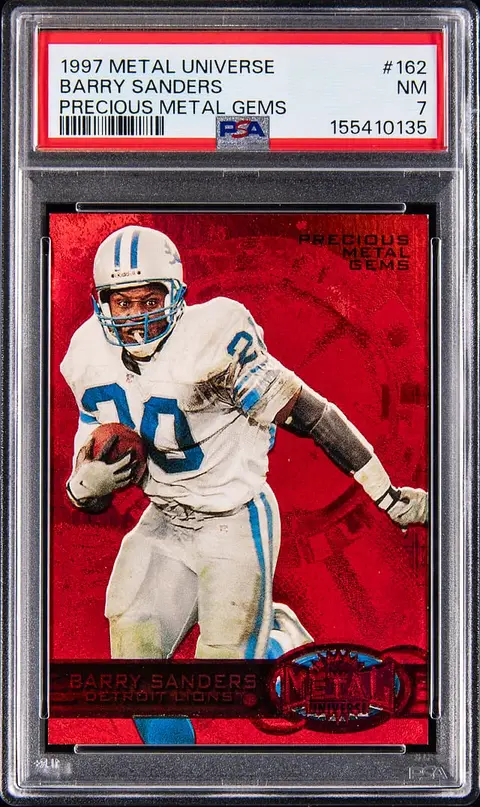
Sold Card
1997 SkyBox Metal Universe Precious Metal Gems (PMG) Red #162 Barry Sanders (#086/150) - PSA NM 7
Sale Price
Platform
Goldin1997 SkyBox Metal Universe Precious Metal Gems (PMG) cards sit near the top of many football collectors’ wish lists, and Barry Sanders is one of the pillars of that checklist. A recent Goldin sale put a fresh data point on this grail.
On May 10, 2026, Goldin sold a 1997 SkyBox Metal Universe Precious Metal Gems Red #162 Barry Sanders, serial numbered 086/150, graded PSA NM 7, for $34,167.
In this post, we’ll break down what this card is, why it matters, and how this sale fits into the broader market for Barry Sanders PMGs.
The card at a glance
Full title: 1997 SkyBox Metal Universe Precious Metal Gems Red #162 Barry Sanders (#086/150) – PSA NM 7
Player: Barry Sanders, Detroit Lions (Hall of Fame running back)
Year / Set: 1997 SkyBox Metal Universe Football
Parallel: Precious Metal Gems Red (serial numbered to 150)
Card number: #162
Serial number: 086/150 (stamped on the card)
Grading company: PSA (Professional Sports Authenticator)
Grade: NM 7 (Near Mint)
This is not a rookie card—Barry Sanders’ rookies are from 1989—but this PMG is widely treated as a key issue for his high‑end collecting market. It combines:
- An all‑time great Hall of Famer
- A famously tough and condition‑sensitive 1990s insert
- A low‑serial‑number parallel from a landmark set
In short, this is one of the defining 1990s Barry Sanders cards.
Why 1997 Precious Metal Gems matter
The 1997 Metal Universe Precious Metal Gems (PMG) parallels are among the most recognizable 1990s inserts across both basketball and football.
A quick overview of why collectors care:
- Low print run: PMG Reds are numbered to 150 copies. For many players, that’s effectively the key serial‑numbered card of the era.
- Condition sensitivity: The colored foil edges and easily chipped surfaces make high grades rare. Even a PSA 7 can be tough.
- Distinctive design: The Metal Universe aesthetic—layered, sci‑fi backgrounds and full‑bleed foil—has become iconic.
- Cross‑sport legacy: 1997 PMGs in basketball (e.g., Michael Jordan, Kobe Bryant, Tim Duncan) helped define the modern “grail insert” concept; football PMGs benefit from that same aura.
Within 1990s football, 1997 PMGs sit in the same conversation as Contenders rookie tickets, SP Authentic autos, and other key parallels when hobbyists talk about “true 90s grails.”
Market context for Barry Sanders PMGs
When looking at a sale like this, collectors often want “comps”—short for “comparable sales.” Comps are past sales of the same card or very similar versions used to understand where a new result fits.
For the 1997 PMG Red Barry Sanders, collectors typically compare:
- Same card, different PSA grades (6, 7, 8, and above)
- The much rarer PMG Green version (the first 15 copies)
- Other high‑end 1990s inserts of Barry Sanders from brands like Flair, EX, and others
While exact recent sales data for every grade can vary and may not be public for each copy, the general pattern in the hobby has been:
- PMG Greens of key Hall of Famers have reached very strong numbers due to just 15 copies existing.
- PMG Reds typically sit below Greens but still command strong prices, especially in clean copies and PSA 7 or better.
- Condition issues are common: chipping along edges, surface scratching, and centering all hold many copies in the PSA 5–7 range.
This Goldin sale at $34,167 for a PSA 7 sits in the upper tier of 1990s Barry Sanders cards more broadly and reflects the premium that collectors place on PMGs relative to other inserts.
Because the population of graded copies is small and each auction can feature a different looking example (eye appeal, centering, color), prices can move more on a card‑by‑card basis than on a smooth curve.
Understanding the PSA 7 grade on this card
PSA’s “NM 7” (Near Mint) generally means:
- Minor wear visible at close inspection
- Some chipping or edge wear (which is common for PMGs)
- Overall strong presentation, but not sharp enough for an 8 or higher
For 1997 PMG Reds, a PSA 7 is often seen as a respectable grade rather than a disappointment. Many raw (ungraded) copies, if submitted, might fall into the 5–7 range due to how fragile the foiling is.
Collectors sometimes look at:
- Pop report: Short for “population report,” which is the grading company’s count of how many copies exist in each grade. On niche, low‑print cards like this, the pop report is typically small, meaning even mid‑high grades can be relatively scarce.
- Eye appeal: Centering, color, and surface shine. Two PSA 7s can look quite different, and that can influence sale prices.
Within that context, this $34,167 result suggests that buyers are comfortable paying a strong premium for a solid, graded example in the mid‑high tier, especially when it appears in a major auction house like Goldin.
1990s era, scarcity, and demand
The 1997 Metal Universe PMGs come from the late 1990s, often called the tail end of the “junk wax” era but before today’s ultra‑modern print explosion.
Key traits of that era for this card:
- True scarcity: While base cards were heavily printed, inserts like PMGs had defined low serial numbers (150 in this case).
- Survivorship: Not all 150 copies of any given player’s PMG survived in collectible condition. Some were lost, damaged, or never graded.
- Growing nostalgia: Many current collectors watched Barry Sanders in real time. As they return to the hobby with more disposable income, high‑end 90s inserts are often the target.
Barry Sanders himself remains a central figure in football collecting:
- Widely considered one of the most electric running backs ever
- Hall of Famer with a shorter but spectacular career
- No major off‑field controversies that would overshadow his cardboard
That stability helps keep focus on the card itself: the combination of player, era, and parallel.
How this sale fits into the broader PMG landscape
Context helps this sale make sense:
- Across sports, 1997 PMGs of cornerstone names (Jordan, Kobe, key Hall of Fame football players) continue to underpin the high‑end insert market.
- Football has historically lagged basketball in price, but key players like Barry Sanders, Jerry Rice, and others have seen increased attention in the last several years.
- As more collectors refine their PCs (personal collections) toward quality over quantity, these true low‑number, era‑defining inserts have drawn steady interest.
Within that environment, a $34,167 sale for a PSA 7 Barry Sanders PMG Red aligns with the idea that:
- This is one of his clear “grail” non‑rookie cards.
- Condition‑sensitive, low‑serial 1990s inserts continue to be treated as long‑term hobby cornerstones rather than trend pieces.
Exact prior sale prices for this specific grade and card may vary due to timing, auction house, and specimen quality, but this Goldin result reinforces the card’s standing near the top of the Barry Sanders hierarchy.
Takeaways for collectors and small sellers
A few practical notes if you’re interested in this card or similar 1990s inserts:
- Expect big spreads between grades. On a fragile card like this, PSA 5 vs 7 vs 9 can mean very different price levels. Even half‑grade changes can matter.
- Eye appeal matters. Two NM 7s can sell differently based on centering, foil chipping, and surface gloss. High‑resolution photos and scans are essential.
- Know your comps, but accept gaps. With only 150 copies and a small graded population, you won’t see constant sales. When comparing, look at:
- Same card, closest possible grade
- Recent sales at similar auction houses
- Overall market tone for 1990s PMGs of comparable Hall of Famers
- Be cautious with raw copies. Raw PMGs can hide surface issues that are only obvious in hand. If you’re buying raw with the intent to grade, build that uncertainty into what you’re willing to pay.
The May 10, 2026 Goldin auction doesn’t rewrite the story of 1997 PMGs, but it does add an important chapter: another confirmed strong result for a cornerstone Barry Sanders card in PSA 7.
For collectors who focus on 1990s inserts, this sale underlines what many already believe: the 1997 SkyBox Metal Universe Precious Metal Gems Red #162 Barry Sanders remains one of the defining cards of an era where design, scarcity, and player greatness intersected in a way the hobby still chases today.