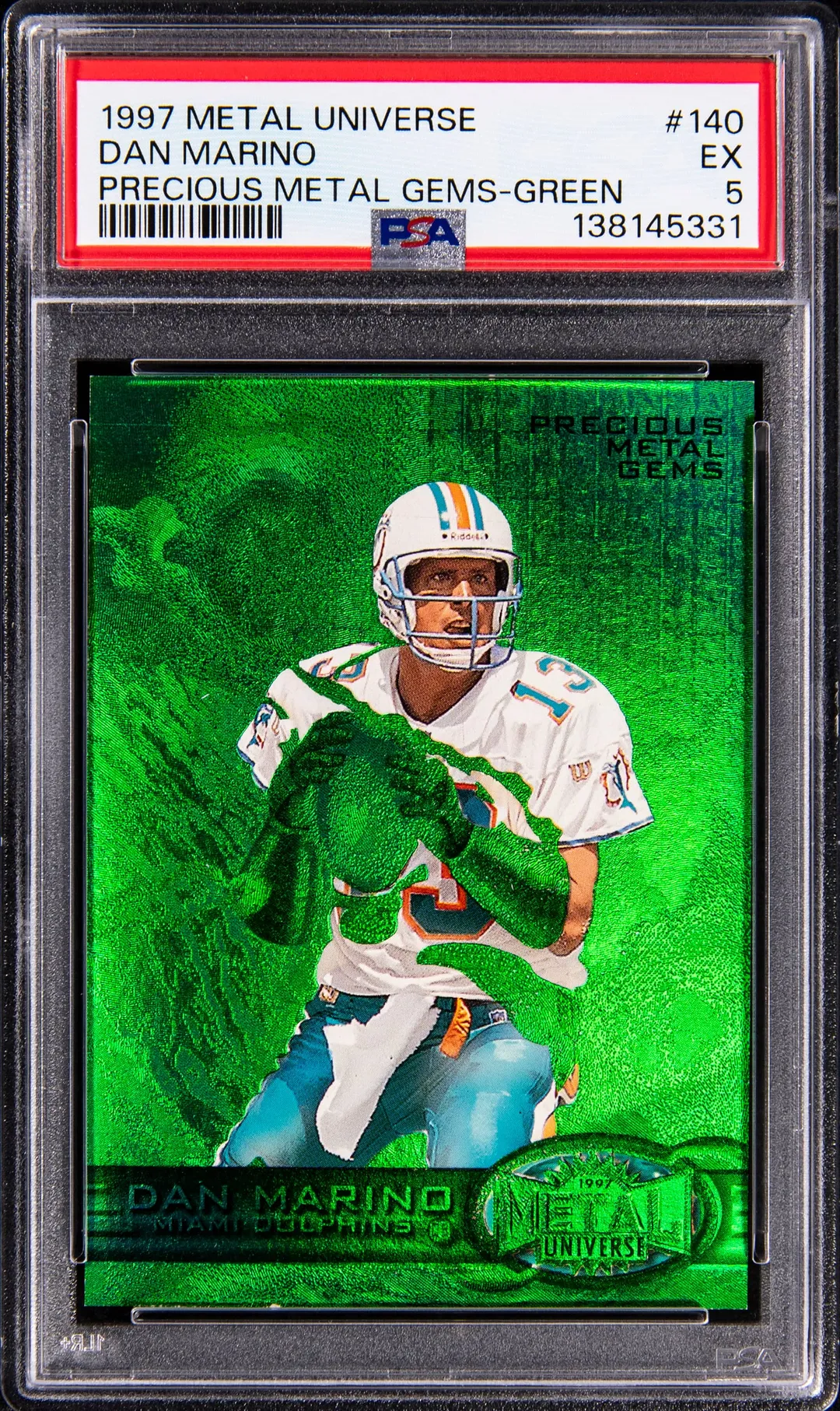
1997 PMG Green Dan Marino PSA 5 sells for $34K
Figoca reviews the $34,160 Goldin sale of the 1997 SkyBox Metal Universe Precious Metal Gems Green Dan Marino PSA 5.
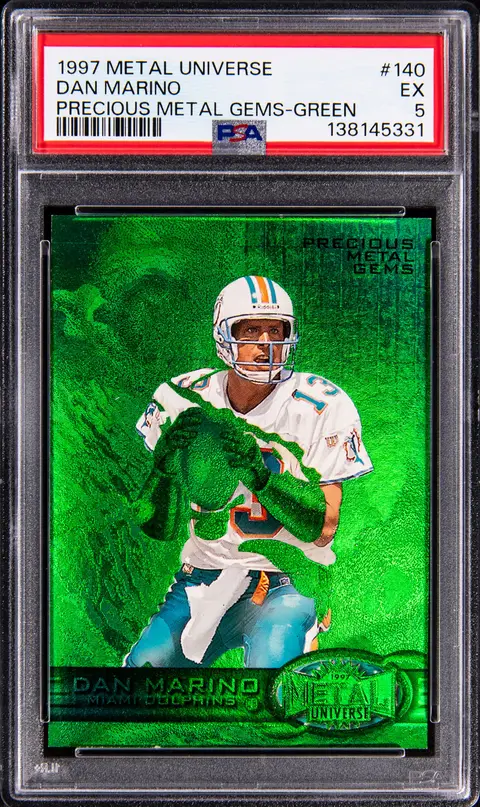
Sold Card
1997 SkyBox Metal Universe Precious Metal Gems (PMG) Green #140 Dan Marino (#012/150) - PSA EX 5
Sale Price
Platform
Goldin1997 SkyBox Metal Universe Precious Metal Gems (PMG) Green cards sit at the intersection of 90s nostalgia and true scarcity. A copy of the Dan Marino Green, card #140, serial-numbered 012/150 and graded PSA EX 5, just sold at Goldin on 2/08/26 for $34,160. For many football collectors, this is one of the defining parallels of the era.
The card at a glance
- Player: Dan Marino, Miami Dolphins
- Year: 1997
- Set: SkyBox Metal Universe
- Parallel: Precious Metal Gems Green
- Card number: #140
- Serial number: 012/150
- Grading company: PSA
- Grade: EX 5
- Rookie?: No – this is a key 90s parallel, not a rookie card
This Marino is part of the original Precious Metal Gems run that helped define the modern parallel era. While the card is numbered to 150, the first 15 copies are the Green version and the remaining 135 are Red. That effectively makes this a /15 Green parallel, even though the foil numbering reads out of 150.
Why PMG Green matters to collectors
1997 Metal Universe PMGs have a reputation that goes well beyond their print run:
- True 90s scarcity: These were produced in the late 90s, before the modern boom in numbered parallels. Surviving copies, especially in decent condition, are noticeably limited.
- Condition sensitivity: The colored foil and edges chip easily. Surface scratches, edge wear, and corner dings are common, which is why high grades are rare across the set.
- Crossover appeal: PMGs are chased by player collectors, set builders, and even non-sport/Marvel PMG collectors who appreciate the shared design language.
- Historical importance: This release is often cited as a blueprint for the serial-numbered, color-tiered parallels that dominate modern products.
For Dan Marino specifically, PMG Green offers a very different lane from his rookie issues. His true rookies are from the 1984 sets, but among 90s parallels, the 1997 PMG Green is one of the most coveted ways to collect him.
Grading context: PSA EX 5
PSA uses a 1–10 scale, with 10 being Gem Mint. An EX 5 typically allows for more visible wear: corner and edge chipping, minor creasing, and surface flaws. For a fragile 1997 PMG Green, a mid-grade like this is not unusual.
Because condition issues are so common, PMG values do not drop off as sharply between grades as they might for modern chromium cards. Collectors often focus on:
- Eye appeal: How the card looks in hand despite the technical grade.
- Serial number: Some prefer specific numbering patterns or matching jersey numbers.
- Overall scarcity: The fact that there are only 15 Green copies carries more weight than the difference between, say, a 5 and a 6.
While exact PSA population data for this specific card can change over time, PMG Greens in any grade generally show very low population counts. That limited supply frames how sales are interpreted.
Recent market context and comps
When collectors talk about “comps,” they mean comparable recent sales that help establish a rough price range. For a niche, low-population card like the 1997 PMG Green Dan Marino, comps are sparse. That’s part of the story.
Recent publicly reported auctions for this exact card and parallel are limited. Compared to more commonly traded modern parallels, PMG Greens simply do not surface often enough to build a smooth, predictable price history. Instead, collectors usually look at:
- Past sales of this exact card and serial number, when available
- Other Marino PMG copies across different grades
- PMG Green sales for similar Hall of Fame quarterbacks from the same set
Against that backdrop, this $34,160 sale at Goldin on 2/08/26 sits within the broader pattern we see for high-end 90s football PMGs: occasional appearances, strong competition among focused collectors, and noticeable price sensitivity to eye appeal and timing.
Because the card trades infrequently, each sale becomes a reference point rather than part of a smooth trend line. This Goldin result supplies another important data point for how the market currently values Marino’s PMG Green in a mid-grade holder.
90s PMGs in today’s hobby
The 1990s are no longer just the “junk wax” era in collectors’ minds. A subset of premium, low-numbered inserts and parallels from that decade—like PMGs—are now treated as foundational pieces:
- Basketball and multi-sport influence: Iconic PMG Greens in basketball (for example, Michael Jordan) have helped pull attention toward the entire PMG family, including football.
- Shift toward rarity: As modern sets generate more parallels every year, some collectors look back to 90s inserts that combined strong design with truly limited production.
- Cross-era player collecting: Marino collectors now often span his 80s rookies, 90s inserts, and modern tributes. PMG Green sits near the top of his 90s hierarchy.
How this sale fits into the bigger picture
A single sale does not define a market, but it adds texture:
- It reinforces the idea that PMG Greens remain among the key high-end Marino cards outside of his rookies.
- It shows ongoing willingness from collectors to pay a significant premium for early, low-serial parallels, even in mid grades.
- It underlines how auction venue and timing (in this case, Goldin on 2/08/26) can matter when relatively few copies are available.
For returning collectors who remember Metal Universe on the shelves, this kind of result can be a reminder that some 90s inserts and parallels have aged into true cornerstone cards. For newer collectors, it’s a practical example of how set history, design, and scarcity can matter just as much as rookie status.
Takeaways for collectors and small sellers
If you’re thinking about PMGs—Marino or otherwise—here are a few practical points:
- Know the numbering structure. For 1997 PMGs, understanding that Green is effectively the first 10% (15 of 150) is crucial.
- Look beyond the grade. On fragile 90s foils, centering, color, and overall presentation can be as important as the number on the label.
- Expect thin markets. With so few copies, price history will look more like a series of individual events than a smooth curve.
- Use comps as reference, not a script. When only a handful of sales exist, each new auction—like this $34,160 PSA 5—adds information but doesn’t lock in a permanent “value.”
The 1997 SkyBox Metal Universe PMG Green #140 Dan Marino PSA EX 5 that closed at Goldin on 2/08/26 is another reminder of how deep the 90s insert well goes. For collectors building Marino PCs, 90s parallel runs, or broader PMG-focused collections, it stands as one of the more historically significant non-rookie cards in his catalog.