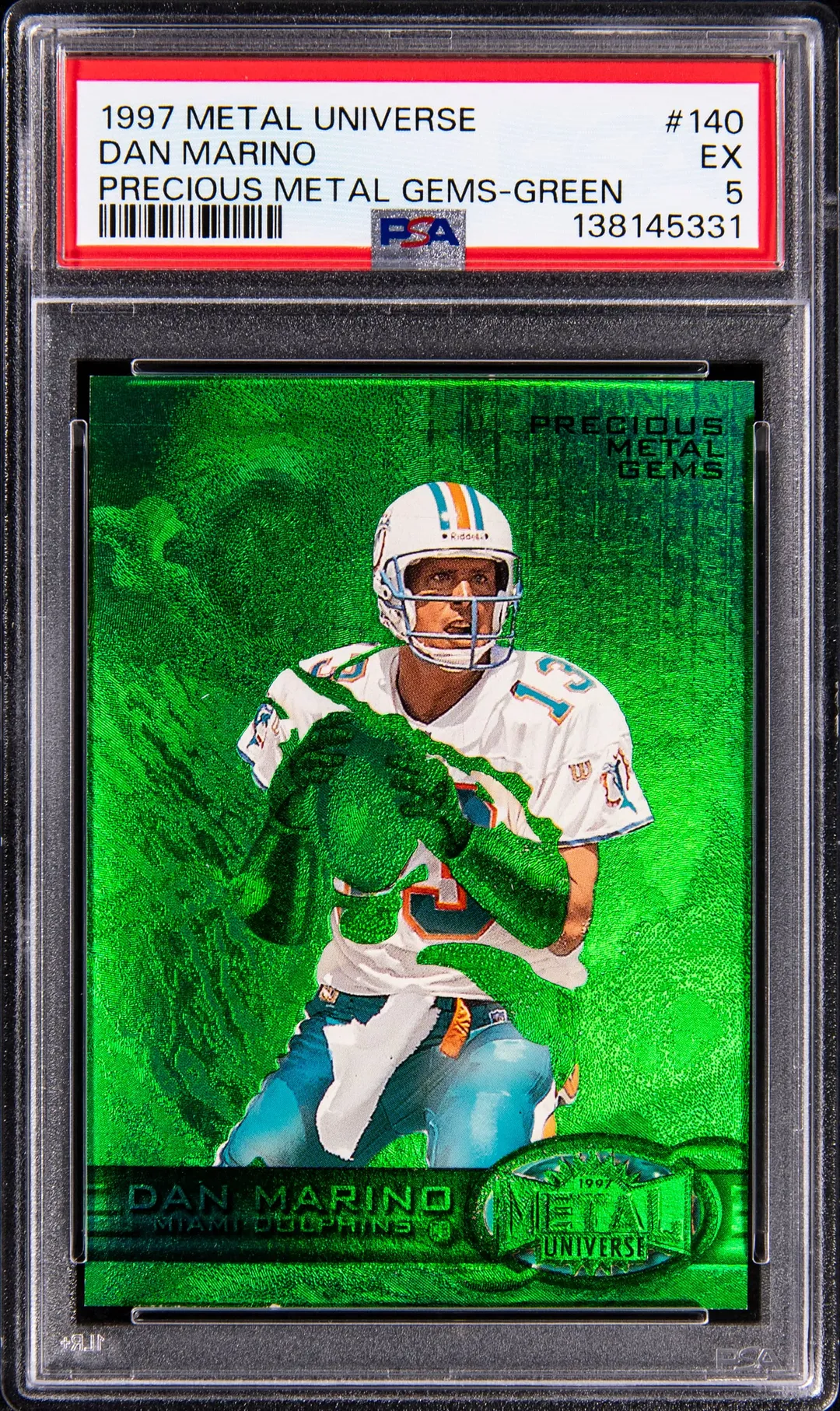
1997 PMG Green Dan Marino PSA 5 Sells for $34,160
Deep dive on the 1997 SkyBox Metal Universe PMG Green Dan Marino PSA 5 that sold for $34,160 at Goldin on February 8, 2026.
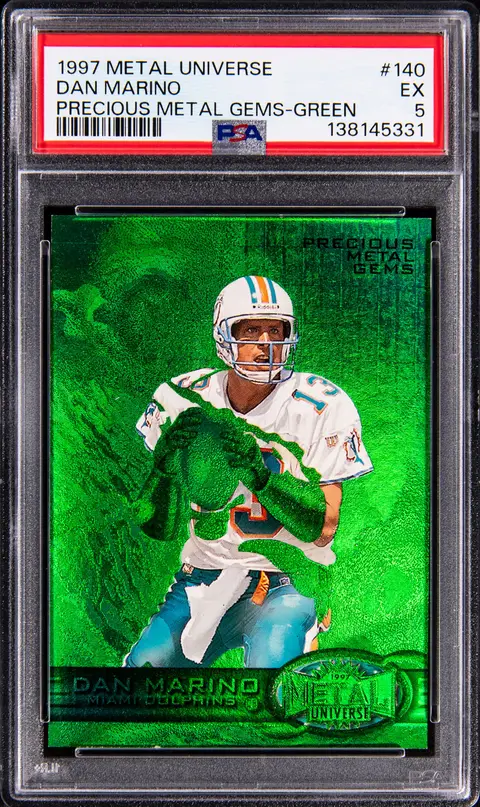
Sold Card
1997 SkyBox Metal Universe Precious Metal Gems (PMG) Green #140 Dan Marino (#012/150) - PSA EX 5
Sale Price
Platform
Goldin1997 SkyBox Metal Universe Precious Metal Gems (PMG) Green cards sit in a small circle of truly foundational 1990s inserts, and this Dan Marino just reminded the market why.
On February 8, 2026, Goldin sold a 1997 SkyBox Metal Universe Precious Metal Gems Green #140 Dan Marino, serial numbered 012/150 and graded PSA EX 5, for $34,160. For a late‑career, non‑rookie card to command that kind of attention says a lot about where the hobby sits with 90s PMGs—and with Marino specifically.
In this breakdown, we’ll look at what this card is, why it matters to collectors, and how this sale fits into recent price history.
Card Profile: 1997 Metal Universe PMG Green Dan Marino
Card details
- Player: Dan Marino (Miami Dolphins)
- Team: Miami Dolphins
- Year: 1997
- Set: SkyBox Metal Universe
- Insert/parallel: Precious Metal Gems Green
- Card number: #140
- Serial number: 012/150 (first 15 are the Green copies)
- Grading company: PSA (Professional Sports Authenticator)
- Grade: EX 5
- Attributes: low‑serial, high‑end 1990s insert, iconic parallel rather than a rookie
This is not a rookie card—Marino’s rookie year cardboard is in 1984. Instead, this is a “key issue” from the late 90s: a flagship parallel from one of the most respected insert sets ever produced.
Precious Metal Gems from 1997 Metal Universe came in two tiers:
- Green (out of 150): widely understood in the hobby to be the first 10% of the print run (cards numbered 001–015/150)
- Red (out of 150): the remaining 90% (cards numbered 016–150/150)
Survivorship is another story. The foil, color‑bleed, and chipping on these cards mean that high grades are extremely difficult, and even mid‑grade copies are treated as high‑end.
Why 1997 PMG Green Matters
Among 1990s inserts, PMG Green sits alongside a handful of sets—think 1997 PMG in basketball or 1998 PMG in football—as genuine hobby landmarks. Collectors care about this card for several reasons:
Set importance
1997 SkyBox Metal Universe Precious Metal Gems is one of the earliest and most distinctive premium parallels. The etched metal aesthetic, intense background art, and full‑bleed color foil made these stand out immediately.True scarcity plus condition scarcity
Even though the serial number is /150, the Green run is effectively /15. Surface and edge wear are almost baked into the design, making PSA 7–8 copies unusually tough and even 4–6 grades very collectible.Marino’s place in football history
Dan Marino is widely considered one of the most talented pure passers of all time. With no modern playing‑day cards and an established legacy, demand for his true “grail‑level” inserts tends to be stable.Cross‑sport PMG culture
Basketball, football, and even Marvel PMG collectors often respect these sets across sports. A strong sale in one category can nudge attention in another as collectors look for comparable pieces.
The era also matters. Late 90s football isn’t “junk wax”; production was far lower and more targeted, especially at higher‑end inserts. That’s one reason these PMGs rarely surface today, especially in original slabs with known provenance through major auction houses.
The Goldin Sale: $34,160 on February 8, 2026
Goldin’s February 8, 2026 sale put this PSA EX 5 copy at $34,160. For context:
- That’s a significant figure for a non‑rookie football card in a mid grade.
- It reflects both the scarcity of the Marino PMG Green and the broader appreciation of 1990s inserts as a distinct collecting lane.
Goldin’s visibility also tends to draw out more serious PMG collectors, which can help establish a clean “comp” (short for comparable sale, a recent realized price used to estimate value).
Recent Sales and Market Context
Public sales data for 1997 PMG Green Marino copies is thin. These do not come up often, and when they do, they’re typically in:
- Major auctions (like Goldin, PWCC, Heritage, etc.)
- Private sales that don’t always report confirmed numbers
Looking across available public information for closely related items gives a rough framework:
Same card, different grades:
Higher‑grade PSA or BGS copies of PMG Greens (for stars at or near Marino’s tier) can sell substantially higher, while lower grades or raw copies tend to track below this result. The exact gap depends heavily on eye appeal: centering, color saturation, and how severe the edge chipping looks.Marino’s PMG Red vs Green:
The Red parallel (same card, numbered 016–150) usually sells at a discount to the Green, both because it’s conceptually more common and because collectors view the Green as the true chase. As a result, strong Red comps can still sit below a Green sale like this, even in a better numeric grade.Comparable 1997 PMG Greens in football:
Greens for all‑time great QBs and skill players have shown a steady trend toward being treated as long‑term collection anchors. While exact numbers vary by player and grade, a mid‑grade Marino landing in the mid‑five‑figures is directionally consistent with how similar‑tier football legends are treated.
Within that context, $34,160 for a PSA 5 lands in a range that makes sense for a Marino PMG Green:
- Not an outlier that redefines the entire market
- But strong enough to reinforce that PMG Greens for top‑tier Hall of Famers remain firmly in the high‑end lane
Because 1997 PMG Greens trade infrequently, each confirmed public sale matters. This result effectively becomes a current reference point for collectors discussing Marino’s PMG market.
Grade Talk: PSA EX 5 on a PMG Green
For a modern or ultra‑modern card, PSA 5 might sound low. For a 1997 PMG Green, it’s a completely different story.
Why mid‑grade still commands attention:
- Design sensitivity: Full‑bleed foil and color chipping almost guarantee wear.
- Production era: Late‑90s handling and storage standards often weren’t designed for what we now consider ultra‑premium cards.
- Relative scarcity of high grades: Many surviving copies cluster in the 3–6 range. High‑end 8s and occasional 9s are major outliers and bring multiples of mid‑grade pricing.
Collectors often prioritize eye appeal over the number alone on PMGs:
- Does the green color still pop?
- Is the foil relatively clean?
- Are the back edges and corners severely chipped or just moderately worn?
That helps explain why a PSA EX 5 copy can still land a five‑figure sale price—the combination of set, player, and visual appeal can outweigh a strict numeric grade.
What This Sale Signals for Collectors
A single auction result doesn’t set the entire market, but this Goldin sale adds a useful data point for anyone tracking high‑end 1990s inserts.
Some takeaways:
1990s football inserts remain a serious lane
Basketball PMGs often get the headlines, but this sale underlines that high‑end football legends in 90s inserts are firmly established in the hobby’s long‑term conversation.Marino’s hobby lane is stable and mature
Marino isn’t a new hype cycle; his legacy is settled. Seeing a PMG Green of his land at this level suggests that collector demand for his best inserts is driven more by long‑term appreciation than by short‑term news.Mid‑grade PMG Greens are treated as premium pieces
With scarcity and condition challenges baked in from release, collectors continue to treat even PSA 4–6 grades as legitimate “grail” cards when the player and set are right.Data points matter, but sample sizes are small
Because these cards appear rarely, each public sale can shift perception more than it would in a heavily traded, modern parallel. It’s useful reference data, but not a guarantee of where the next result will land.
For Newer Collectors: How to Think About Cards Like This
If you’re newer to 1990s inserts or coming back to the hobby:
Know your sets
PMGs are not just colored parallels. They’re a core part of 90s insert history, and that reputation drives interest.Learn what “comps” really tell you
A comp (comparable sale) is a recent realized price that helps you estimate what a card might be worth. For low‑population, rarely sold cards like PMG Greens, comps are more like rough guideposts than precise pricing tools.Check pop reports, but read them carefully
A population report (or “pop report”) shows how many copies a grading company has graded at each grade level. With 1997 PMG Greens, both PSA and BGS pop numbers are low, but the key is how many exist in any grade—not just the top end.Watch eye appeal
Two PSA 5s can look very different. PMG collectors routinely pay premiums for copies that present better than their technical grade.
Where This Marino Fits in the Bigger Picture
The 1997 SkyBox Metal Universe PMG Green Dan Marino #140 PSA EX 5 that sold for $34,160 at Goldin on February 8, 2026, is a classic example of how the hobby is treating premium 1990s inserts:
- Iconic parallel from a historically important set
- Legendary Hall of Fame player
- Tough card in any grade, with mid‑grade copies still seen as centerpieces
For collectors building 1990s football runs, quarterback PC (personal collection) lanes, or cross‑sport PMG collections, this sale is another reminder: these cards move infrequently, and when they do, the market continues to treat them as significant hobby artifacts rather than just another parallel.
As more of these pieces settle into long‑term collections, each auction result—like this Goldin sale—becomes part of the ongoing record that future collectors will look back on when they study how the hobby valued 1990s PMGs.