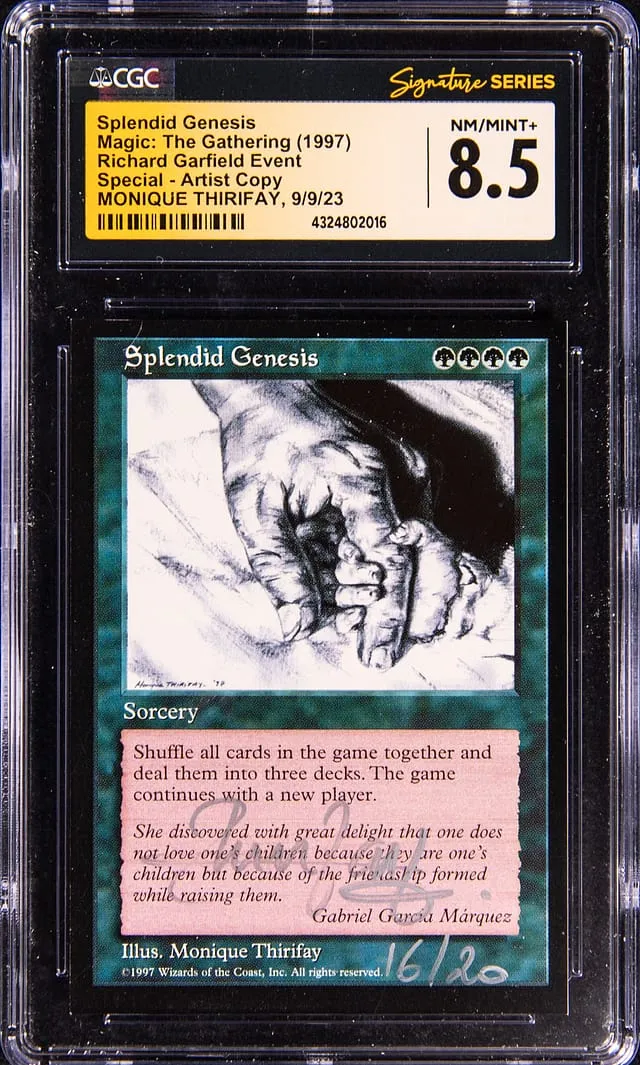
1997 MTG Splendid Genesis Artist Proof Sold
Goldin sold a 1997 MTG Splendid Genesis Artist Proof, signed and sketched by Monique Thirifay, CGC 8.5 Signature Series, for $21,080 on Feb 16, 2026.
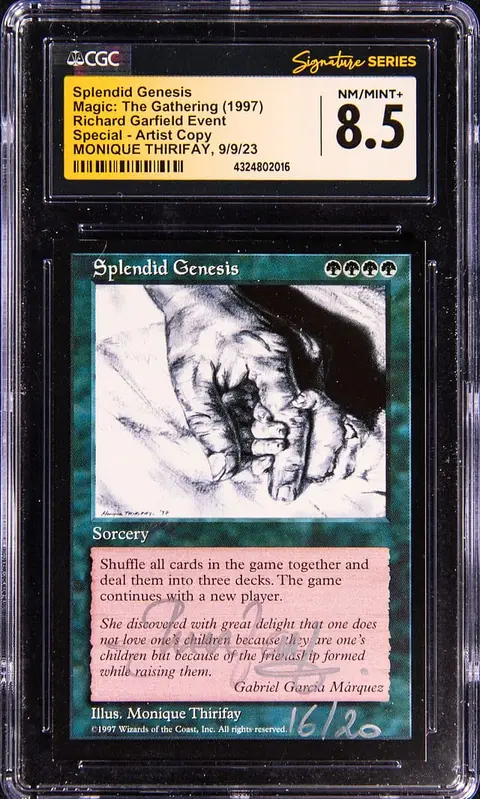
Sold Card
1997 Magic: The Gathering Splendid Genesis Artist Proof, Signed And Sketched by Illustrator Monique Thirifay (#16/20) - CGC Signature Series NM-MT+ 8.5
Sale Price
Platform
Goldin1997 Magic: The Gathering Splendid Genesis Artist Proof, Signed And Sketched by Illustrator Monique Thirifay (#16/20) - CGC Signature Series NM-MT+ 8.5
On February 16, 2026, Goldin sold a 1997 Magic: The Gathering Splendid Genesis Artist Proof, hand-signed and sketched by illustrator Monique Thirifay, graded CGC Signature Series NM-MT+ 8.5, for $21,080.
This isn’t a typical Magic card. It sits at the intersection of game history, artist provenance, and ultra-limited print culture. For collectors who care about the origin stories of Magic and the people who built it, this sale is worth a closer look.
What exactly is this card?
Let’s break down the title into collector-friendly pieces:
- Game / Property: Magic: The Gathering
- Year: 1997
- Card: Splendid Genesis (special release
- Version: Artist Proof – a non-tournament-legal printing given to the illustrator, usually with a blank back and produced in very low quantities.
- Artist: Monique Thirifay
- Serial detail: Hand-marked "16/20", indicating this is the 16th piece in a run of only 20 signed/sketched proofs from the artist.
- Autograph & art: On-card signature and original sketch by Thirifay on the card surface.
- Grading company: CGC Trading Cards (Signature Series)
- Grade: 8.5 NM-MT+ (Near Mint-Mint Plus)
- Label type: CGC Signature Series, meaning CGC directly witnessed the signing or followed their chain-of-custody standards for autograph authentication.
Artist proofs are not “set cards” in the way pack-pulled Splendid Genesis cards are. They’re closer to an artist’s private edition: extremely limited, often hand-numbered, and frequently the only way to get an artist’s sketch on that particular piece.
Why Splendid Genesis matters to Magic collectors
Splendid Genesis occupies a very unusual place in Magic history:
- Ultra-limited, special-occasion card: Splendid Genesis was never a normal pack-inserted release. It was famously distributed in extremely small numbers to insiders and special recipients, tied to a personal event in Magic’s creator circle. As a result, it has long been grouped with the game’s most scarce and talked-about oddities.
- Not a tournament staple, but a lore piece: Many key Magic chase cards are famous for competitive play. Splendid Genesis is instead prized as a historical artifact and a symbol of the game’s early culture and relationships.
- Early-era rarity: Coming from 1997, it sits in what many collectors view as the “early classic” era: old enough to be truly scarce in premium forms, but not quite Alpha/Beta vintage. In print-run terms and hobby awareness, it’s far closer to a boutique rarity than a mass-era chase mythic.
Artist proofs take that already-rare base and push it further into boutique territory. Proofs were created for the illustrator, not for mass circulation. When those proofs are numbered to 20, signed, and uniquely sketched, each piece becomes its own one-of-one in practical terms.
CGC Signature Series 8.5: How the grade fits in
An 8.5 NM-MT+ from CGC means:
- The card is strongly above average for a 1990s piece that has been handled, signed, and sketched.
- Minor edge, corner, or surface issues keep it from mint territory, but overall eye appeal remains high.
The Signature Series label is crucial. In hobby terms, a “signature series” or equivalent label indicates that the grading company directly witnessed or properly authenticated the autograph process. For collectors of signed pieces, that removes a major uncertainty: you’re not just grading the cardboard, you’re grading the integrity of the signature and sketch.
On a piece like this, the autograph and sketch add more to the desirability than a half-grade bump ever could. Many collectors in this lane treat the grade as an assurance of condition and authenticity rather than a strict investment metric.
What we can say about recent market context
For an object this niche, public comps (short for “comparables,” meaning similar recent sales used to gauge price context) are often sparse:
- Exact matches are rare: A 1997 Splendid Genesis Artist Proof, hand-numbered to 20, signed and sketched by Thirifay, and CGC Signature Series 8.5 is already a very tight filter. It’s unlikely that identical combinations of numbering, sketch, and grade show up often in public auction archives.
- Related pieces show a wide range: In the broader Magic market, sales of rare special-release cards, artist proofs, and early oddities can vary sharply based on:
- The specific artist and subject
- Whether there is a sketch versus just a signature
- The quality and aesthetics of the art on the card
- Grading company and label type
Within that context, a $21,080 result lines up with how the market tends to treat top-end Magic historical ephemera: there is a small but serious buyer pool willing to pay a significant premium for authentic, witnessed, artist-connected copies of game-history pieces.
Because of limited public data, it’s more accurate to view this sale as a marker rather than a strict “price guide number.” It establishes that, as of early 2026, collectors are willing to allocate five-figure budgets to this particular configuration of Splendid Genesis.
Artist proofs, sketches, and why collectors chase them
For newer or returning collectors, it can help to frame where artist proofs sit in the hobby:
- Artist proofs (APs): These are small batches of cards produced by the publisher specifically for the illustrator. They typically have blank backs, are not meant for tournament play, and exist in much lower quantities than the regular release.
- Hand-numbering: A run marked "x/20" tells you there are only twenty in that particular artist-handled series. Even if more proofs exist, this sub-run has defined scarcity.
- Signatures and sketches: A signature ties the piece directly to the artist; a sketch turns it into a true original artwork. No two sketches are the same, which effectively makes each card a unique item.
For many Magic collectors, especially those who enjoy the art as much or more than the gameplay, this combination is the pinnacle of personalization: the official card image plus a one-of-one illustration drawn by the same hand.
How this sale fits into the broader Magic market
Over the past several years, Magic’s high-end segment has expanded beyond tournament staples and Black Lotus headlines. We’ve seen:
- Growing interest in unconventional rarities: test prints, special event cards, and internal promos.
- A stronger market for artist-centered collecting: proofs, original paintings, preliminary sketches, and artist-signed limited runs.
- Increased comfort with third-party grading for non-standard items, using companies like CGC to formalize condition and signature authenticity.
This Goldin sale lines up with those trends. Instead of being driven purely by game power level or format legality, it reflects:
- The card’s story as part of Magic’s 1990s mythology
- The direct connection to Monique Thirifay
- The reassurance provided by a CGC Signature Series encapsulation
Takeaways for collectors and small sellers
A few practical observations if you’re navigating this part of the market:
Rarity here is structural, not just a serial stamp
Splendid Genesis was already an ultra-limited historical card. Turning that into a 20-count artist proof run with sketches creates real supply constraints that can’t be replicated by modern mass-produced low-serial cards.Provenance matters as much as the grade
On niche pieces, trail-of-ownership and authentication can be as important to buyers as a 0.5 grade difference. A recognized auction house like Goldin and a Signature Series label from CGC both help build confidence.Comps will be thin and sometimes misleading
Without a steady stream of similar sales, price discovery is noisy. When pieces are effectively unique (different sketches, inscriptions, or numbering), each sale is more of a data point than a definitive “market price.”Collectors in this lane tend to be long-horizon
Buyers of historical Magic artifacts and artist proofs often prioritize owning the piece over short-term price moves. That doesn’t make it a guarantee of future performance, but it does shape how quickly or slowly these items re-enter the market.
What this Goldin result tells us
The February 16, 2026 sale of the 1997 Magic: The Gathering Splendid Genesis Artist Proof #16/20, Signed and Sketched by Monique Thirifay, CGC Signature Series 8.5 for $21,080 confirms a few things about the current state of the Magic market:
- High-end collectors value historical context and artist connection at least as much as raw gameplay relevance.
- Artist proofs with sketches have firmly established themselves as a legitimate upper-tier collectible category, not just a niche curiosity.
- There is a sustained willingness to pay five-figure prices for unique or near-unique pieces that sit at the crossroads of game history, art, and provenance.
For collectors, the sale is less a signal to chase quick flips and more a reminder that Magic’s deepest stories often live in the corners of the catalog—artist proofs, private releases, and the small runs that never saw a booster pack.
Whether you’re building an art-focused Magic collection or simply mapping the evolving high-end landscape, this Goldin result is a clear example of where the hobby’s attention is quietly, steadily moving.