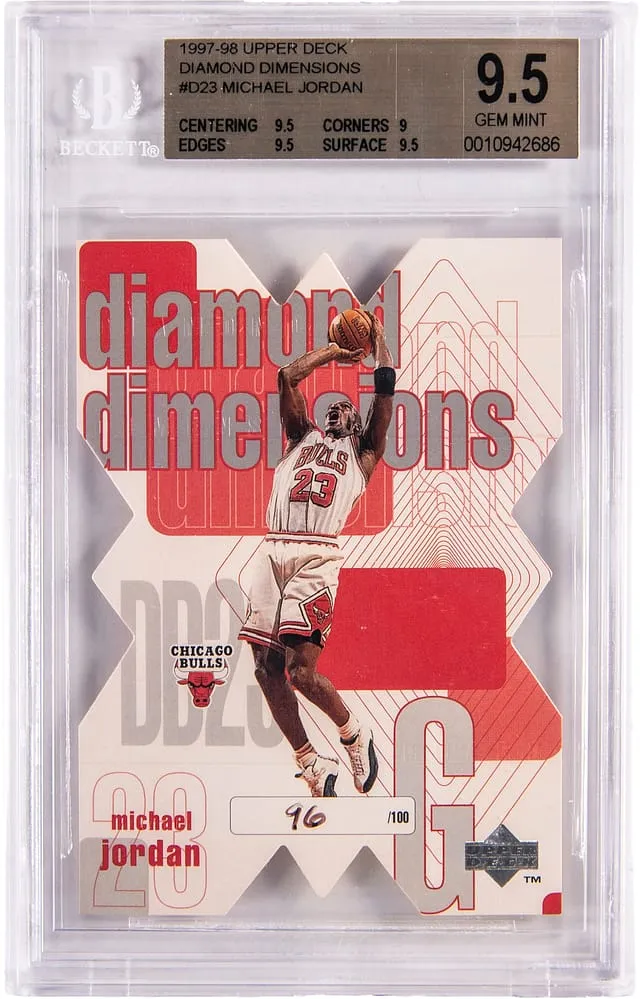
1997-98 UD Diamond Dimensions Jordan BGS 9.5 Sale
Deep dive on the 1997-98 Upper Deck Diamond Dimensions #DD23 Michael Jordan BGS 9.5 that sold for $27,145 at Goldin on May 10, 2026.
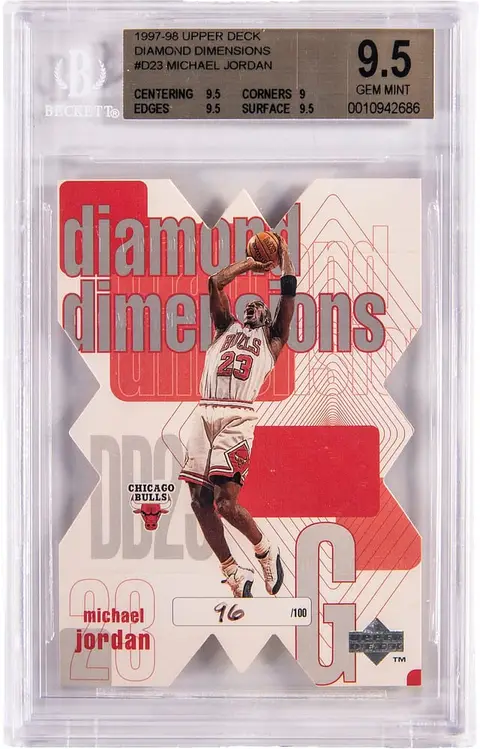
Sold Card
1997-98 Upper Deck Diamond Dimensions #DD23 Michael Jordan (#96/100) - BGS GEM MINT 9.5
Sale Price
Platform
Goldin1997-98 Upper Deck Diamond Dimensions #DD23 Michael Jordan (#96/100) - BGS GEM MINT 9.5 Sells for $27,145
On May 10, 2026, Goldin closed a notable Michael Jordan insert sale: a 1997-98 Upper Deck Diamond Dimensions #DD23, serial numbered 96/100, graded BGS GEM MINT 9.5, realized $27,145.
For an insert from the late 1990s—often called the “insert boom” era—this result adds another data point to how collectors are currently valuing rare, serial-numbered Jordan cards just outside the very top tier of his market.
Card overview
Let’s start with the basics of the card itself:
- Player: Michael Jordan
- Team: Chicago Bulls
- Year: 1997-98
- Set: Upper Deck Diamond Dimensions
- Card number: #DD23
- Serial numbering: #96/100 (print run of 100)
- Grading company: Beckett Grading Services (BGS)
- Grade: GEM MINT 9.5
- Type: Premium insert, not a rookie card
Diamond Dimensions is a short-printed premium insert from 1997-98 Upper Deck. The late-90s Upper Deck inserts, along with brands like SkyBox and Flair, helped define the concept of high-end chase cards: low-serial print runs, distinctive die-cut or foil-heavy designs, and tough pack odds.
Jordan’s #DD23 is one of the key cards in the Diamond Dimensions checklist. While it’s not as universally known as the most famous Jordan inserts (think 1997-98 Metal Universe PMG, 1997-98 E-X2001 Jambalaya, or 1997-98 Flair Showcase Legacy), it occupies that next tier of serious 90s Jordan inserts that advanced collectors track closely.
Why this card matters to collectors
1. 1990s Jordan insert culture
The 1990s were the era when inserts and parallels really took off. Manufacturers experimented with:
- Short prints (intentionally low production)
- Serial numbering (hand or machine-numbered print runs)
- Distinctive technology (holograms, foil, die-cuts, intricate textures)
Jordan was at the center of this shift. His base cards were widely available, but rare inserts created a parallel ecosystem of high-end collecting. Sets like Diamond Dimensions gave collectors a chance to chase something clearly scarcer than the flagship base issues.
2. Scarcity and condition
With a print run of only 100 copies, the raw population is small from the start. By 1997-98 standards, /100 is quite low.
Layer on top of that:
- The card’s age: it’s approaching three decades old.
- Condition sensitivity: 90s inserts often have chipping, edge wear, and surface issues.
- Surviving supply: not every copy was sleeved, graded, or even preserved.
A BGS GEM MINT 9.5 means this particular example is among the better-preserved copies. In BGS grading, Gem Mint usually implies subgrades around 9.5, sometimes with a 10 in one area. That kind of condition is not automatic for late-90s inserts, even when pack-pulled and stored.
3. Insert, not rookie—but still a key issue
This is not a rookie card; Jordan’s true rookies are from 1984-85 Star and 1986-87 Fleer. However, many long-time basketball collectors treat certain 1990s inserts as “key issues” in their own right because they capture:
- Peak Bulls championship years
- Innovative design experiments of the era
- Early versions of the modern “chase card” concept
Diamond Dimensions sits within that collecting philosophy. It’s not the most famous Jordan insert, but it’s a recognized, limited, 90s-era chase card with clear scarcity and a strong player.
Price context: how $27,145 fits in
This Goldin sale closed at $27,145. To understand that, it helps to think in terms of comps—short for “comparables,” or recent sales of the same or very similar cards.
Because this is a very low-population card (/100) and high grade, transactions are infrequent. When sales are sparse, it’s harder to build a clean trendline, so collectors look at a mix of:
- The same card in other grades
- Other serial-numbered 1990s Jordan inserts of similar tier
- The general direction of high-end Jordan insert prices
Recent hobby patterns suggest the following broad context:
- High-end 90s MJ inserts (PMGs, Jambalaya, Credentials, etc.) have set headline prices well above this level, especially in top grades and iconic designs.
- Second-tier but respected inserts like Diamond Dimensions, when numbered to 100 and graded 9.5 or PSA 10, often trade meaningfully below those mega-grails but still in strong five-figure territory when the right buyer and auction format line up.
- Mid to high grades (BGS 9, PSA 9) for similar 90s Jordan inserts, when serial numbered to around /100, tend to find support at lower levels, with a noticeable premium attached to top-of-the-pop grades.
Within that framework, $27,145 for a BGS 9.5 aligns with the idea that:
- The market continues to pay a premium for high-end, 90s-era serial-numbered Jordan inserts.
- There is still a pricing gap between the very top-tier Jordan grails and strong but slightly less iconic inserts like Diamond Dimensions.
Because transactions in this exact card and grade are relatively rare, it’s more accurate to say this sale adds another important data point than to label it a clear record or bargain.
BGS GEM MINT 9.5: why the grade matters
For newer collectors, here’s a quick grading gloss:
- BGS 9.5 (Gem Mint) is typically the top BGS grade most cards achieve in any volume. BGS 10 “Pristine” or “Black Label” is rarer.
- A Gem Mint grade indicates:
- Very sharp corners
- Clean edges
- Strong surface with minimal flaws
- Centering that meets tight tolerances
For a 90s insert like Diamond Dimensions, reaching BGS 9.5 can be notably tougher than for many modern, ultra-thick, chromium-based cards printed with grading in mind.
The pop report—short for “population report,” which is the grading company’s census of how many copies exist at each grade—tends to show relatively low numbers of Gem Mint 9.5s for cards like this. Even when the exact pop numbers vary, the general pattern is consistent: there are far fewer high-grade copies than the raw print run might suggest.
A BGS 9.5 therefore often carries a significant premium over BGS 9 or ungraded copies, especially for collectors building high-grade 1990s Jordan insert runs.
How this sale fits into the broader MJ market
Michael Jordan’s card market is layered:
- True rookies and key early issues (Star, Fleer) with long, well-documented price histories.
- Iconic 1990s inserts and parallels that function almost like modern art pieces in the hobby.
- Modern and post-playing career issues, from autos to limited parallels, that appeal to a wider, sometimes more speculative audience.
This Diamond Dimensions sale falls squarely in layer 2. Some points that help frame it:
- It shows sustained interest in 1990s serial-numbered inserts, even ones that don’t dominate headlines.
- It reinforces that collectors continue to differentiate carefully between:
- Historically important, low-pop 90s cards
- Mass-produced base and lower-end parallels
- It highlights how condition and grading remain central to pricing in this segment.
While no single sale defines a market, Goldin’s platform typically attracts both seasoned Jordan collectors and high-end bidders. When a card like this clears at $27,145 on May 10, 2026, it becomes a useful reference point for buyers and sellers considering similar pieces.
What this means for collectors and small sellers
For collectors who focus on—or are considering entering—the 1990s Jordan insert lane, this sale suggests a few practical takeaways:
Rarity plus player still matters. Serial numbering to 100, combined with Jordan at the height of the Bulls dynasty, continues to command attention.
Grade sensitivity is real. The step from high raw or near-mint (e.g., BGS 8.5–9) to Gem Mint (BGS 9.5 or PSA 10) can mean a substantial price gap. Good storage and careful handling still pay off.
Set recognition influences ceiling. Ultra-iconic inserts may continue to outpace second-tier sets in price, but strong secondary inserts like Diamond Dimensions can offer a different mix of scarcity and cost for collectors building focused MJ runs.
Comps require context. When sales are infrequent, it’s worth:
- Checking multiple auction houses and fixed-price platforms
- Looking at nearby grades and similar inserts
- Considering seasonal timing and broader hobby sentiment
For small sellers, this Goldin result is a reminder that:
- High-end inserts often perform best in venues where serious Jordan collectors are already active.
- Clear scans, accurate grading, and strong descriptions help buyers understand what they’re looking at, especially for niche 90s inserts.
Final thoughts
The May 10, 2026 Goldin sale of the 1997-98 Upper Deck Diamond Dimensions #DD23 Michael Jordan (#96/100) in BGS GEM MINT 9.5 for $27,145 underscores the staying power of high-quality 1990s Jordan inserts.
It’s not the loudest card in the Jordan market, but it reflects a consistent theme: well-preserved, low-serial MJ inserts from the late 90s continue to find serious buyers, and each sale like this helps refine our understanding of where that segment of the hobby currently stands.
As always, it’s one data point among many—but for collectors tracking 1990s Jordan inserts closely, it’s a meaningful one to add to the notebook.