1997-98 Trophy Pikachu Silver sells for $186,660
Deep dive on the 1997-98 Japanese Trophy Pikachu Silver 2nd Place sale at Goldin for $186,660, and what it means for high-end Pokémon collectors.
Sold Card
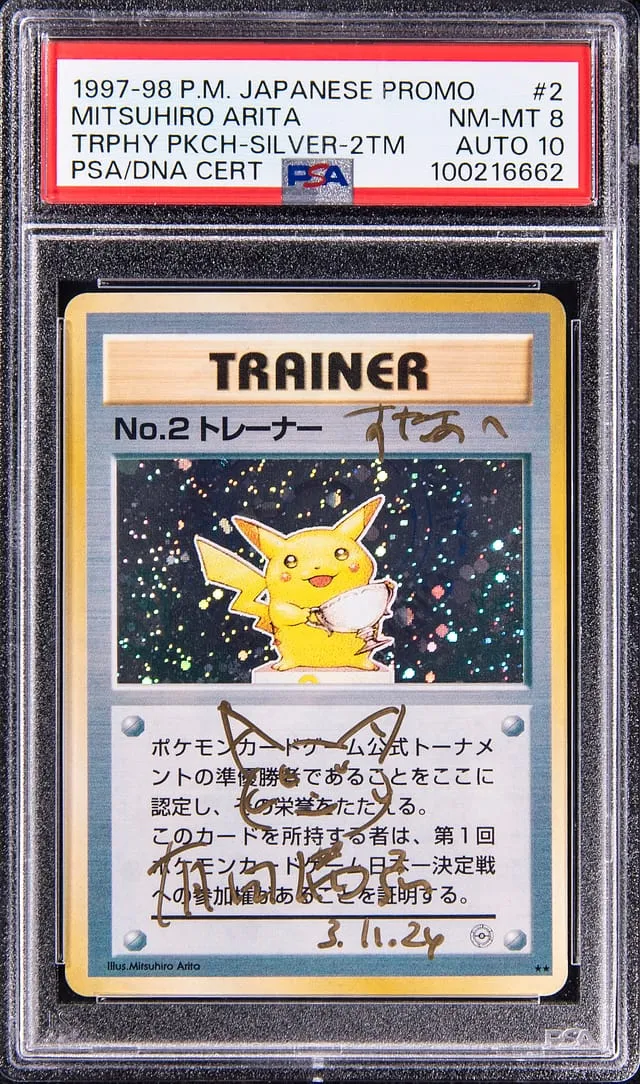
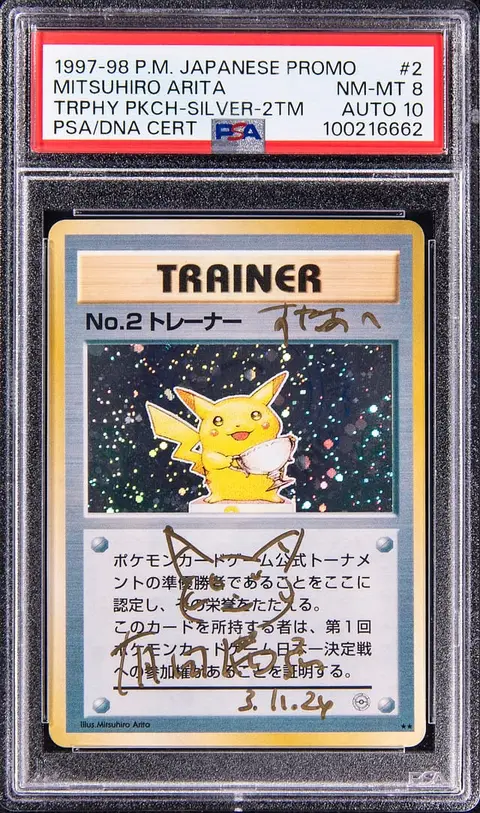
1997-98 Pokemon Japanese Promo 2nd Tournament Silver 2nd Place #2 Trophy Pikachu - Signed, Sketched by Mitsuhiro Arita - PSA NM-MT 8, PSA/DNA GEM MT 10 - Pop 1
Sale Price
Platform
Goldin1997-98 Japanese 2nd Tournament Silver Trophy Pikachu Sells for $186,660
On March 9, 2026, Goldin closed a landmark sale for a true grail-level Pokémon prize card: a 1997-98 Pokémon Japanese Promo 2nd Tournament Silver 2nd Place #2 Trophy Pikachu, signed and sketched by artist Mitsuhiro Arita, graded PSA NM-MT 8 with PSA/DNA GEM MT 10 autograph. The final price landed at $186,660.
For serious Pokémon collectors and researchers, this card sits at the crossroads of early hobby history, tournament lore, and original artwork.
Card Breakdown: What Exactly Sold?
Let’s define the card clearly, because details matter a lot here.
- Year: 1997–98
- Game/Franchise: Pokémon TCG (Japanese)
- Card Name: Trophy Pikachu (2nd Tournament Silver 2nd Place)
- Card Number: #2
- Type: Japanese Promo, Tournament Prize Card
- Variant: Silver 2nd Place version from the early official Pokémon tournaments
- Autograph / Sketch: On-card signature and sketch by illustrator Mitsuhiro Arita
- Grading:
- Card: PSA NM-MT 8 (Near Mint–Mint)
- Autograph: PSA/DNA GEM MT 10 (Gem Mint)
- Population: Pop 1 in this exact configuration (PSA 8 card with PSA/DNA 10 Arita signed + sketched)
This is not a pack-pulled card or standard promo. It’s a trophy card – a card awarded to top finishers in official competitions, produced in extremely low quantities and never made available to the general public.
Why Trophy Pikachu Matters
Among early Japanese trophy cards, Trophy Pikachu stands alongside cards like the original Pikachu Illustrator and the early Trophy Kangaskhan as symbols of the game’s competitive roots.
A few key points on significance:
Early Organized Play History
These cards were prizes for high finishers in early official Pokémon tournaments in Japan. Owning one is essentially owning a piece of the birth of Pokémon organized play.Ultra-Low Supply
Trophy cards weren’t distributed in booster packs or retail products. They were produced in very small numbers and handed directly to winners. Long-term, some have been lost, damaged, or kept in private collections, which keeps public supply extremely thin.Pikachu as the Icon
Pikachu is the face of the Pokémon franchise globally. Early, high-status Pikachu promos and trophies are often treated as core pieces for advanced collections.Arita Signature and Sketch
Mitsuhiro Arita is one of the defining artists of the Pokémon TCG, known for many foundational artworks including the original Base Set Charizard. An on-card signature and sketch from Arita turns the card into a hybrid between a tournament trophy and a piece of original art.Era and Condition
Late-1990s Japanese trophy cards fall into what many collectors consider the “vintage” or early era of Pokémon. Surviving copies in strong condition – and then further preserved in a PSA 8 case – are not taken for granted.
Grading and Population Context
This copy carries two crucial labels:
Card Grade: PSA NM-MT 8
PSA (Professional Sports Authenticator) grades trading cards on a 1–10 scale, with 10 being Gem Mint. An 8 indicates light, but noticeable, wear while still presenting extremely well.Autograph Grade: PSA/DNA GEM MT 10
PSA/DNA is PSA’s autograph authentication and grading arm. A 10 here represents a clean, well-executed Arita signature and sketch with top-tier presentation.
The sale description notes this is Pop 1, meaning PSA’s population report lists only one example in this exact combination: a PSA 8 card with a PSA/DNA 10 Arita auto + sketch.
For rare trophies, population numbers can be tricky to interpret—some copies may be raw (ungraded), held in Japanese collections, or graded by other companies. But even accounting for that, it’s clear that signed and sketched, authenticated copies are scarce.
Market Context and Recent Sales
Because these are ultra-rare, tournament-only cards, public sales are infrequent. Instead of a constant stream of comps (comparable sales), we see isolated auctions that effectively reset expectations each time they appear.
Key themes from recent years around Trophy Pikachu and similar cards:
Sparse Public Transactions
Only a handful of Trophy Pikachu cards, in any placement (Gold, Silver, Bronze) and any grade, surface publicly over multi-year spans.Condition and Configuration Matter
Differences such as placement (1st vs 2nd vs 3rd), grade, and whether the card is signed or sketched by Arita heavily affect prices. A raw or unsigned copy is not directly equivalent to an authenticated, PSA/DNA 10 Arita-inked example.Arita-Signed Trophies Are a Subset of a Subset
Genuine, authenticated Arita signatures and sketches on trophy-level cards are far rarer than signatures on mass-produced promos or modern cards.
Within that context, the $186,660 result at Goldin on March 9, 2026, is consistent with the broader pattern: elite early Pokémon trophies, especially with strong provenance and unique features, can command six-figure prices when they surface.
Because public data for this exact card and configuration is extremely thin, it’s more useful to think of this sale as one data point in a small set of high-end trophy outcomes rather than as a stable “market price” in the way we might approach modern, regularly traded cards.
How This Sale Fits the Larger Pokémon Market
In recent years, the Pokémon market has matured into several layers:
- Mass-printed vintage and modern (Base Set holos, WotC-era packs, popular modern chase cards) with many available comps.
- Scarce promos and early Japanese exclusives (No Rarity Base, early CoroCoro promos, players’ promos) with irregular but trackable sales.
- True trophies and ultra-rare awards, where each auction is a significant event.
This Trophy Pikachu clearly belongs in the third group. A few implications for collectors and sellers:
Reference Point for Early Trophy Pikachu
Even if you don’t collect at this price level, the sale serves as a benchmark for how the market currently values historically important, low-population Pikachu trophies.Growing Recognition of Artist-Linked Items
Arita-signed and sketched trophy cards highlight a trend: more collectors are treating signed and sketched items—especially from original artists—as a distinct category, closer to fine art than to standard TCG pieces.Separation Between High-End and Broad Market
It’s important to keep sales like this in perspective. While this card reached $186,660, that doesn’t automatically translate into similar moves for regular Pikachu promos or mass-printed set cards. Trophy and award cards occupy their own niche.
What Collectors Can Take Away
For newcomers and returning collectors, here are some practical takeaways:
Understand card type before looking at prices. A trophy card like this is fundamentally different from a normal holo or promo. It’s not a baseline for the rest of the hobby.
Learn the story behind high-end cards. Knowing that this particular card is tied to early Japanese tournaments, low distribution, and an Arita sketch gives context to the six-figure price.
Use sales like this for macro context, not micro pricing. When you see a headline sale, treat it as a data point about the health and seriousness of the high-end market, not as a direct comp for your everyday collection.
Autographs and sketches need authentication. For long-term collecting or resale, recognized third-party verification (like PSA/DNA) can help clarify what you actually have and make it easier to compare with future sales.
Final Thoughts
The March 9, 2026 Goldin auction of the 1997-98 Pokémon Japanese Promo 2nd Tournament Silver 2nd Place #2 Trophy Pikachu—signed and sketched by Mitsuhiro Arita and graded PSA 8 with a PSA/DNA 10 auto—adds another important chapter to the history of high-end Pokémon collecting.
For most of the hobby, this is a card to study rather than chase: a reference point for how the market values the rarest, most historically significant pieces. As more early trophy cards emerge from long-time collections over the coming years, sales like this one will be key markers for understanding how the top of the Pokémon market is evolving.
figoca will continue tracking these high-end results so collectors at every level can understand where their own cards fit within the broader landscape of the hobby.