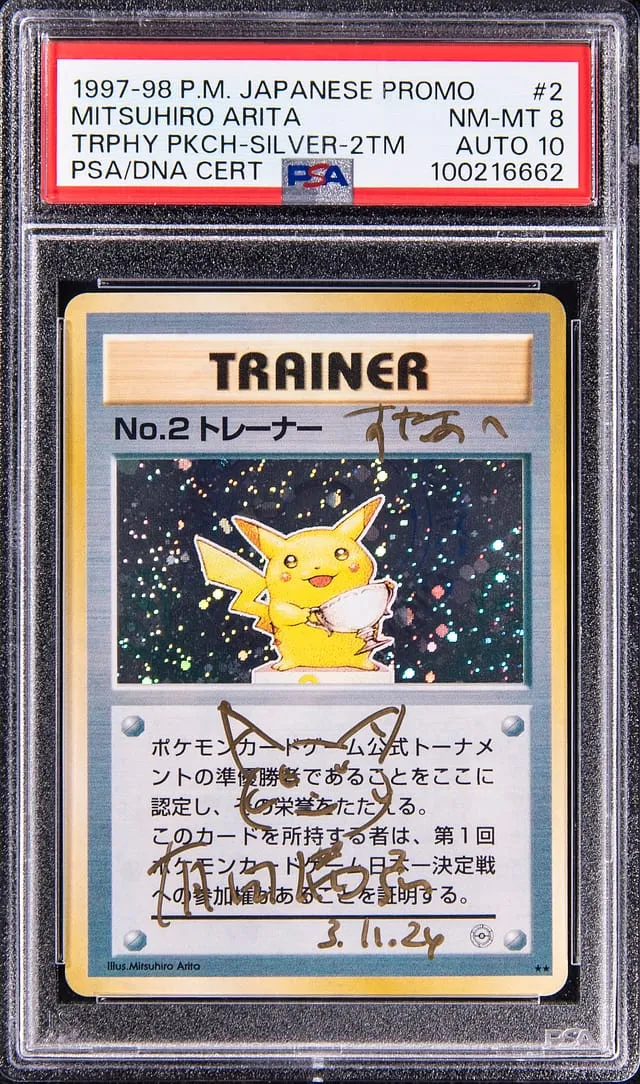
1997-98 Trophy Pikachu Silver 2nd Place Sale
Goldin sold a 1997-98 Japanese Trophy Pikachu Silver 2nd Place, Arita signed and sketched, PSA 8 / PSA-DNA 10, pop 1, for $186,660 on March 9, 2026.
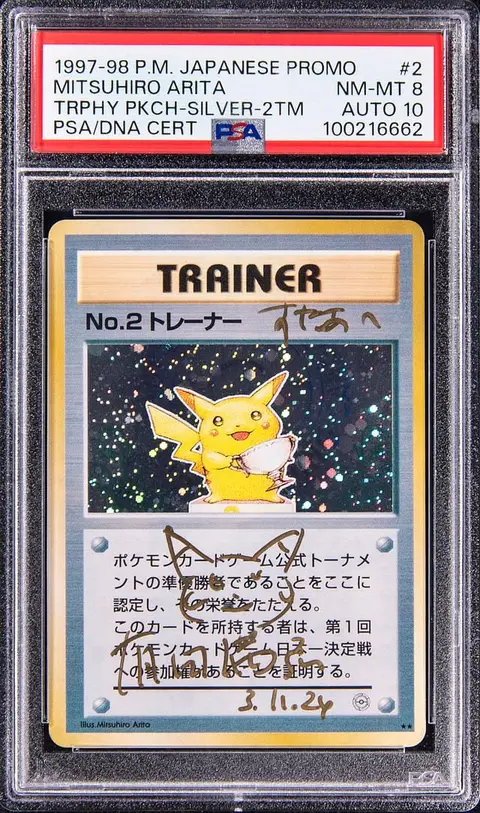
Sold Card
1997-98 Pokemon Japanese Promo 2nd Tournament Silver 2nd Place #2 Trophy Pikachu - Signed, Sketched by Mitsuhiro Arita - PSA NM-MT 8, PSA/DNA GEM MT 10 - Pop 1
Sale Price
Platform
Goldin1997-98 Pokemon Japanese Promo 2nd Tournament Silver 2nd Place #2 Trophy Pikachu – Signed, Sketched by Mitsuhiro Arita – PSA NM-MT 8, PSA/DNA GEM MT 10 – Pop 1
On March 9, 2026, Goldin closed a landmark sale for one of the most historically important Pokémon cards ever produced: a 1997-98 Pokémon Japanese Promo 2nd Tournament Silver 2nd Place #2 Trophy Pikachu, signed and sketched by illustrator Mitsuhiro Arita, graded PSA NM-MT 8 with a PSA/DNA GEM MT 10 autograph. The card realized $186,660.
For collectors who follow high-end Japanese trophy cards, this result sits at the intersection of rarity, provenance, and the growing appreciation for early Pokémon history.
What exactly is this card?
Let’s break down the title piece by piece so it’s clear what sold and why it matters:
- Year: 1997–98
- Game / IP: Pokémon Trading Card Game
- Card: Trophy Pikachu
- Language: Japanese
- Type: Prize / Trophy card (not a pack-pulled card)
- Event: Pokémon Tournament (early official Japanese events)
- Placement: 2nd Place – Silver
- Number: #2 (within the promo/trophy numbering system)
- Attributes:
- Awarded to competitors who placed 2nd at early Japanese tournaments.
- This specific copy is signed and sketched on-card by original illustrator Mitsuhiro Arita.
- Graded PSA NM-MT 8 (card condition) and PSA/DNA GEM MT 10 for the autograph/sketch.
- Population (pop) 1 at this combined grade/auto designation – meaning PSA’s population report shows only one example with this exact configuration.
Trophy Pikachu cards are not standard releases. They were awarded at invitation-only tournament stages in the earliest years of the Pokémon TCG. That makes them fundamentally different from even the rarest pack-pulled cards: they began life as ultra-limited awards, not products on a shelf.
Why Trophy Pikachu matters to collectors
Among serious Pokémon collectors, Trophy Pikachu is viewed as one of the true pillars of the hobby:
- Earliest era: These promos trace back to the very first organized Pokémon tournaments in Japan, effectively the birth of competitive Pokémon TCG.
- True scarcity: Unlike chase cards from booster packs, trophy cards were produced in tiny quantities, roughly aligned with the number of winners. Exact print figures are not publicly confirmed, but we’re talking about extremely small runs.
- Historical weight: These cards commemorate the earliest official competitions. For collectors who care about the history of the game, they sit in the same conceptual space as first printing Charizard or first-edition base set holos – but with much lower supply.
- Character choice: Pikachu is the franchise’s global mascot. Pairing the most iconic character with one of the rarest distribution methods amplifies long-term collector interest.
This specific card layers another dimension on top of that:
- Mitsuhiro Arita signature and sketch: Arita is the original illustrator of many foundational Pokémon cards (including the classic Base Set Charizard). A signed and sketched trophy card connects the competitive history of the game with one of its most important artists.
Grading details: PSA 8 and PSA/DNA 10
Two grading components matter in this sale:
PSA NM-MT 8 (card grade):
- PSA (Professional Sports Authenticator) evaluates the card’s physical condition – corners, edges, surface, and centering.
- NM-MT 8 is considered strong for a late-1990s trophy card that was awarded to and handled by a live tournament participant.
PSA/DNA GEM MT 10 (autograph grade):
- PSA/DNA is PSA’s autograph authentication arm.
- GEM MT 10 is their highest grade, indicating an exceptionally clean, bold signature and sketch.
Combined, this means the underlying card is high-grade relative to its era and distribution, and the Arita inscription is about as strong as you can reasonably hope for.
Population and scarcity: what “Pop 1” really means
“Pop report” or “population report” is a census published by grading companies summarizing how many copies of a given card exist at each grade.
- For this specific configuration – 1997-98 Japanese Trophy Pikachu Silver 2nd Place, PSA 8 with a PSA/DNA GEM MT 10 Arita signature/sketch – PSA reports it as Population 1.
- Pop 1 doesn’t mean only one copy of the card exists in the world; it means only one has been graded in this card/grade/auto configuration.
- With trophy cards, the raw (ungraded) pool is tiny to begin with. So a pop 1 in a premium grade-autograph combo is meaningful.
Market context: where does $186,660 fit?
While comprehensive public data for this exact version (Silver 2nd Place, signed and sketched by Arita, PSA 8 / PSA-DNA 10) is limited, we can set some context using nearby categories:
- Other Trophy Pikachu sales: Over the past several years, various Trophy Pikachu copies (across Gold, Silver, and Bronze variants, different years, and different grades) have sold in the six-figure range, particularly at major auction houses.
- Unsigned vs signed: There are recorded sales of unsigned trophy cards at lower six-figure levels depending on medal (Gold vs Silver vs Bronze), condition, and year. When you add a premium signature and sketch from Arita, you move into a more niche, art-and-history-focused segment of the market.
- PSA 8 tier: For vintage trophy cards, PSA 8 is often viewed as an upper-tier grade. Higher grades exist in some cases, but supply is thin and sales are infrequent.
Given this context, a $186,660 result at Goldin on March 9, 2026 falls in line with high-end trophy card territory. It reflects a strong but not surprising level of demand for:
- Earliest-era Pokémon trophy material.
- Pikachu as a central character.
- Arita-signed and sketched pieces at the highest autograph grade.
Because sales are infrequent, each auction becomes a key data point more than a “typical comp.” In other words, this isn’t a card with monthly or even yearly turnover.
Why this sale matters beyond the headline number
For collectors, sales like this carry several signals:
Continued respect for Japanese trophy cards
Results like this reinforce that the market differentiates between early Japanese trophy releases and mainstream pack-pulled cards, even at the very high end.Growing focus on provenance and uniqueness
A raw price tag only tells part of the story. This specific copy is:- A documented prize card from early organized play.
- Signed and sketched by the illustrator.
- Graded and authenticated at high levels.
- Confirmed as a pop 1 combination.
That combination of traits is what sets it apart from even other trophy cards.
Artist-signed and art-forward cards gaining traction
Over the last few years, collectors have increasingly focused on artist-signed cards, original sketches, and items that connect the trading card to its creator. A card like this Trophy Pikachu is not just a game piece; it’s also a canvas for Arita’s work.Historical anchoring in an expanding hobby
As new collectors enter the Pokémon space, the most historically grounded pieces tend to act as reference points – things people research, learn about, and compare others to, even if they never plan to buy them. Trophy Pikachu sits firmly in that reference category.
Takeaways for different types of collectors
Whether you’re new to Pokémon or returning from a long break, this sale offers a few practical insights:
For newcomers
- Trophy cards vs regular holos: This Trophy Pikachu was never in booster packs. It represents a completely separate tier of scarcity and history. Understanding that difference helps put big auction numbers into context.
- Grading language: When you see a description like “PSA 8, PSA/DNA 10 auto,” treat it as two separate evaluations: one for the card, one for the autograph.
For returning collectors
- Japanese promos are central, not secondary: Many long-time collectors started with English Base Set and may still see Japanese cards as side-collectibles. The market continues to affirm that early Japanese promos – especially trophy cards – are actually core to the hobby’s history.
- Condition expectations: Trophy cards often show wear consistent with being awards, not sealed products. PSA 8 can be a top-end grade in this lane.
For active hobbyists and small sellers
- Comps are sparse at the top: “Comps” – recent comparable sales used for price context – are often unavailable or thin for one-of-a-kind or pop 1 items. Each sale becomes its own data point rather than a tight price range.
- Autographs matter: For certain subjects (especially key artists like Arita), authenticated signatures and sketches can create a separate pricing tier, not a small add-on.
- Story drives demand: Cards tied to the earliest organized play, iconic characters, and marquee artists tend to attract sustained research attention, even if actual transaction volume is low.
Final thoughts
The March 9, 2026 Goldin sale of the 1997-98 Pokémon Japanese Promo 2nd Tournament Silver 2nd Place #2 Trophy Pikachu – signed and sketched by Mitsuhiro Arita, PSA NM-MT 8 with a PSA/DNA GEM MT 10 autograph, pop 1 – is another data point confirming the long-term importance of early Japanese trophy cards.
For many collectors, it’s less about the exact dollar amount and more about what the card represents: a direct link back to the first wave of organized Pokémon competition, given new life by the hand of one of the game’s most influential artists.
As more attention flows to the hobby’s roots, cards like this help define what “historic” means in Pokémon, and how rarity, artistry, and provenance come together in the modern market.