1997-98 Trophy Pikachu Bronze Arita Sketch Sale
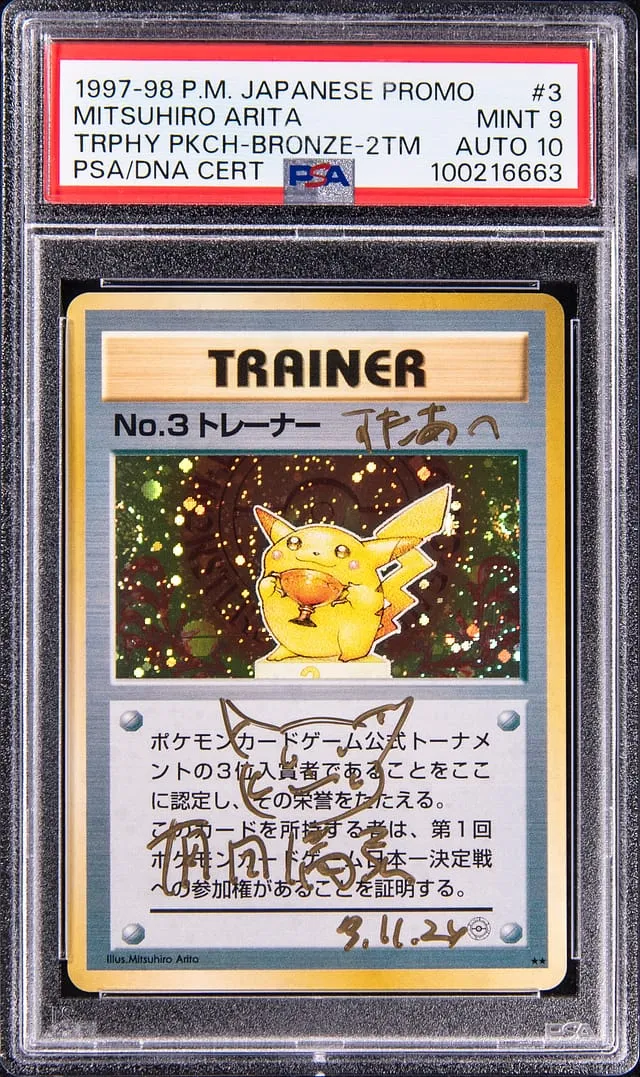
A Pop 1 1997-98 Japanese Trophy Pikachu Bronze with Arita sketch and auto, PSA 9/PSA-DNA 10, sold for $189,100 at Goldin on March 9, 2026.
Sold Card
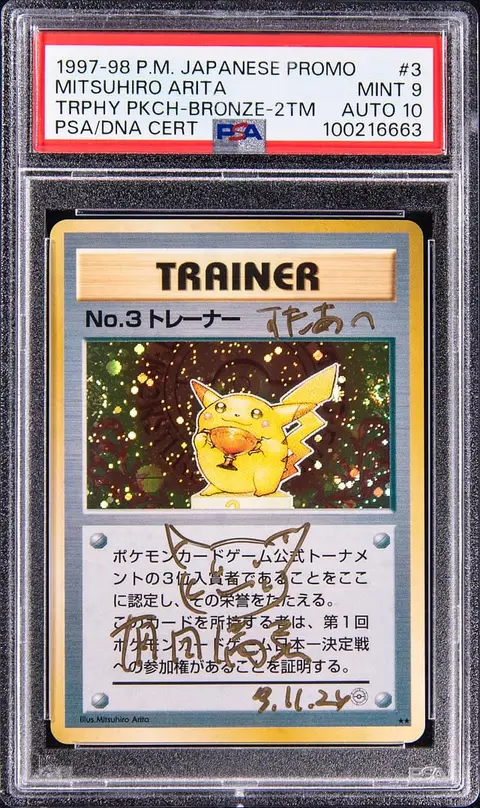
1997-98 Pokemon Japanese Promo 2nd Tournament Bronze 3rd Place #3 Trophy Pikachu - Signed, Sketched by Mitsuhiro Arita - PSA MINT 9, PSA/DNA GEM MT 10 - Pop 1
Sale Price
Platform
Goldin1997-98 Pokemon Japanese Promo 2nd Tournament Bronze 3rd Place #3 Trophy Pikachu – Signed, Sketched by Mitsuhiro Arita – PSA MINT 9, PSA/DNA GEM MT 10 – Pop 1
On March 9, 2026, Goldin sold one of the most unusual and historically important Pikachu promos in the hobby: a 1997-98 Pokemon Japanese Promo 2nd Tournament Bronze 3rd Place #3 Trophy Pikachu, graded PSA MINT 9 with a PSA/DNA GEM MT 10 autograph and sketch by illustrator Mitsuhiro Arita, for $189,100.
For a niche slice of the Pokemon market, this is a landmark combination of early tournament history, ultra-low population, and an authenticated on-card sketch and signature that is unlikely to be replicated.
What exactly is this card?
Let’s break down the title and why it matters.
- Year & era: 1997-98, very early Pokemon TCG era in Japan (pre-English Base Set launch in 1999)
- Card: Trophy Pikachu #3
- Issue: Japanese promo awarded at the 2nd Pokemon Card Game Official Tournament, Bronze prize for 3rd place
- Type: Trophy card – a prize card awarded only to top tournament finishers, not sold in packs
- Autograph & sketch: On-card signature and Pikachu sketch by the original card illustrator, Mitsuhiro Arita
- Grading:
- PSA MINT 9 (card condition)
- PSA/DNA GEM MT 10 (signature/sketch authentication and condition)
- Population: Pop 1 in this configuration at PSA (the only copy with these grades)
This is not a rookie card in the sports sense, but in the Pokemon world it functions as an elite, early-era trophy promo tied directly to the organized play scene that helped define the game’s competitive roots.
Why Trophy Pikachu matters to collectors
Trophy cards are prize cards awarded at top-level events. They are typically printed in extremely small numbers and given only to finalists or top finishers. Unlike standard set cards, they were never available in booster packs or retail product.
The 1997-98 Trophy Pikachu promos occupy a special place because they:
- Come from the earliest organized tournaments for the Pokemon TCG in Japan
- Feature art by Mitsuhiro Arita, a foundational illustrator for the game
- Were awarded only to small, defined groups of winners, making true print runs very low
Within that family, the Bronze / 3rd place #3 is widely considered one of the key early trophy variants. It sits alongside the Gold (1st) and Silver (2nd) versions as part of a very small and coveted hierarchy.
The Arita autograph and sketch
Most Trophy Pikachu copies that appear on the market are unsigned. This example adds two extra layers:
- An on-card signature by Mitsuhiro Arita
- An original Pikachu sketch drawn directly on the card
PSA has authenticated and graded the signature/sketch as PSA/DNA GEM MT 10, their highest grade for autographs. Combining a high-grade card and a perfect-grade autograph/sketch on an already tiny-issue trophy card is the main reason this example is described as Pop 1.
For collectors, this creates a unique object:
- It’s both a tournament prize artifact and a piece of original art
- The sketch connects directly back to the illustrator who helped shape the look of early Pokemon cards
Because Arita has been more accessible for signings in recent years, raw signed cards are no longer rare in themselves—but signed, sketched, early trophy cards that were awarded in the 1990s remain exceptionally uncommon, especially when independently authenticated and graded at this level.
Population and scarcity
"Pop" (short for population) refers to how many copies of a card a grading company has encapsulated in a given grade. A Pop 1 means there is only one card in that exact grade/label combination in PSA’s census.
Key points on scarcity here:
- Trophy Pikachu cards already start with very low print runs, likely in the low dozens or less for each prize tier and event
- Many prize cards were kept ungraded, lost, or played, so surviving high-grade examples are a fraction of the original awards
- Layering on a PSA MINT 9 card grade and a PSA/DNA GEM MT 10 autograph/sketch grade narrows the field further
- As of this sale, PSA records this exact combo as Pop 1
Other grading companies (BGS, CGC) may have graded Trophy Pikachu examples, but PSA remains the main reference point for population data in this segment of the Pokemon market.
Market context and recent sales
In hobby discussions, "comps" are comparable sales—recent confirmed transactions for the same card or very similar cards, used to understand current price ranges.
For early Trophy Pikachu cards, public comps are sparse because:
- Very few surface at public auction
- Many are held long-term by serious collectors
- Each card may have unique attributes (grade, autograph, sketch, provenance)
Based on public auction records and marketplace data over the last several years:
- Unsigned Trophy Pikachu cards from this era in strong grades have sold from the mid five figures into six figures, depending on tier (Gold/Silver/Bronze), condition, and timing
- Top-end early trophy cards with significant provenance or unique attributes have pushed well into the six-figure range
Against that backdrop, this $189,100 result at Goldin for a:
- 1997-98 2nd Tournament Bronze 3rd Place #3 Trophy Pikachu
- PSA 9 card / PSA/DNA 10 signature+sketch
- Pop 1 configuration
…sits comfortably in the upper tier of the Pokemon market but is still within the range that high-end collectors have paid for top trophy pieces in recent years.
Because there are few directly comparable sales—especially with both a high card grade and PSA/DNA GEM MT 10 sketch/signature—this price is best viewed as a data point for a unique item rather than a universal benchmark for all Trophy Pikachu cards.
How this sale fits into the broader Pokemon market
A few broader trends help explain why this kind of card attracts sustained interest:
Mature high-end segment
Since the late 2010s, early trophy cards and ultra-scarce promos have formed a distinct, more stable segment separate from volatile modern chase cards. Collectors focused on history and rarity tend to gravitate toward this tier.Preference for provenance and story
Cards tied to specific events, players, or creators often command a premium. Here, the connection to the 2nd official tournament and Arita’s direct involvement give the card a clear narrative: early organized play + original illustrator + unique sketch.Grading and authentication as a trust layer
For high-value items, third-party grading and autograph authentication reduce uncertainty. The dual PSA/PSA-DNA labels make it easier for future buyers and sellers to agree on condition and authenticity.Shift toward quality over quantity
Experienced collectors increasingly prioritize a few cornerstone items over large, less-focused collections. Early trophy cards, especially Pop 1 or uniquely pedigreed examples, are natural targets for that mindset.
Why collectors care about this specific example
There are several reasons this particular card stands out:
- Early-era tournament prize: It captures a moment when the Pokemon TCG competitive scene was just forming in Japan
- Artist connection: Arita’s signature and sketch turn a scarce card into a one-of-a-kind art object tied directly to its original illustrator
- Dual grading: PSA MINT 9 for the card plus PSA/DNA GEM MT 10 for the autograph/sketch provide a clear, high-end condition profile
- Population 1: Within PSA’s framework, there is no true substitute for this combination
For a collector building a focused run of early Japanese trophies, Arita pieces, or museum-level Pikachu items, this is the kind of card that can anchor an entire collection.
Takeaways for different types of collectors
Whether or not you chase six-figure cards, there are a few useful lessons here:
- Understand tiers of rarity. Not all promos are equal. Trophy cards, especially from 1990s tournaments, sit at the extreme end of scarcity compared to mass-distributed promos.
- Context matters. The same character (Pikachu) exists on countless cards, but tournament history, illustrator involvement, and print run all change how collectors view a specific issue.
- Grading and authentication shape markets. High-value, one-off items rely heavily on trusted grading and autograph authentication to circulate confidently.
- Use comps as guides, not guarantees. For ultra-rare pieces, each sale is a reference point, not a promise. Conditions, timing, and unique attributes all matter.
Summary
The $189,100 sale at Goldin on March 9, 2026, of the 1997-98 Pokemon Japanese Promo 2nd Tournament Bronze 3rd Place #3 Trophy Pikachu—PSA MINT 9 with a PSA/DNA GEM MT 10 Arita autograph and sketch—highlights how deep the market is for historically important, genuinely scarce Pokemon cards.
For collectors watching the high-end segment, this Pop 1 result reinforces the long-term appeal of early Japanese trophy cards, especially when they combine tournament provenance, key illustrators, and top-tier third-party grading.
If you’re tracking rare promos, trophy issues, or early Japanese Pokemon, keeping an eye on auction houses like Goldin and their archived results is one of the best ways to build a realistic picture of how these cards trade over time.