1997-98 Trophy Pikachu Arita Sketch Sells for $186K
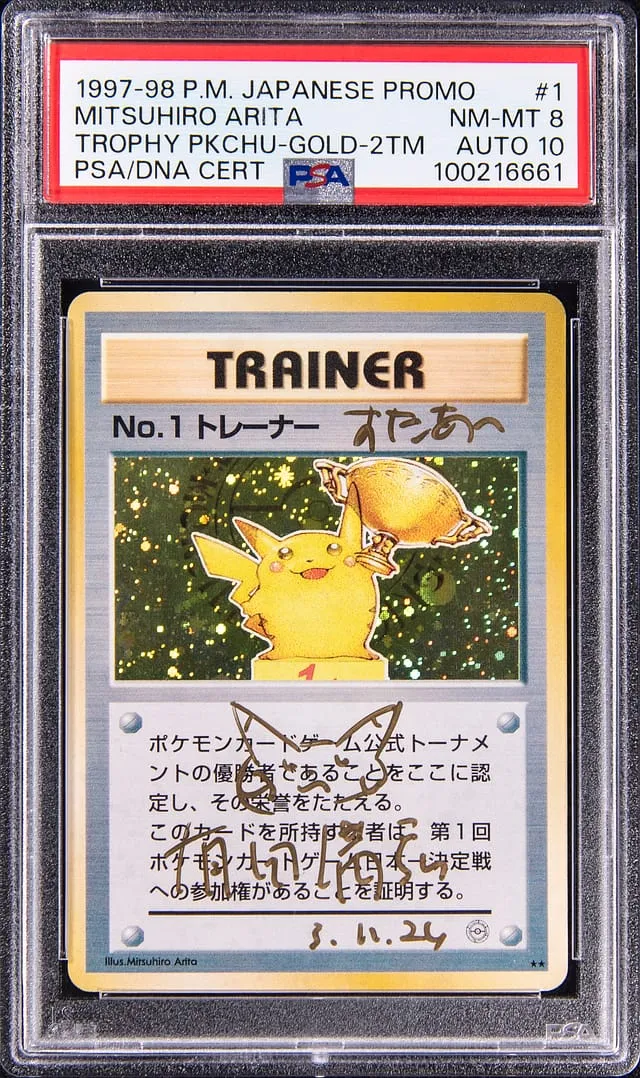
Goldin sold a 1997-98 1st Place Trophy Pikachu Arita signed and sketched PSA 8 / PSA-DNA 10 Pop 1 for $186,660. Here’s what it means for collectors.
Sold Card
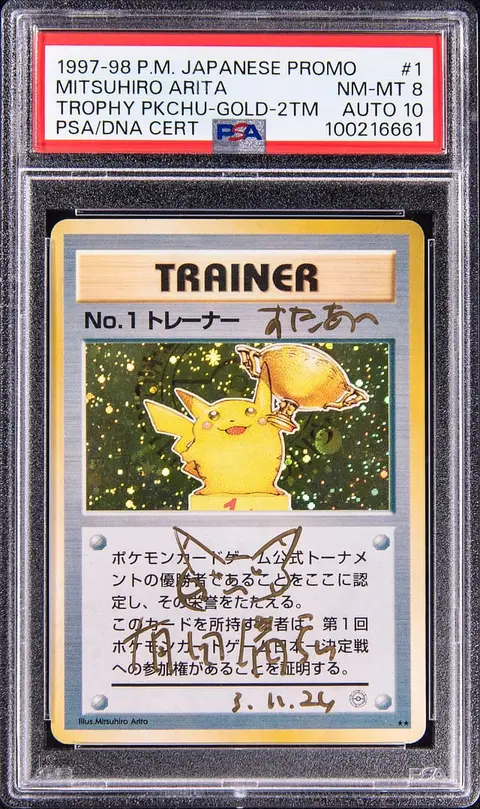
1997-98 Pokemon Japanese Promo 2nd Tournament Gold 1st Place #1 Trophy Pikachu - Signed, Sketched by Mitsuhiro Arita - PSA NM-MT 8, PSA/DNA GEM MT 10 - Pop 1
Sale Price
Platform
Goldin1997-98 Pokémon Japanese Promo 2nd Tournament Gold 1st Place #1 Trophy Pikachu – Signed, Sketched by Mitsuhiro Arita – PSA NM-MT 8, PSA/DNA GEM MT 10 – Pop 1
On March 9, 2026, Goldin sold one of the most elusive and historically important Pokémon cards in existence: a 1997-98 Pokémon Japanese Promo 2nd Tournament Gold 1st Place #1 Trophy Pikachu, signed and sketched by illustrator Mitsuhiro Arita, graded PSA NM-MT 8 with a PSA/DNA GEM MT 10 autograph. The final price was $186,660.
For long-time collectors, this card sits at the intersection of three pillars of the hobby: early competitive history, extreme scarcity, and a unique artist inscription. For newer collectors, it’s a case study in how tournament promos and one-of-a-kind attributes can create a market outlier.
Card overview: what exactly sold?
Let’s break down the full title and what each piece means:
- Year / Era: 1997-98, the very beginning of organized Pokémon play in Japan
- Card: Trophy Pikachu #1 – the 1st Place version
- Release type: Japanese promo, awarded as a tournament prize, not a pack-pulled card
- Event: 2nd Tournament, part of the earliest Japanese tournaments
- Finish: Gold 1st Place (the winner’s trophy card for that event)
- Character: Pikachu, the franchise mascot and most recognized Pokémon globally
- Autograph & sketch: On-card signature and sketch by Mitsuhiro Arita, one of the most important early Pokémon illustrators
- Grading:
- Card grade: PSA NM-MT 8 (Near Mint–Mint)
- Autograph grade: PSA/DNA GEM MT 10 (a perfect auto grade)
- Population: Pop 1 in this exact configuration (a PSA 8 card with PSA/DNA GEM MT 10 auto and sketch), according to the description
This is not a rookie card in the sports sense, but in Pokémon terms it is an early-era, top-tier trophy promo, firmly in the “key issue” category for serious collectors.
Why Trophy Pikachu cards matter
Before looking at prices, it helps to understand the context.
Early tournament history
The 1997–98 Trophy Pikachu promos were awarded at some of the very first official Pokémon tournaments in Japan. They were not sold at retail, not available in booster packs, and not distributed widely as mail-in or magazine promos.
Instead, they were given only to top finishers – often 1st, 2nd, and 3rd place – in these early events. That immediately puts them into the:
- Extremely low print run category
- Historically important category, since they directly document the start of organized Pokémon play
Scarcity and condition
Trophy cards have two layers of scarcity:
- Total copies created – believed to be very low for each placement and tournament
- Surviving graded copies – many stayed in winners’ collections, raw and ungraded, for years
On top of that, this specific example adds an extra layer:
- Artist-signed and sketched by Mitsuhiro Arita
- Autograph graded GEM MT 10 by PSA/DNA
That makes it not just a trophy card, but a one-of-a-kind trophy/artist hybrid within the graded population.
Grading and population notes
From the listing data and PSA/DNA labels:
- PSA card grade: NM-MT 8
- For an ultra-rare late-1990s trophy card, an 8 is often considered strong. These were not pulled from packs and sleeved immediately; they were awards, sometimes handled or displayed.
- PSA/DNA autograph grade: GEM MT 10
- Autograph grading evaluates the quality and presentation of the signature (and in this case, the sketch). A GEM MT 10 signals a clean, bold, essentially flawless inscription.
- Pop 1
- “Pop 1” means population 1 – PSA’s census shows only one example in this exact grade configuration. For collectors, this is a major driver of uniqueness.
Market context and comps
Because this card is so scarce and so specialized (trophy status + Arita sketch + dual grades), there are very few direct “comps” – a hobby shorthand for comparable recent sales.
However, we can still place it within a broader context:
Trophy Pikachu and early Japanese trophy cards
Across major auction houses like Goldin, Heritage, and PWCC, Trophy Pikachu cards from the late 1990s have consistently appeared in:
- High five-figure to six-figure ranges, depending on:
- Placement (1st vs 2nd vs 3rd)
- Tournament (1st, 2nd, etc.)
- Condition and grading
- Whether the card is signed or sketched
Non-autographed, high-grade trophy cards from this era have historically recorded some of the strongest Pokémon prices.
Signed & sketched Arita pieces
Artist-signed cards, especially by Mitsuhiro Arita, have become their own subcategory:
- Common or mass-printed cards with Arita signatures usually sell in much more accessible ranges.
- Ultra-rare promos or trophy-level pieces with on-card sketches and PSA/DNA GEM MT 10 autos set themselves apart as premium outliers.
Within this segment, the $186,660 price realized at Goldin on March 9, 2026, is consistent with the idea that a top-tier, pop 1, Arita-sketched trophy card commands a significant premium over unsigned or non-sketch counterparts.
Because these sales are infrequent and each example can be unique (different sketch, different inscription, different grading path), it’s more accurate to view this result as one data point in a very thin market, not a stable “going rate.”
How this sale fits into the broader Pokémon market
A few broader themes are worth noting:
High-end Pokémon remains driven by true scarcity
While the broader Pokémon market has seen cycles of growth and correction, the very top tier – early trophies, no-number promos, and unique items – has generally held the strongest relative interest among advanced collectors.Historical significance is increasingly valued
Cards tied to the origins of organized play, like the 1997-98 trophy promos, are often viewed as hobby artifacts as much as collectibles.Artist involvement adds a distinct layer of demand
As more collectors pay attention to illustrators (Arita, Sugimori, etc.), signed and sketched examples move from “nice extra” to “core part of the card’s identity.” A GEM MT 10 autograph grade emphasizes that this particular example is as clean as it gets on that front.
What collectors can learn from this sale
For newcomers and returning collectors, here are a few practical takeaways:
- Tournament and trophy promos occupy a different lane than standard booster cards. Their value is often tied more to history and scarcity than to character popularity alone.
- Population reports matter, especially for grail-level pieces. When you see “Pop 1” on a card like this, it’s signaling that even if you have the money, you may simply not see another one available soon.
- Autographs and sketches need structure. Third-party authentication (like PSA/DNA) and grades (like GEM MT 10) help the market reach some agreement on value by removing questions about authenticity and condition of the autograph.
- Comps are less straightforward at the top. For modern set cards, recent sales might create a fairly tight price band. For a pop 1 trophy with a unique sketch, each auction becomes its own reference point.
For small sellers and active hobbyists
Most collectors will never own a 1997-98 Gold 1st Place Trophy Pikachu, but this sale still offers useful perspective:
- It shows how provenance and story (tournament origin, illustrator involvement, grading) can compound value.
- It underlines how high-end collectors increasingly focus on uniqueness – whether that’s a rare stamp, a specific promo run, or an artist sketch.
- It demonstrates the role of major auction houses like Goldin, which provide a venue and documentation trail for these top-tier sales.
If you’re buying or selling lower-tier promos or signed cards, understanding these same factors – history, scarcity, condition, and authentication – can help you contextualize your own pieces in the wider market, even if the dollar amounts are smaller.
Final thoughts
The March 9, 2026 Goldin sale of the 1997-98 Pokémon Japanese Promo 2nd Tournament Gold 1st Place #1 Trophy Pikachu – Signed and Sketched by Mitsuhiro Arita – PSA 8, PSA/DNA 10, Pop 1 at $186,660 reinforces a consistent theme in the Pokémon market:
At the very top, collectors are prioritizing irreplaceable items with clear historical significance, verified authenticity, and unique artistic elements. For a card that represents the dawn of competitive Pokémon, bears the hand-drawn work of one of its most iconic illustrators, and exists as a population 1 example in this configuration, that premium makes sense within today’s high-end market context.
As always, prices can move in both directions over time. For now, this sale stands as a reference point for how the hobby is currently valuing the rarest intersections of history, art, and competition in Pokémon cards.