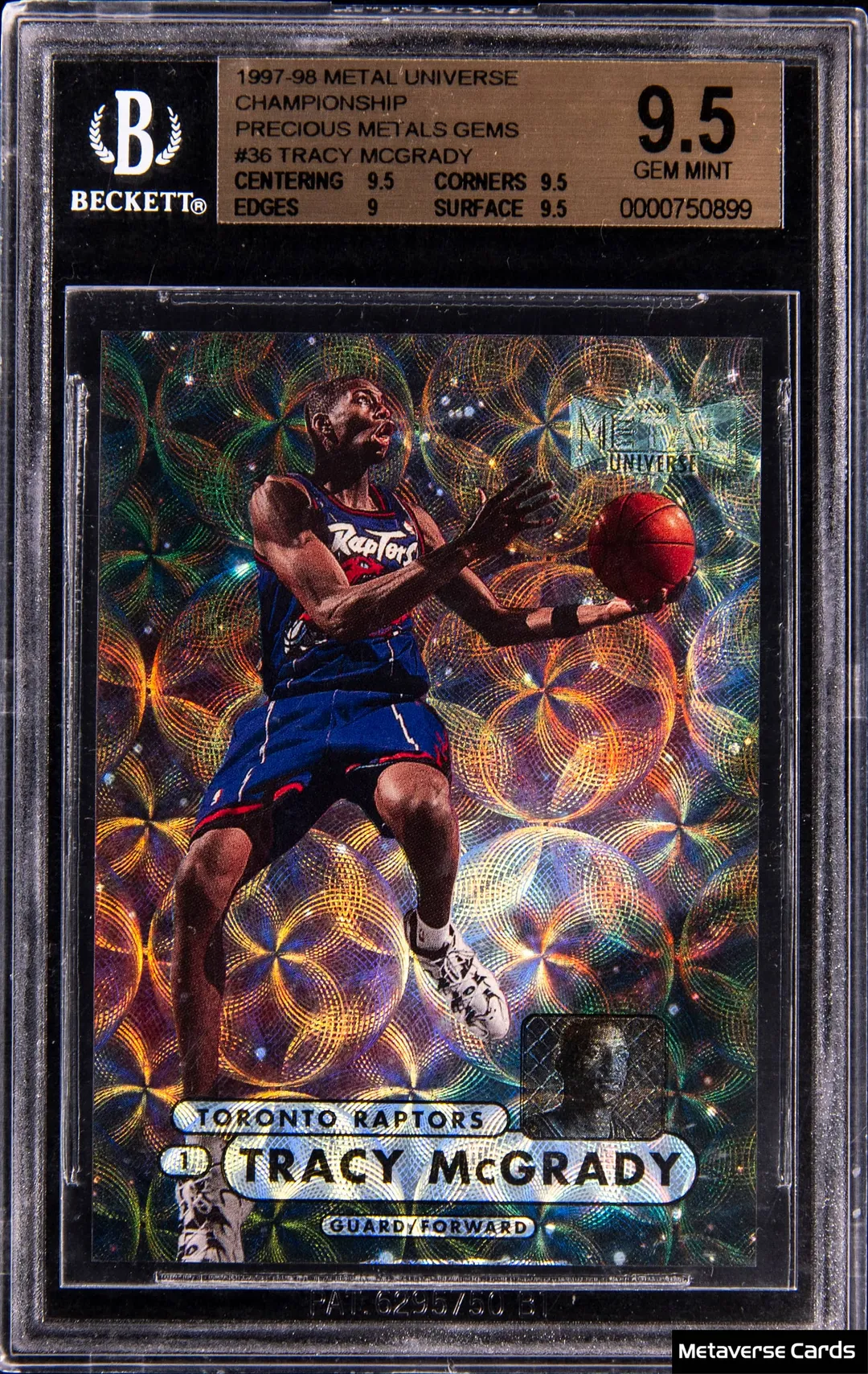
1997-98 T-Mac PMG Championship BGS 9.5 Sells at Goldin
A BGS 9.5 1997-98 Metal Universe Championship PMG Tracy McGrady rookie /50 sold for $20,362 at Goldin on Feb 8, 2026. Here’s the market context.
Sold Card
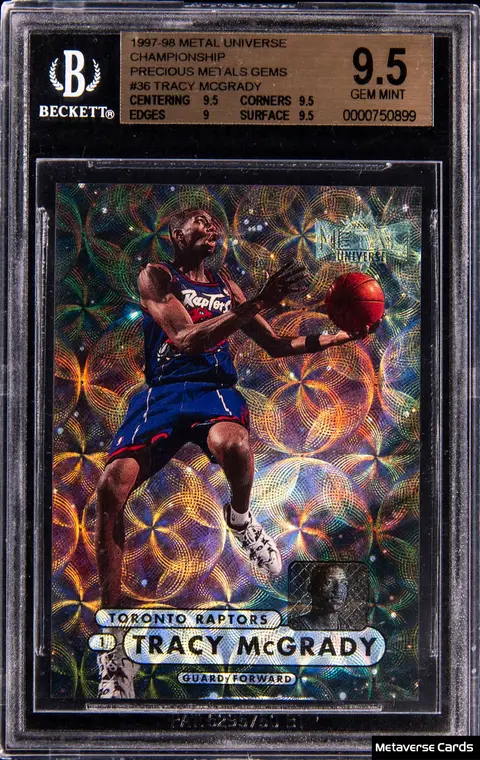
1997-98 SkyBox Metal Universe Championship Precious Metal Gems (PMG) #36 Tracy McGrady Rookie Card (#008/50) - BGS GEM MINT 9.5 - Pop 3
Sale Price
Platform
Goldin1997-98 SkyBox Metal Universe Championship Precious Metal Gems (PMG) cards sit near the top of many 90s basketball wantlists. When a high-grade rookie surfaces, it tends to turn heads.
On February 8, 2026, Goldin sold a 1997-98 SkyBox Metal Universe Championship Precious Metal Gems #36 Tracy McGrady Rookie Card, serial numbered 008/50, graded BGS GEM MINT 9.5, for $20,362. This is one of the key 90s McGrady issues and a meaningful data point for the PMG Championship market.
Card overview
Let’s break down exactly what this card is:
- Player: Tracy McGrady
- Team: Toronto Raptors
- Year: 1997-98
- Set: SkyBox Metal Universe Championship
- Insert/Parallel: Precious Metal Gems (PMG)
- Card number: #36
- Rookie card: Yes, this is a premier parallel of McGrady’s rookie season
- Serial number: 008/50
- Grading company: Beckett Grading Services (BGS)
- Grade: BGS 9.5 GEM MINT
- Population: Pop 3 in BGS 9.5 for this specific PMG Championship parallel
The Championship PMGs are a tougher, lower-serial companion to the standard 1997-98 Metal Universe PMGs. While the base Metal Universe set is already popular for its artwork and 90s aesthetic, the Championship versions bring an additional level of scarcity.
Why this card matters to collectors
Several factors give this card outsized importance in the 90s basketball lane:
PMGs as a cornerstone 90s parallel
Precious Metal Gems inserts are widely viewed as one of the defining 1990s basketball parallels. They feature bold foil designs and strict serial numbering, which was still relatively new at the time. The Championship PMGs, serial numbered to just 50 copies, sit in a tier of scarcity that helps them function more like modern super-short prints.Rookie-year Tracy McGrady
Tracy McGrady is a Hall of Famer, a two-time scoring champion, and one of the most gifted offensive players of his era. While his mainstream rookie cards come from several 1997-98 sets, high-end parallels like PMGs are where serious 90s collectors often focus when they want a “centerpiece” T-Mac.Low population in a high grade
The Goldin copy is graded BGS 9.5 GEM MINT and is a Pop 3—meaning Beckett has only graded three examples of this card at 9.5. PMGs are notoriously condition-sensitive due to chipping and surface issues. Seeing any PMG Championship in GEM MINT is relatively uncommon, and that scarcity often shows up in pricing.Era and set significance
The late-90s “insert and parallel boom” predates today’s ultra-modern chase cards, but a lot of the current hobby’s design language and rarity structure can be traced back to sets like Metal Universe and their PMG inserts. Collectors who are focused on historical importance and aesthetics tend to gravitate toward these 1997-98 issues.
Market context and recent sales
When hobbyists talk about “comps,” they mean comparable recent sales—cards that are as close as possible in set, player, grade, and serial numbering. For a card this scarce, comps are naturally thin.
For this specific card:
- 1997-98 Metal Universe Championship PMG #36 Tracy McGrady /50, BGS 9.5 (Pop 3)
- Sold at Goldin on February 8, 2026 for $20,362.
Because PMG Championship cards are low-serial and many are locked into long-term collections, the market doesn’t see a steady stream of identical copies. Instead, collectors often look at a mix of:
- The same card in lower grades (BGS 8, BGS 8.5, BGS 9, PSA 8–9)
- Other high-end McGrady rookies (e.g., traditional PMGs, key parallels from 1997-98 flagship products)
- Other Hall of Famer PMG Championship rookies from the same set
Across this broader group of comps, PMG Championship rookies from the 1997-98 run have generally established themselves in a clear premium tier over non-PMG rookies. Pricing can vary sharply by player, grade, and eye appeal, but the pattern is consistent: PMG Championship + Hall of Fame rookie + high grade tends to command strong results relative to more common parallels.
How this $20,362 sale fits in
Given the limited public sales of this exact card and grade, the $20,362 result should be read as a current data point rather than a definitive market ceiling or floor. What we can reasonably say from the context:
- It confirms ongoing demand for high-grade 90s PMG rookies, even outside the very top tier of headliners.
- It reinforces that BGS GEM MINT 9.5 still carries weight for 90s PMGs in the eyes of many collectors, especially when the pop report is low.
- It shows that well-presented PMG Championship copies continue to attract significant capital in major auction settings.
Because the card is both serial-numbered to 50 and Pop 3 in BGS 9.5, even small shifts in demand can move prices meaningfully. With so few examples that trade hands, each sale tends to influence how collectors think about the card’s range.
Tracy McGrady’s hobby standing
Tracy McGrady’s legacy is fairly well settled:
- Hall of Fame inductee (Class of 2017).
- Two-time scoring champion and seven-time All-Star.
- A central figure in the early-2000s scoring era.
Unlike active stars, his market isn’t driven by nightly performance swings. Instead, interest in his cards tends to follow broader trends:
- Renewed appreciation for late-90s and early-2000s aesthetics.
- Ongoing focus on Hall of Fame-level scorers.
- Increased attention on insert and parallel history, where PMGs almost always enter the conversation.
This PMG Championship rookie sits at the intersection of all three themes, which helps explain why collectors treat it as a key McGrady card rather than just another parallel.
What this means for collectors
For collectors and small sellers looking at this sale as a reference point, a few takeaways:
Ultra-scarce 90s parallels behave differently than base rookies.
With only 50 copies printed and a BGS 9.5 pop of 3, this card doesn’t follow the more predictable price patterns of widely available rookies. Sales tend to be sporadic, and each auction can reset expectations.Grade and eye appeal both matter.
A BGS 9.5 label is important, but PMG collectors also pay close attention to color, chipping, and centering. Two GEM MINT copies can still be evaluated differently based on their visual presence.Context beats headlines.
The $20,362 Goldin result is a strong sale, but for decision-making, it’s best used alongside other comps: lower grades, related McGrady PMGs, and similar Hall of Fame PMG Championship rookies.PMG Championship remains a long-term reference point.
Regardless of short-term price moves, this parallel is embedded in the story of 90s basketball inserts. Collectors who care about the history of the hobby will likely keep this set on their radar.
How figoca looks at a sale like this
At figoca, we treat a sale like the February 8, 2026 Goldin auction as one more data point in a larger pattern:
- We track serial-numbered, low-population 90s inserts separately from mass-produced rookies.
- We prioritize grade plus population when comparing results; a Pop 3 BGS 9.5 is not interchangeable with a much more common grade.
- We see PMG Championship rookies as important markers when mapping the trajectory of Hall of Fame player markets.
For collectors building a 90s portfolio—or simply deciding whether to hold or move a high-end McGrady—this sale offers another anchor point, not a guarantee. As always, prices can and do move in both directions, and each card’s condition and timing play a significant role.
What doesn’t really change is the card’s place in the hobby’s history: a low-serial, GEM MINT copy of a PMG Championship Tracy McGrady rookie will likely remain one of the defining McGrady cards of the 1990s, regardless of where the next auction lands.