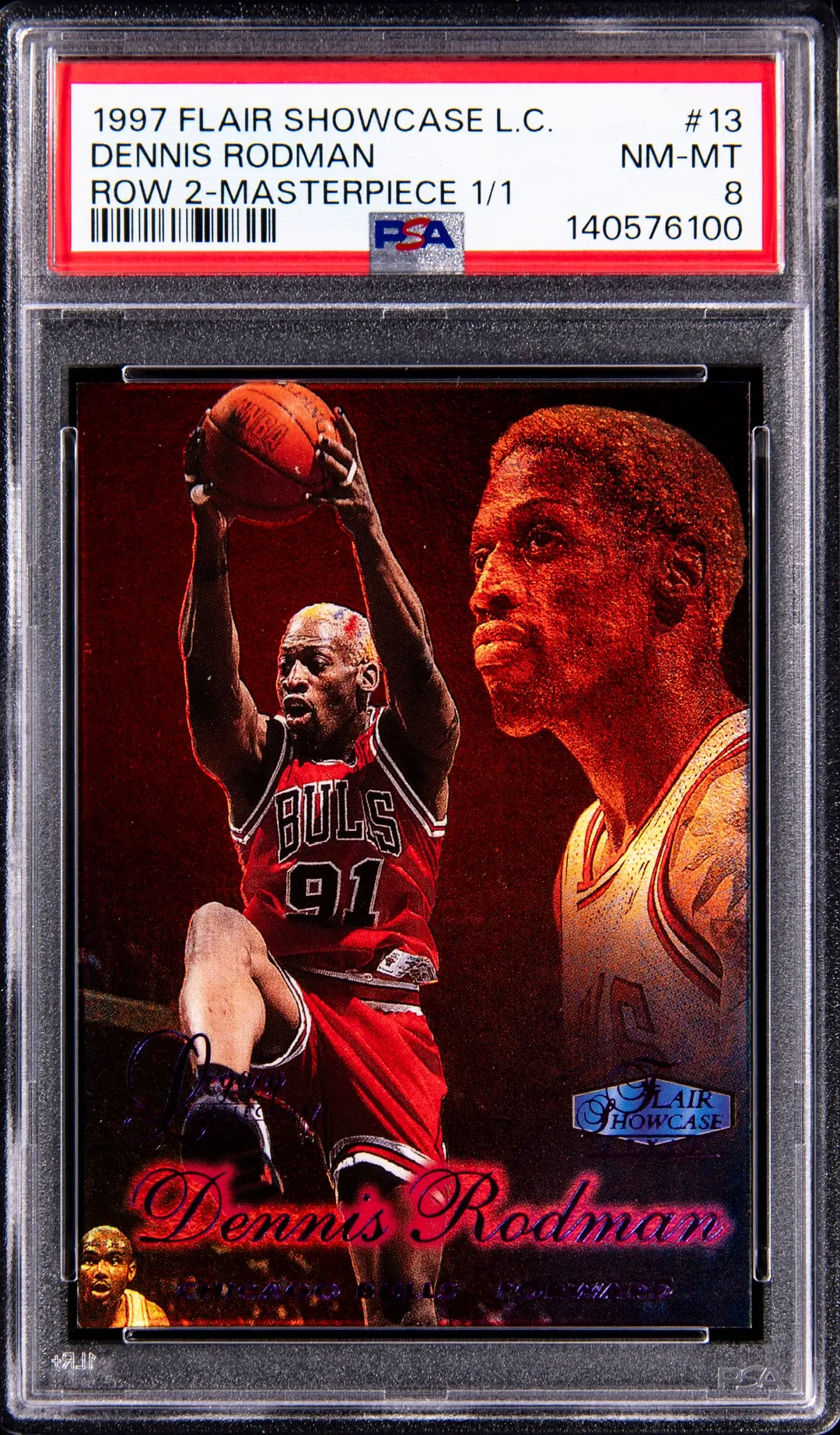
1997-98 Rodman Flair Legacy Masterpiece 1/1 Sale
Figoca breaks down the $63,440 sale of the 1997-98 Flair Showcase Legacy Collection Row 2 Masterpiece 1/1 Dennis Rodman, PSA 8, at Goldin on 2/08/26.
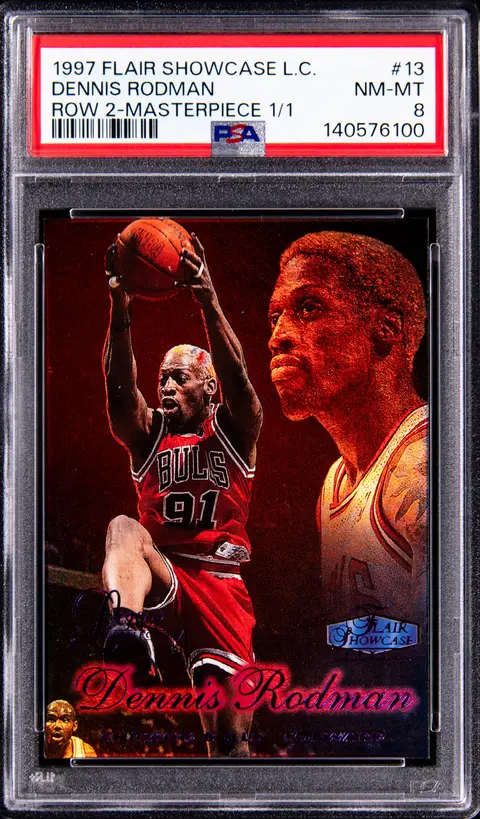
Sold Card
1997-98 Flair Showcase Legacy Collection Row 2 Masterpiece #13 Dennis Rodman (#1/1) - PSA NM-MT 8
Sale Price
Platform
Goldin1997-98 Flair Showcase Legacy Collection Row 2 Masterpiece #13 Dennis Rodman (#1/1) - PSA NM-MT 8 Sold for $63,440 on Goldin (2/08/26)
For collectors who follow 1990s basketball inserts and parallels closely, the 1997-98 Flair Showcase Legacy Collection Masterpieces sit near the top of the pyramid. A copy of the Dennis Rodman Masterpiece from this run – the 1997-98 Flair Showcase Legacy Collection Row 2 Masterpiece #13 Dennis Rodman, serial-numbered 1/1 and graded PSA NM-MT 8 – just sold at Goldin on 2/08/26 for $63,440.
This sale offers a useful checkpoint for how the hobby currently values one-of-one 1990s Hall of Famer parallels from a historically important insert era.
Card overview
Let’s start by laying out exactly what this card is:
- Player: Dennis Rodman (Chicago Bulls)
- Year: 1997-98
- Set: Flair Showcase
- Subset/Parallel: Legacy Collection Row 2 Masterpiece
- Card number: #13
- Serial numbering: 1-of-1 (the only copy produced)
- Grading company: PSA (Professional Sports Authenticator)
- Grade: NM-MT 8 (Near Mint-Mint 8)
- Rookie or key issue? Not a rookie, but a premier 90s parallel and a key high-end Rodman issue
The Legacy Collection cards were already premium parallels in 1997-98, with distinct blue foil and serial numbering. The Masterpiece level takes that a step further: for each player, there is only one Masterpiece copy produced. In other words, this is the only Row 2 Masterpiece Rodman that exists.
There are no autos or patches on this card. The appeal comes from three things: the 1990s era, the Flair Showcase brand, and the absolute scarcity of a 1/1 parallel of an iconic Hall of Famer.
Why Flair Showcase Legacy Masterpieces matter
For newer or returning collectors, a quick bit of context:
- Flair Showcase in the late 1990s was a higher-end basketball product from Fleer, focused on premium card stock and photography.
- The product was structured in “Rows” – usually Row 0, Row 1, and Row 2 – which changed the design and, generally, the relative scarcity and appeal.
- The Legacy Collection parallels added blue foil and serial numbering, making them significantly tougher than the base cards.
- The Masterpiece tier is the pinnacle: a unique, one-of-one version for each player.
In hobby terms, these are considered “grail” level cards for player collectors. They’re from the late-90s insert boom, before serial-numbering and parallels became widespread in every release. That combination of era, design, and extreme scarcity is what gives the Masterpieces their long-term importance in the market.
Rodman’s Bulls-era cards benefit from the broader demand around the 1990s Chicago Bulls dynasty. While his rookie cards are from the late 1980s, many collectors see his mid-to-late 90s high-end inserts and parallels as the true centerpieces of a Rodman collection.
Grading context: PSA 8 for a 1990s 1/1
A PSA 8 (Near Mint-Mint) on a 1997-98 Flair Showcase card is fairly typical for a 90s premium insert. The thicker card stock, foil, and dark backgrounds often show:
- Edge and corner chipping
- Surface scratches or print lines
- Minor handling wear from the original pack-out era
For one-of-one cards, the grade does matter, but it’s often secondary to the fact that the card exists at all. With only a single copy in the world, the PSA population report (called the “pop report,” which tracks how many copies PSA has graded at each grade) will show a population of one with no higher or lower comparisons.
In other words: there is no “better” copy out there to chase. This PSA 8 is the Rodman Row 2 Masterpiece.
Market context and comparable sales
Because this is a 1/1 Masterpiece, traditional “comps” (short for comparables – recent sales of the same or very similar items) are naturally limited. You can’t line up multiple copies of the exact same card.
Instead, collectors and market watchers usually look at:
- Sales of other Rodman 1990s grail-level parallels
- Sales of other players’ Flair Showcase Masterpieces from the same era
- Sales of high-end 90s one-of-one parallels for comparable Hall of Fame players
Recent auction and marketplace data for this exact card is sparse, which is expected for a unique, high-end piece that tends to sit in collections for long periods. When Masterpieces and similar-tier 1/1 1990s parallels do show up, they’re usually handled by major auction houses (Goldin, PWCC, Heritage, etc.) rather than casual marketplaces.
Based on the broader pattern of high-end 90s Hall of Famer parallels:
- Star-level and Hall of Fame non-rookie 1/1 parallels from the late 90s typically sell at a steep premium versus more available inserts and numbered parallels.
- Character and narrative matter – Rodman’s status as one of the most recognizable defenders and rebounders of all time, and his role on the Bulls’ second three-peat, increases collector interest.
- Flair Showcase Legacy Masterpieces for top-tier 90s icons (Jordan, Kobe, etc.) sit at the very top of the 90s basketball price structure when they surface.
Within that framework, a $63,440 result for a Rodman Masterpiece in PSA 8 is in line with the broader trend of strong pricing for true one-of-one 90s Hall of Famer cards. Because public sales of this exact card are scarce, it’s better understood as a fresh benchmark rather than something clearly “high” or “low” versus a long track record of identical comps.
Why collectors care about this card
Several factors combine to make this a meaningful card for both Rodman collectors and 1990s specialists:
True scarcity
There is only one Masterpiece copy for this player in this row. Modern sets often produce large runs of numbered parallels, color variations, and case hits. In contrast, the 1990s one-of-one structure was much more limited and selective.1990s insert era importance
The mid-to-late 1990s are widely seen as the foundation of modern insert and parallel culture. Sets like Flair Showcase, E-X, Metal Universe, and others established many of the ideas that modern products still rely on: serial numbering, distinct visual parallels, and chase tiers.Rodman’s hobby profile
Rodman is not a volume scorer, but his reputation as an elite defender and rebounder, combined with his personality and pop culture visibility, gives his key cards a different lane of demand compared to traditional scoring legends.Bulls championship era connection
1997-98 is tied to the Bulls’ sixth championship and the era covered in “The Last Dance.” Cards from that window benefit from a mix of nostalgia and long-term cultural attention.
How this sale fits into the current hobby
The $63,440 sale price at Goldin on 2/08/26 reflects a few broader trends collectors have been watching in recent years:
- Consolidation into true scarcity: Many advanced collectors have shifted focus from widely available modern parallels to genuinely scarce, historically important 90s inserts and 1/1s.
- Player-collector depth: High-end Rodman pieces have an audience beyond just Bulls team collectors. Player-specific collectors often prioritize rare inserts and 1/1s over base rookies once they reach a certain level of commitment.
- Stable demand for 90s hall-of-fame inserts: While broader market cycles have had ups and downs, the upper tier of 1990s inserts and parallels for Hall of Famers has generally held attention and liquidity in the auction space.
This sale doesn’t rewrite the entire price structure of Rodman cards on its own, but it does:
- Provide a clear, public marker for what a top-tier Rodman 1/1 from the 90s can command
- Reinforce the status of Flair Showcase Legacy Masterpieces as serious, long-term targets for set builders and player collectors
Takeaways for collectors and small sellers
If you’re a collector or small seller trying to understand what this means in practical terms:
- Most Rodman cards won’t be in this price tier. This is a perfect storm of scarcity (1/1), brand (Flair Showcase), era (late 90s), and player (Hall of Famer on a dynasty team).
- Condition still matters, even for 1/1s. A PSA 8 is respectable for the era, and higher grades can matter significantly for other high-end 90s inserts where more copies exist.
- For pricing your own cards, focus on real comps. Look at recent sales of similar sets, players, and scarcity tiers rather than assuming that any serial-numbered or “rare” card will track this kind of result.
- If you collect 90s inserts, this is a reference point. You can use this sale as part of your mental map for where Masterpieces and other 1/1 90s parallels fit relative to more common inserts, numbered cards, and modern parallels.
Final thoughts
The 1997-98 Flair Showcase Legacy Collection Row 2 Masterpiece #13 Dennis Rodman (#1/1) in PSA NM-MT 8 selling for $63,440 at Goldin on 2/08/26 is another data point confirming how the market values true one-of-one 1990s Hall of Famer cards.
For Rodman collectors, it’s a reminder that his very best 90s pieces have moved firmly into the high-end tier. For 90s insert enthusiasts more broadly, it reinforces the long-term importance of Flair Showcase Legacy Masterpieces as cornerstone cards in the era’s story.
As always, it’s worth treating sales like this as context, not a price promise. They help map the upper end of the market while you build a collection that fits your own budget, goals, and taste.