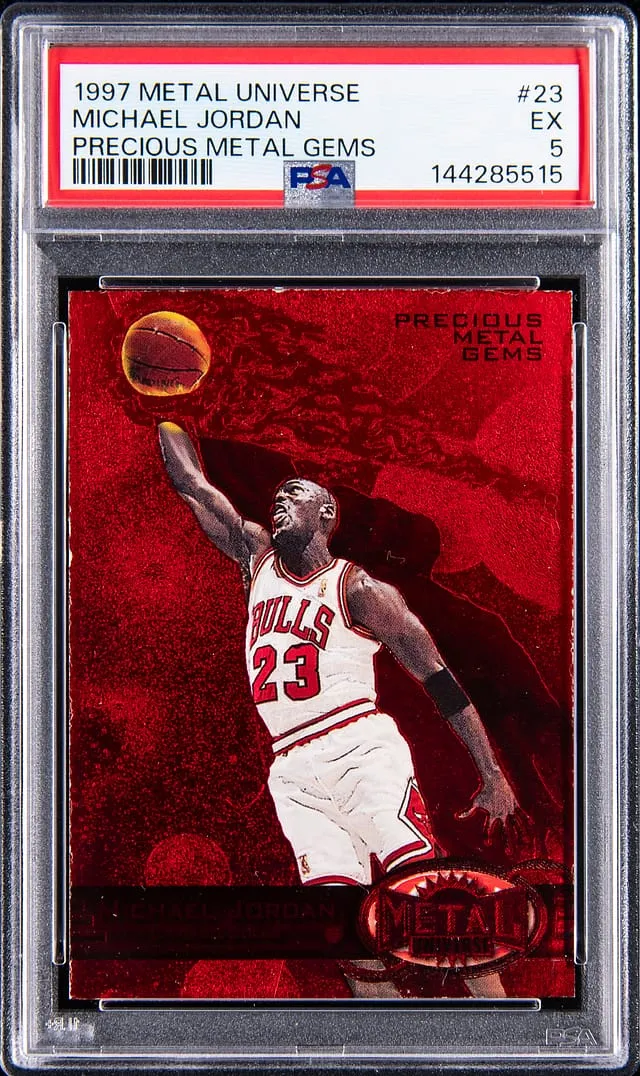
1997-98 PMG Red Michael Jordan PSA 5 Sells for $640K
Figoca looks at the $640,500 Goldin sale of a 1997-98 SkyBox Metal Universe PMG Red Michael Jordan PSA EX 5 and what it means for collectors.
Sold Card
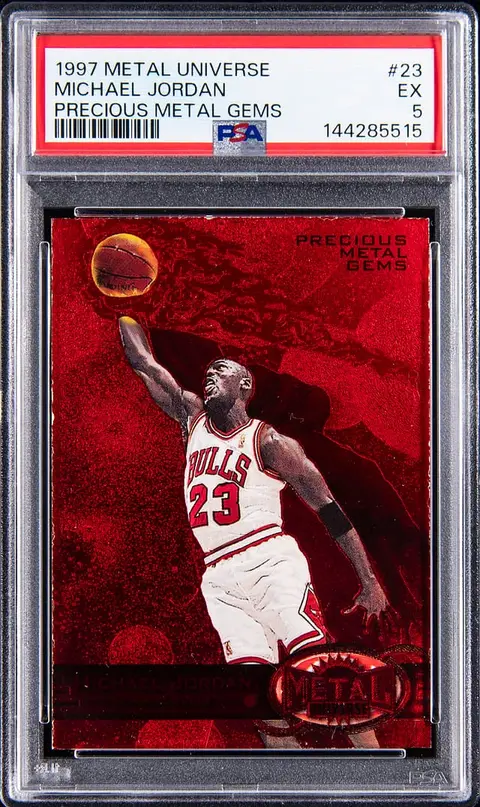
1997-98 SkyBox Metal Universe Precious Metal Gems (PMG) Red #23 Michael Jordan (#060/100) - PSA EX 5
Sale Price
Platform
Goldin1997-98 SkyBox Metal Universe Precious Metal Gems (PMG) Red #23 Michael Jordan (#060/100) – PSA EX 5 sold on March 8, 2026 at Goldin for $640,500. For many collectors, that sentence alone says a lot about where the high-end basketball market is today.
In this breakdown, we’ll walk through what this card is, why it matters so much, and how this sale fits into recent price history and collector sentiment.
The card at a glance
- Player: Michael Jordan
- Team: Chicago Bulls
- Year: 1997-98
- Set: SkyBox Metal Universe
- Parallel: Precious Metal Gems Red
- Card number: #23
- Serial numbering: #060/100
- Rookie?: Not a rookie card, but widely viewed as a key Jordan issue
- Grading company: PSA (Professional Sports Authenticator)
- Grade: EX 5 (Excellent)
This is the iconic 1997-98 Metal Universe Precious Metal Gems Red Jordan, serial numbered to 100 copies. Within that print run, the first 10 serial numbers were the even rarer Green parallel, leaving effectively 90 true Red copies in the checklist.
PMG Reds are not about pack-fresh perfection. The foil, colored edges, and fragile surface mean that even lightly handled copies often show chipping, edge wear, or surface defects. That’s why a PSA 5 (Excellent) can still command strong attention and significant bids.
Why this card matters to collectors
A cornerstone 1990s parallel
The 1997-98 Precious Metal Gems run is one of the defining parallel sets of the 1990s. When collectors talk about “grails” (cards that sit at the top of a player’s market), Jordan’s PMG Green and PMG Red are always near the top of the list.
Key reasons collectors care so much about this card:
- Historic parallel: PMGs helped establish the modern idea of highly limited, colored parallels that drive a player’s high-end market today.
- True scarcity: With a print run of 100 (and only 90 Reds), this is inherently scarce, especially compared to mass-produced 1990s base cards.
- Condition sensitivity: The red foil design and full-bleed color make high-grade copies extremely difficult, which magnifies demand across the grade spectrum.
- Era significance: Late-1990s inserts and parallels are now seen as the blueprint for today’s premium basketball releases.
- Player: Michael Jordan’s hobby status needs no explanation. For many, this is one of his top non-rookie, non-autograph cards.
Within the broader Jordan market, this card sits alongside 1986 Fleer rookies, key 1990s inserts, and early autographs as a “pillar” piece – especially for collectors focused on rare parallels rather than rookies.
Understanding the grade: PSA EX 5
PSA’s EX 5 (Excellent) grade generally allows for moderate wear: visible edge and corner wear, some surface issues, and small print or handling defects.
On a modern chrome card, EX 5 might feel very low. On a 1997-98 PMG Red, the bar is different:
- Many raw (ungraded) examples show heavy chipping, edge flaking, and creases.
- The combination of colored foil and full-bleed design punishes even minor handling.
Because of this, collectors often evaluate PMGs more on eye appeal (how the card looks at arm’s length) than strictly on the number on the label. A PSA 5 with strong centering and color can be more desirable than a technically higher grade with more obvious flaws.
Market context: how $640,500 fits in
This copy realized $640,500 at Goldin on March 8, 2026 (UTC).
To understand that number, it helps to look at:
- Comps – short for “comparables,” meaning recent sales of the same card or closely related versions.
- Relative positioning – how this sale compares to higher and lower grades of the same card and to other key Jordan issues.
PMG Red Jordan price landscape
Over the last several years, the 1997-98 PMG Red Jordan has seen a wide range of realized prices, influenced by grade, eye appeal, and broader market cycles. Top-grade examples and visually strong mid-grade copies have commanded particularly strong attention.
While exact numbers move over time, the pattern has been relatively consistent:
- High-grade PMG Reds (PSA 8–9, strong BGS equivalents): have historically pushed into very high six-figure and, in some instances, seven-figure territory at peak moments of the market.
- Mid-grade PMG Reds (around PSA 5–7): tend to trade in a lower band but still firmly within high-end territory, reflecting the combination of scarcity and Jordan’s status.
- Lower-grade / heavily worn copies: still attract serious bidding due to the inherent rarity of any authentic example.
This PSA EX 5 result at $640,500 slots firmly in the mid-grade band while reflecting the broader trend that even “modest” grades for this card can command significant premiums over many other Jordan inserts and parallels.
Relative to other Jordans
Within the Jordan market, this sale underscores a few ongoing themes:
- Non-rookie premium: Top non-rookie Jordan cards, especially rare 1990s parallels, continue to sit in the same conversation as flagship rookie assets.
- Set prestige matters: The Metal Universe PMG name still carries weight. Collectors are not just buying a Jordan card; they’re buying a piece of hobby history.
- Grade tolerance for key 1990s parallels: For cards this difficult, collectors have shown consistent willingness to pay for mid-grade examples when the card is important enough.
Collector significance in 2026
Michael Jordan’s status in the hobby is stable: his playing career is long over, his place in history is secure, and he regularly features in hobby conversations, documentaries, and cultural references. There isn’t typically a single news event driving demand; instead, it’s his long-term, established status.
What continues to matter for cards like this PMG Red are:
- Supply hitting the market: PMG Jordan Reds do not appear frequently at public auction. When they do, collectors and investors alike tend to pay attention.
- Eye appeal versus technical grade: High-resolution images and detailed descriptions often influence bidding more than the grade number alone.
- Broader market tone: Periods of stronger high-end auction activity generally see more aggressive bidding on grail-level 1990s inserts.
The Goldin sale on March 8, 2026 adds another data point showing that demand for iconic 1990s parallels, especially PMGs, remains solid across the grading spectrum.
How small collectors can use this information
Most collectors will never chase a PMG Jordan Red. Still, this sale contains useful lessons for anyone active in the hobby:
- Set history matters. Cards from historically important insert and parallel runs often hold collector interest across market cycles.
- Scarcity plus condition sensitivity is powerful. Limited print runs combined with fragile designs can drive long-term demand, even in middle grades.
- Look beyond rookies. For established legends, non-rookie grails can be as important as – or even more important than – their first-year cards.
- Use comps thoughtfully. When looking up recent sales, focus on:
- The exact card (year, set, parallel, numbering).
- The grade and the grading company.
- How the card actually looks in photos.
For a card like this, small differences in centering, chipping, or surface can help explain sizeable swings in realized prices from one auction to the next.
Final thoughts
The sale of the 1997-98 SkyBox Metal Universe PMG Red #23 Michael Jordan #060/100, PSA EX 5 for $640,500 at Goldin on March 8, 2026 reinforces the position of PMGs as foundational pieces in the high-end basketball market.
For seasoned PMG collectors, it’s another important data point in an already-documented story. For newer collectors, it offers a clear example of how set history, design, scarcity, and condition all come together to shape what becomes a true modern grail.
As always, these results are better viewed as context rather than predictions. They help map today’s market for one of the hobby’s most storied parallels, and they highlight how deep collector demand runs for the very best of the 1990s.