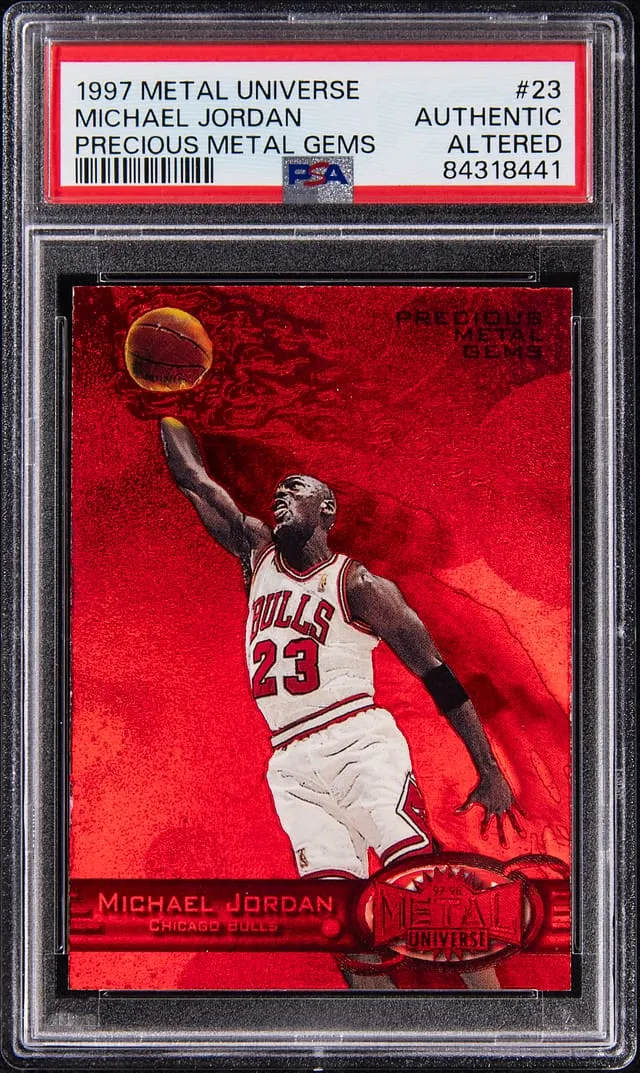
1997-98 PMG Red Jordan #23 sells for $244,000
Goldin sold a 1997-98 Metal Universe PMG Red #23 Michael Jordan (063/100, PSA Authentic/Altered) for $244,000. Here’s the context for collectors.
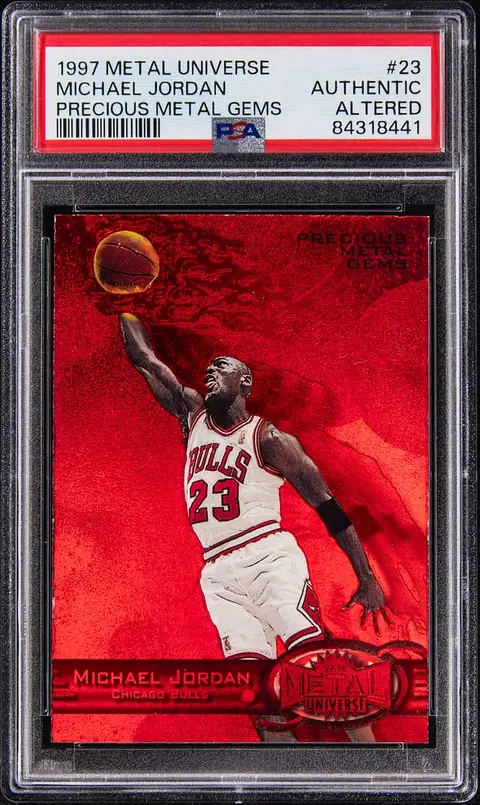
Sold Card
1997-98 SkyBox Metal Universe Precious Metal Gems (PMG) Red #23 Michael Jordan (#063/100) - PSA Authentic/Altered
Sale Price
Platform
Goldin1997-98 Metal Universe PMG Red Jordan Sells for $244,000
On March 15, 2026, Goldin closed a major 90s insert sale: a 1997-98 SkyBox Metal Universe Precious Metal Gems (PMG) Red #23 Michael Jordan, serial numbered 063/100, graded PSA Authentic/Altered, sold for $244,000.
For many collectors, this is one of the defining Michael Jordan cards of the 1990s. Below, we’ll break down what this card is, why it matters, and how this sale fits into the broader market for PMGs.
The card at a glance
- Player: Michael Jordan
- Team: Chicago Bulls
- Year: 1997-98
- Set: SkyBox Metal Universe
- Parallel: Precious Metal Gems Red (PMG Red)
- Card number: #23
- Serial number: 063/100 stamped on the card
- Grading company: PSA
- Grade: Authentic/Altered (PSA confirms the card is real but notes that it has been altered in some way)
- Sale price: $244,000
- Auction house: Goldin
- Sale date (UTC): 2026-03-15
This is not a rookie card, but it is widely considered one of Jordan’s key 90s “grail” issues. The Precious Metal Gems run is famous for being one of the earliest, most visually distinctive, and most condition-sensitive numbered parallels in basketball.
What makes 1997-98 PMG Red special?
The 1997-98 SkyBox Metal Universe Precious Metal Gems cards are a cornerstone of 90s basketball inserts:
- Print structure: Each player in the set has 100 Precious Metal Gems copies: 10 Emerald (green) and 90 Red. All are serial numbered out of 100 in total.
- Condition sensitivity: The colored foil surface and fragile edges chip and scratch easily. High-grade copies are very tough.
- Era: Late 90s inserts sit between “vintage” and “modern” – produced in smaller quantities than junk-wax-era base cards but before the ultra-modern era of serials on nearly everything.
- Crossover appeal: The same Precious Metal Gems concept later influenced football, other sports, and even non-sports cards. PMG has become a hobby-wide term for ultra-desirable, colored, low-serial parallels.
For Jordan specifically, the 1997-98 PMG Red is often mentioned in the same breath as his most important non-rookie cards. It sits alongside:
- 1997-98 PMG Green
- 1997 Metal Universe Championship and other high-end inserts
- 1997-98 and 1998-99 essential credentials and similar numbered parallels
Understanding the PSA Authentic/Altered label
PSA’s “Authentic/Altered” designation means:
- The card itself is genuine.
- PSA has determined it has been altered in some way after production. This could be trimming (edges cut to improve appearance), color touch, surface work, or other changes.
For collectors, that usually has two key implications:
- It won’t be assigned a numerical grade. The card doesn’t receive, say, a PSA 4 or PSA 7; it is simply labeled as authentic but altered.
- Price impact vs. graded copies. Altered copies typically sell at a discount to numerically graded examples in similar visual condition, but they often still command strong prices when the card itself is extremely scarce or important.
In a card as iconic and limited as a Jordan PMG Red, many collectors are willing to consider altered copies as a more accessible entry point compared to high-grade examples.
Market context and recent PMG Jordan sales
In hobby conversation, “comps” simply means recent comparable sales for similar cards. They help collectors understand the current price environment but are not price guarantees.
For this specific card, the main comparison points are:
- Other 1997-98 PMG Red Jordan #23 copies (different grades)
- PMG Green versions (far rarer, only 10 copies)
- Other 1990s numbered Jordan inserts
Over the past few years, the PMG Jordan market has seen:
- High-grade PMG Red sales that have reached well into the mid- to high-six-figure range, especially for strong PSA or BGS grades.
- PMG Green record-level sales above the Red versions, reflecting their much lower print run of 10 copies.
- A spread based on condition and designation: Ungraded, low-grade, or Authentic/Altered examples can sell meaningfully below the top-graded copies, but still at very significant prices.
Within that broader context, a $244,000 sale for a PSA Authentic/Altered copy signals that:
- The market continues to place substantial value on just owning a genuine copy of this card, even when it isn’t numerically graded.
- Condition and label matter, but for extremely scarce, culturally important cards, many collectors are focused first on authenticity and eye appeal.
Because markets move over time, and each copy has distinct centering, color, and surface characteristics, comparing this result to individual past sales requires looking at the specific card, images, and grading notes. But in broad terms, this result sits in line with the established status of the PMG Red as a super-premium Jordan issue.
Why collectors care so much about this card
Several long-term factors keep demand for this card strong among both seasoned and returning collectors:
Scarcity that’s easy to understand
The serial number out of 100 is printed directly on the card. Even newcomers can grasp its rarity immediately.Design and era
1990s Metal Universe is one of the most distinctive designs in basketball – bold, busy backgrounds and full-bleed foil. Combined with the fragile surface, it stands out in person in a way that’s hard to capture in photos.Jordan’s enduring position in the hobby
Jordan remains the central figure in basketball collecting. His key 90s inserts are where nostalgia, limited print runs, and modern collecting mindsets meet.Set-wide importance
PMGs are important not only for Jordan PC (personal collection) collectors but also for people who build Hall of Fame runs, 90s insert showcases, or cross-sport PMG displays.Historical hobby relevance
Precious Metal Gems helped establish the template for color-based, low-serial parallels that are now standard in modern products. In that sense, this Jordan is part of the origin story for a large part of today’s hobby design language.
How this sale fits into the broader PMG and Jordan market
Looking at the $244,000 result through a market-lens:
- It reinforces the idea that iconic, low-serial Jordan cards from the 1990s remain among the most stable and closely watched segments of the basketball market.
- It shows that there is a tiered market:
- Top-grade PMG Reds and any PMG Greens often lead the headlines.
- Authentic/Altered and lower-grade copies still command significant amounts as entry points into a very small population of cards.
- It also highlights that label details matter. Collectors tracking price history for PMGs usually separate:
- High-grade numerically graded sales (PSA/BGS/SGC).
- Low-grade numerically graded sales.
- Authentic-only or Authentic/Altered sales.
For anyone tracking the health of the Jordan high-end market, this Goldin result is another data point suggesting continued depth of demand, even for non-ideal labels, as long as the card itself is a true grail.
Notes for newer or returning collectors
If you’re newer to the hobby or coming back after a long break, here are a few takeaways you can apply beyond this single sale:
- Learn the key sets first. For 90s basketball, understanding sets like Metal Universe, Flair Showcase, and various credentials-style parallels will help you interpret high-end prices more clearly.
- Understand grading language.
- "PSA 8" or "BGS 9" are numerical grades.
- "Authentic" alone means real but no number.
- "Authentic/Altered" means real but changed after production.
- Use comps as context, not certainty. Recent sales tell you what some buyers have been willing to pay, not what any card must sell for next time. Look at several results over time when possible.
- Focus on what matters to you. Some collectors prefer only numerically graded cards; others will consider altered examples if they like the eye appeal and understand the trade-offs.
What this means going forward
This $244,000 Goldin sale on March 15, 2026, doesn’t rewrite the PMG Jordan story, but it does add another clear datapoint:
- Demand for genuine 1997-98 PMG Red Jordans remains strong.
- Even with an Authentic/Altered designation, the card commands a six-figure result.
- The broader narrative of 90s Jordan inserts as central pieces of the modern basketball market remains intact.
Collectors watching this segment can continue to track future sales of PMG Reds and Greens, especially across different grades, to build a more complete picture of how condition, label notation, and eye appeal influence realized prices over time.
For now, this particular copy – 063/100, PSA Authentic/Altered – joins the short list of documented, publicly sold PMG Reds that help define the market for one of the most important Jordan cards ever produced.