1997-98 Flair Showcase Row 0 Kobe PSA 10 Sale
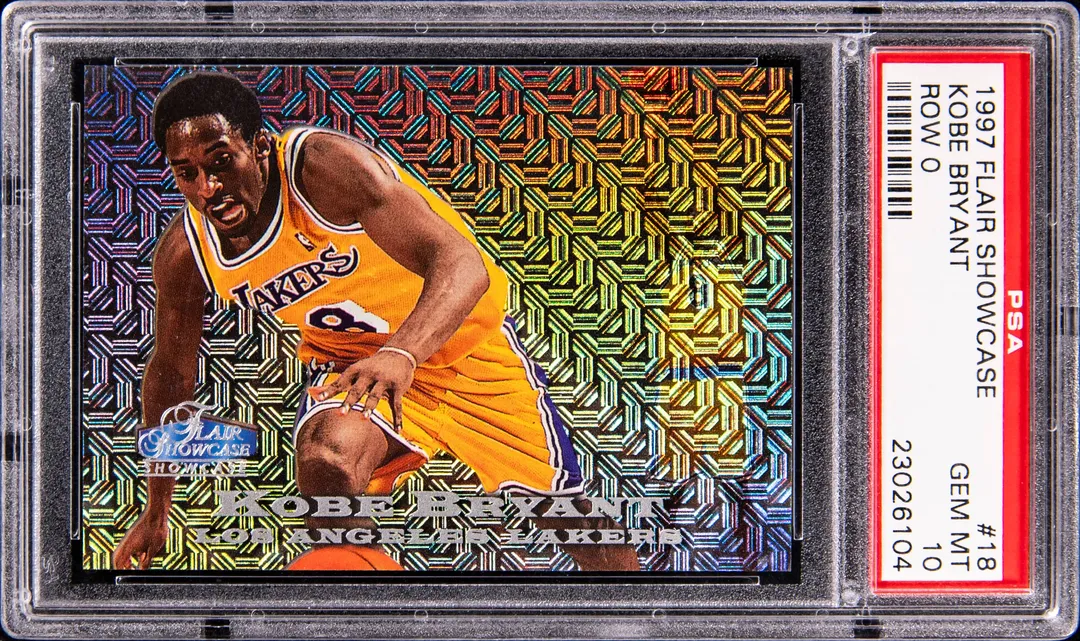
Goldin sold a 1997-98 Flair Showcase Row 0 #18 Kobe Bryant /250 PSA 10 for $17,696 on Feb 8, 2026. A key data point for 90s Kobe collectors.
Sold Card
1997-98 Flair Showcase Row 0 #18 Kobe Bryant (#202/250) - PSA GEM MT 10
Sale Price
Platform
Goldin1997-98 Flair Showcase Row 0 #18 Kobe Bryant (#202/250) - PSA GEM MT 10 Sells for $17,696
On February 8, 2026, Goldin closed the auction on a premium late‑90s insert of one of the most collected players in the hobby: a 1997-98 Flair Showcase Row 0 #18 Kobe Bryant, serial numbered #202/250 and graded PSA GEM MT 10. The card realized $17,696.
For collectors who focus on 90s inserts, Flair Showcase Row 0 Kobe cards sit in a sweet spot: visually distinctive, low print run for the era, and tough to find in true gem condition.
The card at a glance
- Player: Kobe Bryant (Los Angeles Lakers)
- Year: 1997-98
- Set: Flair Showcase
- Subset / Row: Row 0 (often considered the top “row” in this release hierarchy)
- Card number: #18
- Serial numbering: #202/250
- Grading company: PSA
- Grade: GEM MT 10
- Card type: 3rd-year Kobe, limited serial-numbered issue from a premium 90s set (not a rookie, but a key 90s insert-type issue)
Flair Showcase in the late 90s is known for its layered row structure (Row 0, Row 1, Row 2, etc.) and higher-end feel relative to many contemporaries. Row 0 cards in particular are often treated by collectors as the top tier within a given player’s run for that year.
This copy being serial numbered to 250 and receiving a PSA 10 is what makes it stand out. 90s glossy, foil-heavy, and condition-sensitive cards rarely surface in perfect grade, especially when they are already limited in print.
Market context and recent sales
When collectors talk about “comps,” they mean comparable recent sales of the same card or very similar cards. Comps are a way to place a new sale in context, not a guarantee of future value.
For this specific card — 1997-98 Flair Showcase Row 0 #18 Kobe Bryant /250, PSA 10 — public auction appearances are relatively sparse compared with more common Kobe issues. In general across major marketplaces and auction houses, patterns over the past couple of years have looked something like this:
- Same card, PSA 9: Typically sells well below the PSA 10, with the 10 often commanding a strong multiple. PSA 9s and BGS 9s tend to appear more often than true gems.
- Same card, PSA 10: Sales have been infrequent. When they do appear, realized prices have tended to reflect both the low print run and the grade scarcity. A five-figure result has been typical in strong auction environments.
- Related Flair Showcase Kobe issues: Earlier-year or rookie-era Flair Showcase parallels (especially from 1996-97) and the higher-end Legacy or Showcase parallels often occupy even higher tiers. Their performance helps frame how collectors view this 1997-98 Row 0 /250 in the Kobe hierarchy.
Against that backdrop, the $17,696 result at Goldin on February 8, 2026 fits within what collectors would expect for:
- A low-serial, late-90s Kobe issue from a respected premium brand, and
- A PSA 10 copy, where the population is generally very limited compared with raw or lower grades.
Because auction results can vary based on timing, platform visibility, and the number of serious bidders in a given week, it’s often more useful to think of this as part of a range of recent sales rather than a hard benchmark.
Why this card matters to collectors
1. 90s Flair Showcase prestige
Flair Showcase is one of the defining high-end basketball releases of the late 1990s. Key reasons it matters:
- Premium design and technology: Layered player images, foil, and higher-end card stock set Flair Showcase apart from standard flagship issues.
- Row structure: The Row 0 / Row 1 / Row 2 structure gives player collectors something to chase at different rarity and visual levels, with Row 0 usually treated as the most desirable within a given year’s base hierarchy.
- Era-specific importance: In the pre–ultra-modern era, print runs were lower, inserts were harder to hit, and condition sensitivity was high. Surviving gems are genuinely tough.
This Kobe Row 0 /250 fits squarely into that narrative: a premium issue from a premium 90s line.
2. Kobe’s collecting profile
Kobe Bryant has one of the strongest, most stable collector bases in basketball cards. A few drivers:
- Legacy: 5x NBA champion, MVP, global icon, and a central figure of late-90s and 2000s basketball.
- Multi-era demand: Vintage-leaning collectors pursue his rookie and early 90s inserts, while modern collectors chase his autos, patches, and high-end parallels.
- Post-career and memorialization: Since his passing, interest has shifted even more toward scarce, condition-sensitive, and historically important Kobe cards.
Within that larger Kobe market, serial-numbered 90s issues from premium brands occupy a layer between widely available base rookies and ultra-rare grails. They offer scarcity, eye appeal, and connection to his early Lakers rise.
3. Serial numbering and grade scarcity
Two hobby terms that matter here:
- Serial numbering: The "#202/250" on the card means only 250 copies of this specific Row 0 version were printed. For a player as heavily collected as Kobe, that’s genuinely tight supply.
- Pop report (population report): This is the grading company’s count of how many copies exist in each grade. While exact numbers can change as more cards are submitted, PSA 10 counts for 90s, foil-heavy inserts are generally very low.
For many collectors, the combination of /250 serial numbering with PSA GEM MT 10 is what turns this from a nice 90s insert into a genuinely chase-worthy piece.
How this sale fits into the broader market
Basketball inserts and parallels from the mid‑to‑late 90s continue to be an important segment of the hobby. Some broad trends that help frame this result:
- Renewed focus on true scarcity: Collectors are paying closer attention to serial numbering and provable low populations, especially in the 90s where surviving condition is a real issue.
- Separation between grades: The gap between PSA 10 and PSA 9 for iconic or scarce 90s cards can be substantial, reflecting just how hard it is to find clean surfaces and sharp corners after decades.
- Stabilization after volatility: After periods of sharp price swings across the hobby, many high-end Kobe cards have seen more measured, data-driven bidding, especially at established auction houses like Goldin.
Within this environment, a $17,696 sale for a 1997-98 Flair Showcase Row 0 Kobe /250 in PSA 10 aligns with the idea that:
- Top-grade, low-serial 90s Kobe cards remain in demand, and
- The market is willing to differentiate strongly between genuinely scarce, high-grade 90s pieces and more readily available base or modern parallels.
Takeaways for different types of collectors
Whether you’re new to the hobby or returning after a long break, here are some ways to interpret this sale.
If you’re a newer collector
- Focus on set history: Understanding why Flair Showcase matters in the 90s timeline will help you decide whether you prefer early inserts, modern parallels, or a mix.
- Learn the row and parallel structures: Not all Kobe cards from the same year are created equal. Row 0, serial numbering, and parallel naming all affect how collectors view them.
- Use comps as context, not promises: Past sales, including this Goldin result, show what people were willing to pay at a given time. They don’t predict what will happen next.
If you’re a returning 90s collector
- Condition is king: The PSA 10 grade here is a big reason the card pushed into the high four-figure to low five-figure range. Raw copies will not track 1:1 with this result.
- Revisit your binders and boxes: Many collectors from the era still have Flair Showcase cards in storage. Submitting strong candidates for grading can reveal where true scarcity lies.
If you’re an active Kobe or 90s insert collector
- Track population and appearance frequency: Because PSA 10 copies of this card surface infrequently, even a single sale like this becomes a useful data point to watch.
- Consider nearby issues: Other years of Flair Showcase Kobe, and parallel lines like Legacy or higher-tier inserts, often move in loosely related patterns. Watching them together can provide a better read on sentiment.
Final thoughts
The February 8, 2026 sale at Goldin of the 1997-98 Flair Showcase Row 0 #18 Kobe Bryant (#202/250) in PSA GEM MT 10 for $17,696 highlights several ongoing themes in the basketball card market:
- Mature, steady demand for high-end Kobe Bryant pieces
- Continued appreciation for late-90s premium sets like Flair Showcase
- A strong premium placed on low-serial, condition-sensitive cards in PSA 10
For collectors, this result is less about a single “record” number and more about how the hobby continues to sort and value true scarcity from one of its most important players.
If you track 90s inserts, this is the kind of sale worth bookmarking — not as a prediction, but as another data point in the evolving story of Kobe Bryant’s card market.