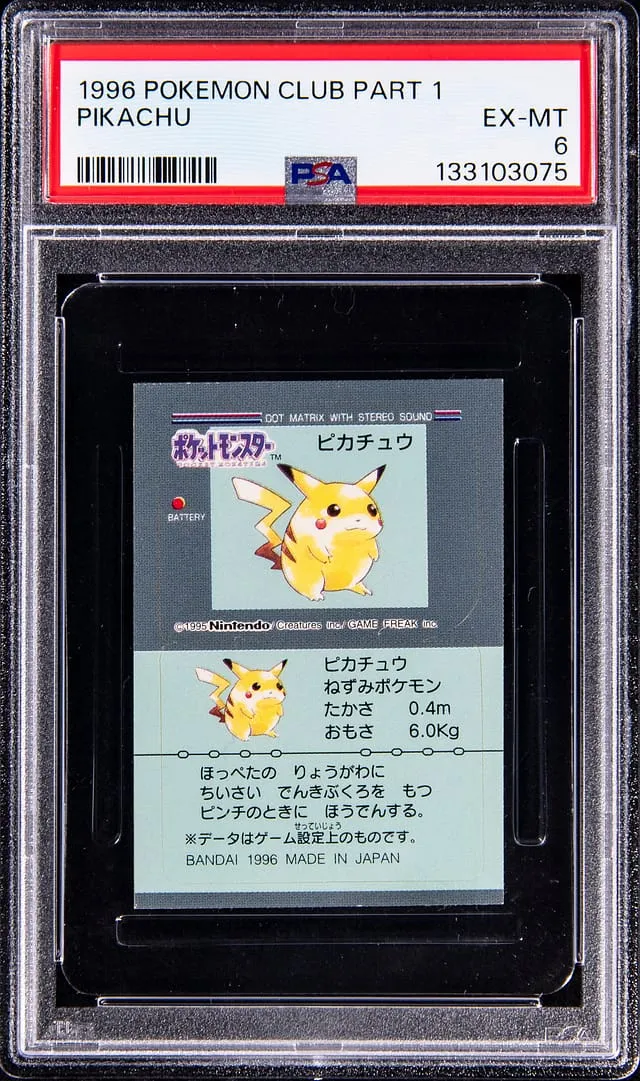
1996 Pokemon Club Pikachu PSA 6 Sells for $55,800
Deep dive on the 1996 Pokemon Club Part 1 Pikachu PSA 6 Pop 1 that sold for $55,800 at Goldin on February 16, 2026, and what it means for collectors.
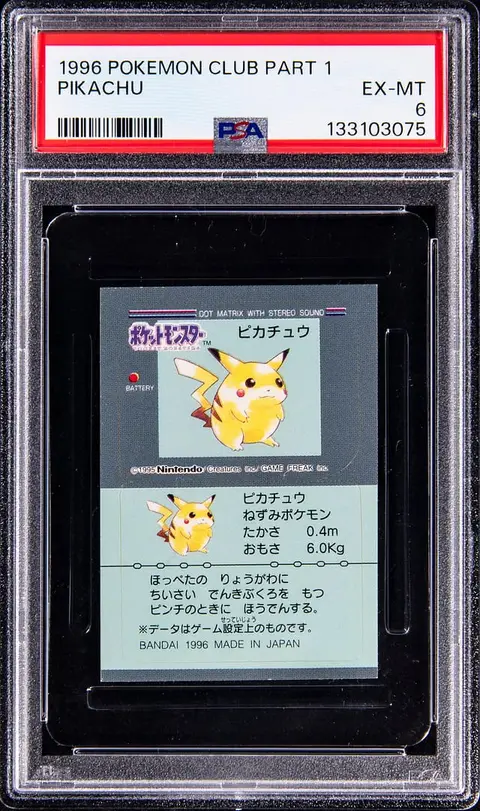
Sold Card
1996 Pokemon Club Part 1 Pikachu - PSA EX-MT 6 - Pop 1
Sale Price
Platform
Goldin1996 Pokemon Club Part 1 Pikachu - PSA EX-MT 6 - Pop 1: Why This $55,800 Sale Matters
When an obscure 1990s promo quietly sets a five‑figure result, serious Pokémon collectors tend to take notice. That’s exactly what happened on February 16, 2026, when Goldin sold a 1996 Pokemon Club Part 1 Pikachu, graded PSA EX-MT 6, for $55,800.
Below, we’ll break down what this card is, why it matters, and how this sale fits into the broader Pikachu and 1990s promo market.
The card at a glance
- Character: Pikachu
- Year: 1996
- Set / Issue: Pokemon Club Part 1 (Japanese Pokémon Fan Club / Pokemon Club promotional release)
- Card type: Early Japanese promo, Pikachu key issue (not a pack-pulled set card)
- Grading company: PSA (Professional Sports Authenticator)
- Grade: EX-MT 6
- Population (“pop”): Pop 1 in this grade at PSA
- Attributes: Early Pikachu promo from the 1990s hobby era; not a standard TCG expansion card
PSA’s EX-MT 6 grade means the card is considered “Excellent-Mint,” typically with moderate edge or corner wear and possibly a couple of more noticeable flaws. In many modern sets a 6 would be considered purely a collector-grade card, but for mid‑1990s Japanese promos—especially ones that were not treated like high-end collectibles at the time—lower technical grades often coexist with meaningful demand.
What is the 1996 Pokemon Club Part 1 Pikachu?
The Pokemon Club Part 1 Pikachu comes from an early Japanese Pokémon fan club / Pokemon Club promotion. These were not pulled from booster packs; instead, they were distributed through fan programs and special mail‑in or membership‑style channels.
Key points about this issue:
- Early-era promo: Released in 1996, right at the start of Pokémon’s trading card history in Japan.
- Distribution: Fan club / Pokemon Club style issues were typically earned, mailed, or given through membership or participation, making them less common than pack‑pulled Base Set cards.
- Condition challenges: Many of these cards were handled like regular game pieces by kids in the 1990s, not preserved as investments, which is why high‑grade examples—or even clean mid‑grades—can be difficult to find.
- Pikachu focus: As the franchise mascot, Pikachu promos from the 1990s tend to be watched closely by serious collectors who build long‑term Pikachu, promo, or Japanese‑only collections.
While this card doesn’t have the massive name recognition of Trophy Pikachu or the Gold Star era, it sits in that important lane of obscure, early Japanese Pikachu promos that advanced collectors actively seek out.
Population report and scarcity
PSA’s population report (often shortened to “pop report”) is a running count of how many copies of a card have been graded in each grade. As of this Goldin sale:
- This specific example is PSA EX-MT 6, Pop 1 (the only copy in that grade).
- Overall pop for the card remains very low, especially compared to mass‑printed pack cards.
A Pop 1 in a mid‑grade is meaningful primarily because:
- It confirms how infrequently the card shows up for grading, not just how rarely it sells.
- It suggests much of the surviving population may either be ungraded, in very rough shape, or locked away in long‑term collections.
For niche 1990s promos, collectors often think more in terms of overall availability than in chasing a specific numeric grade. The combination of:
- Early Pikachu artwork,
- Fan club style distribution, and
- Low grading population
creates a profile collectors generally consider “hard to replace,” especially once a copy enters a long‑term collection.
Price context: how does $55,800 fit the market?
This card sold at Goldin on February 16, 2026 for $55,800.
To understand that number, collectors usually look at “comps”—short for comparable sales. These are recent sales of the same card or very similar versions (different grades, close parallels) used to gauge current price ranges.
For a niche, low‑pop 1990s promo like this, comps can be limited. Typically, you see:
- Long gaps between public auctions
- Big swings depending on grade, eye appeal, and where it’s sold (major auction vs. fixed‑price marketplace)
Recent public data for this exact card and grade is extremely thin, if present at all, which is common for Pop 1 cards that don’t appear often. In practice, that means this Goldin result effectively sets a fresh reference point for PSA‑graded copies, even if it doesn’t necessarily represent a stable “market price.”
When comparing across related items:
- High‑end Pikachu promos (trophy cards, ultra‑rare campaign issues, or extremely high grades of core promos) have established a track record of strong five‑figure and sometimes six‑figure results.
- Mid‑grades of challenging 1990s promos can still command serious attention, especially when they rarely surface at major houses.
Within that context, a $55,800 sale for a Pop 1 PSA 6:
- Underscores how deep the demand is for rare 1990s Pikachu promos, not just the best-known trophy pieces.
- Highlights that availability, provenance, and timing (which auction house, what else is in the sale, who’s watching) can be as important as the technical grade.
Because public comps are limited, it’s more accurate to treat this as a notable benchmark rather than proof of a consistent price level.
Why collectors care about this card
Several threads pull together here for collectors:
1. Early Pikachu history
Pikachu is the face of the Pokémon brand. Cards tied to its early Japanese history tend to be viewed as:
- Key pieces for Pikachu character collectors
- Important ingredients in “history of the Pokémon TCG” style collections
While not every early Pikachu promo is a trophy card, the combination of age, region (Japan), and distribution method matters.
2. 1990s promo era scarcity
The mid‑1990s to early 2000s promo era in Japan is very different from today’s ultra‑modern era:
- Fewer cards were preserved in gem‑mint condition.
- Many promos were earned through fan clubs, events, or mail campaigns, not mass blister packs.
- Documentation on exact print runs is often incomplete, so collectors rely on a mix of pop reports, archival info, and observed availability.
As a result, even mid‑grade copies of certain promos can be meaningfully scarce in the open market.
3. Low pop and long hold patterns
Low‑pop promos like the Pokemon Club Part 1 Pikachu:
- Appear infrequently at large auction houses.
- Often vanish into long‑term collections once acquired.
That pattern means each public sale becomes a reference point for years to come. For anyone tracking historic promo trends or building a Pikachu timeline, this Goldin result is a data point worth recording.
Market and hobby context around early 2026
While this specific sale is about a single card, a few broader hobby currents are relevant:
- Continued strength in high‑end Pokémon: Even as modern print runs have exploded, selective demand for early Japanese promos and key Pikachu cards has remained steady, with serious collectors focusing on depth and quality.
- Refined collector tastes: Many advanced collectors are narrowing into theme collections—by character (Pikachu), by era (1996–1999), or by category (Japanese promos). Cards like the Pokemon Club Part 1 Pikachu fit these focused approaches well.
- Auction house visibility: A card like this appearing at a major platform such as Goldin increases its visibility, potentially drawing in both long‑time Pokémon collectors and cross‑collectors from other segments (sports, comics) looking at early franchise history pieces.
None of this guarantees where prices go next, but it helps explain why an early promo in a mid‑grade can still achieve a notable result.
How collectors might think about this sale
Without offering any financial advice, here are some practical ways collectors and small sellers might use this sale as context:
- For Pikachu collectors: This is another reminder to document the full landscape of 1990s Pikachu promos. Some of the less‑talked‑about fan club and membership issues are clearly on the radar for high‑end collectors.
- For promo specialists: The result reinforces that distribution story plus era plus character can matter as much as a perfect grade. A compelling combination of those three can still draw major attention even in EX‑MT.
- For small sellers: If you encounter early Japanese promos—especially Pikachu—consider:
- Verifying exact card identity carefully (set, year, promo origin).
- Checking population reports before deciding how and where to sell.
- Looking at major auction house archives to understand how rarely similar pieces show up.
Final thoughts
The February 16, 2026 Goldin sale of the 1996 Pokemon Club Part 1 Pikachu, PSA EX-MT 6 (Pop 1) at $55,800 is less about a single grade number and more about what it represents:
- Ongoing respect for rare, early Japanese Pikachu promos.
- A willingness among advanced collectors to compete for low‑pop, historically interesting pieces—even in mid‑grade.
- Another data point in the long‑term story of how 1990s Pokémon promos are being cataloged, valued, and preserved.
For collectors building out the early chapters of Pikachu’s TCG history, this card—and now this sale—sits squarely on the radar.