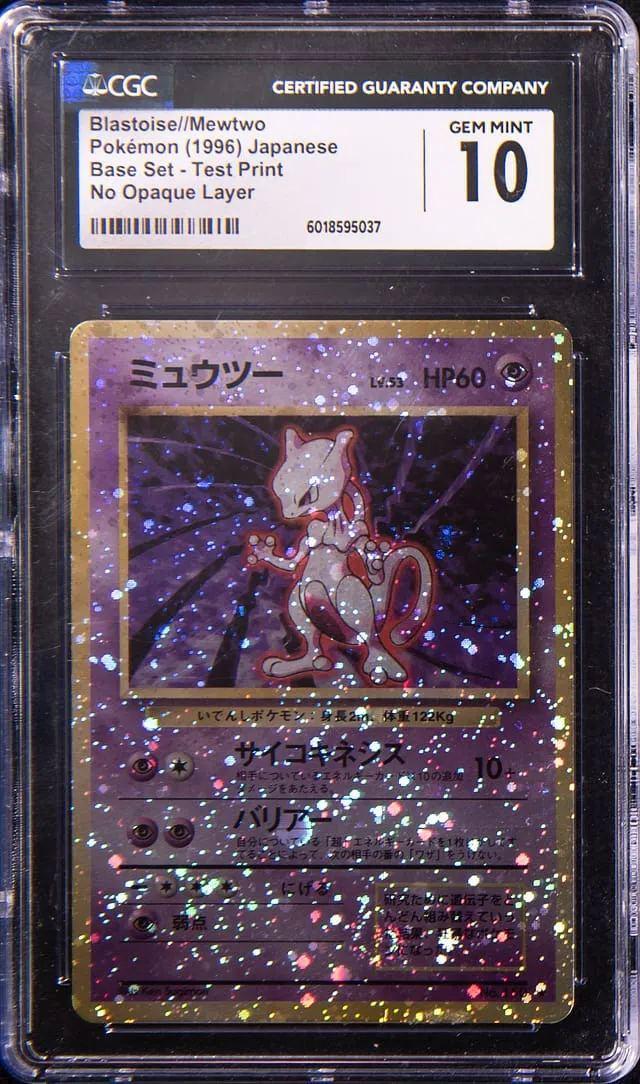
1996 Pokémon Test Print Blastoise/Mewtwo Sells for $12K
Figuring out the $12,400 Goldin sale of a 1996 Pokémon Japanese Base Set No Opaque Layer Blastoise/Mewtwo CGC 10 test print and what it means.
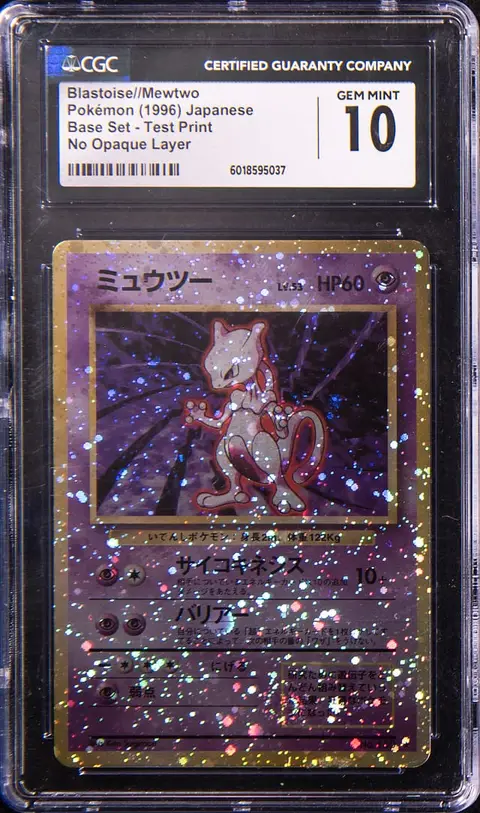
Sold Card
1996 Pokemon Japanese Base Set Test Print No Opaque Layer Blastoise/Mewtwo - CGC GEM MINT 10 - Pop 3
Sale Price
Platform
Goldin1996 Pokemon Japanese Base Set Test Print No Opaque Layer Blastoise/Mewtwo - CGC GEM MINT 10 - Pop 3
On February 16, 2026, Goldin closed a notable sale for one of the more unusual early Pokémon test issues: a 1996 Pokémon Japanese Base Set Test Print “No Opaque Layer” Blastoise/Mewtwo graded CGC Gem Mint 10, with a population of just three in that grade. The final price was $12,400.
In this breakdown, we’ll walk through what this card is, why it matters to collectors, and how this $12,400 result fits into the broader market context.
What exactly is this card?
Title: 1996 Pokemon Japanese Base Set Test Print No Opaque Layer Blastoise/Mewtwo – CGC GEM MINT 10 – Pop 3
Characters: Blastoise and Mewtwo
Year: 1996
Origin: Japanese Base Set–era test print
Type: Production/test print card (pre-production), not a standard pack-issued card
Grader: CGC (Certified Guaranty Company)
Grade: Gem Mint 10
Population: 3 in CGC 10 (per the auction description)
This piece is part of a niche but historically interesting lane in the hobby: test prints. These are cards produced by the printer or publisher to test ink, layout, or layering before final production. They are not traditional chase cards from booster packs, but they help document how the game and its printing process developed.
The key phrase here is “No Opaque Layer.” On standard Pokémon cards, an opaque white or light-colored layer sits behind the artwork and text to make colors pop and to prevent the back from showing through. A “No Opaque Layer” test print was produced without that layer, leaving the card looking more transparent or washed out. That makes it visually different from traditional Base Set cards and clearly marks it as a production oddity.
Why collectors care about this test print
1. Early Pokémon history
This test print tracks back to the launch era of the Pokémon Trading Card Game in Japan (1996). For many collectors, anything tied directly to 1996 Japanese Base Set falls into the “early history” bucket, whether it’s pack-issued cards, sample cards, or printer tests.
While this is not a “rookie card” in the sports sense, it is an early-era artifact related to some of the game’s most recognizable characters:
- Blastoise – One of the three original final evolutions alongside Charizard and Venusaur, headlining the Water-type starter line.
- Mewtwo – One of the franchise’s most iconic legendary Pokémon, featured heavily in early movies, games, and high-end cards.
That combination—two flagship first-generation Pokémon on a pre-production item from 1996—gives the card a lot of historical weight relative to its niche.
2. Test print niche and scarcity
Test print collectors usually care about:
- Documented provenance (clear ties to a specific set or print run)
- Distinct production differences (like missing layers, odd backs, or mis-registered colors)
- Confirmed low population
Here, we have all three:
- It’s a Japanese Base Set test print, not a random misprint.
- The missing opaque layer is a defined, intentional production difference, not damage or fading.
- The auction lists a CGC population of 3 in Gem Mint 10, and overall graded population for this exact test configuration remains very small across grading companies.
Because test prints were never meant for mass distribution, they tend to surface in very low quantities, often via printer archives, former employees, or small, specialized releases years later.
3. Grade: CGC Gem Mint 10
CGC has become a prominent grader in the non-sports and TCG space. A Gem Mint 10 label indicates a card that is essentially free of noticeable flaws even under close inspection.
Given that many test prints were not handled or stored like traditional collectibles, seeing one in Gem Mint condition is uncommon. A pop 3 (population 3) in this grade underscores how few examples have both survived and achieved top marks.
Market context and price comparison
This sale closed at $12,400 through Goldin on February 16, 2026.
When we talk about “comps” (short for comparables), we mean recent sales of the same card or very similar items that help frame where current market prices sit.
Because this is a niche test print, there are very few direct, public comps for this exact card in CGC 10. Public auction data for similar items tends to show:
- Lower grades or raw versions of early Pokémon test prints and no-opaque-layer items trading at significantly lower prices than top-graded copies, but still well above standard Base Set cards because of scarcity.
- Comparable pre-production/test items for key 1990s TCGs often landing in the four- to low five-figure range when they combine:
- iconic characters,
- confirmed early print origins, and
- top grades from major grading companies.
Within that general landscape, a $12,400 result for a pop 3 Gem Mint 10 example of a 1996 Japanese Base test print featuring Blastoise and Mewtwo is:
- Consistent with the broader pattern of high-end test and sample pieces from early Pokémon.
- On the strong side for niche pre-production items, but not out of line with what the market has shown it’s willing to pay for rare, well-documented early Pokémon oddities.
Because the population is so small and sales are infrequent, it’s difficult to call this a “typical” price. It’s more accurate to treat it as a data point in a very thin market: one buyer and one seller agreeing on value at one moment in time.
How this sale fits into the 1990s Pokémon landscape
From a broader perspective, this card sits at the crossroads of three collector interests:
- 1990s Pokémon nostalgia – Anything from the 1996–1999 window taps into the earliest TCG memories for many collectors.
- Printing and production history – There’s a growing segment of the hobby that actively chases sample cards, test sheets, prototypes, and error cards as a way to map out how sets were actually made.
- High-grade scarcity – In thinly populated niches, the top-graded examples become the main reference points whenever serious collectors decide they want a copy.
For collectors and small sellers, the takeaways are:
- Documentation matters. The clearer the connection to a known set or print run, the more confidence the market tends to have in the piece.
- Condition still drives the top of the market. In a population of very few, the jump from “nice copy” to Gem Mint can be substantial.
- Expect sporadic pricing. With so few comps, each new sale can set a very different mark, especially if the bidder pool changes.
What this means for different types of collectors
New or returning collectors
If you’re newer to the hobby or coming back after years away, this type of card can be confusing:
- It’s not a standard 1996 Japanese Base Blastoise or Mewtwo you’d pull from a pack.
- It’s a specialized test print, more like a behind-the-scenes production artifact than a regular release.
For most collectors, test prints are interesting to learn about, but not a required piece of a typical collection. They’re more relevant if you:
- Collect early Pokémon by print history,
- Focus on rare variations and production oddities, or
- Prefer owning “one-of-a-few” pieces rather than standard releases.
Active hobbyists and small sellers
For more experienced participants in the hobby, key points to note from this sale:
- Niche but real demand exists for early Pokémon test prints, especially when they’re graded by a major company and clearly described.
- Pop report references (like “Pop 3”) continue to be important signals. A pop report is a tally of how many copies of a specific card and grade a grading company has recorded.
- Auction house choice matters for thin markets. A platform like Goldin can aggregate enough serious bidders to surface strong prices for unusual items that might otherwise slip through the cracks in smaller venues.
Final thoughts
This 1996 Pokémon Japanese Base Set Test Print No Opaque Layer Blastoise/Mewtwo in CGC Gem Mint 10 is a clear reminder that the Pokémon hobby isn’t just about Charizard holos and modern chase cards. Early production pieces, especially those tied directly to 1996, have carved out a stable, if niche, lane of their own.
At $12,400 through Goldin on February 16, 2026, the card’s price reflects:
- The historical pull of the 1996 era,
- The combined appeal of Blastoise and Mewtwo,
- The scarcity of documented test prints, and
- The premium the market assigns to top-grade examples in very low populations.
For collectors who enjoy the story behind how cards are made, this sale is another data point showing that early Pokémon production history continues to find committed, well-informed buyers—without needing hype or speculation to justify its place in the market.