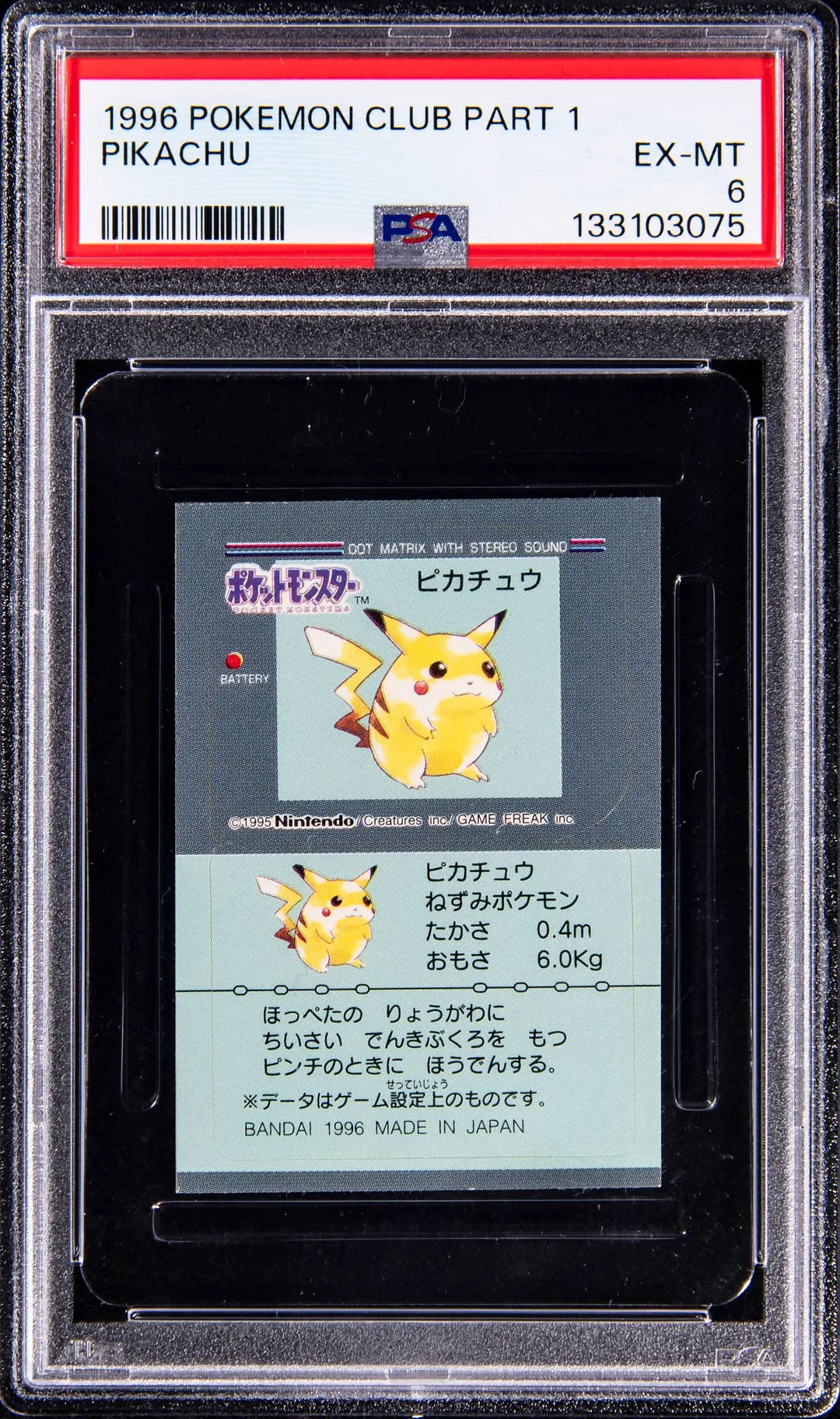
1996 Pokémon Club Pikachu PSA 6 Sells for $55,800
A 1996 Pokémon Club Part 1 Pikachu PSA EX-MT 6 Pop 1 sold for $55,800 at Goldin on 2/16/26. Here’s what this early promo means for collectors.
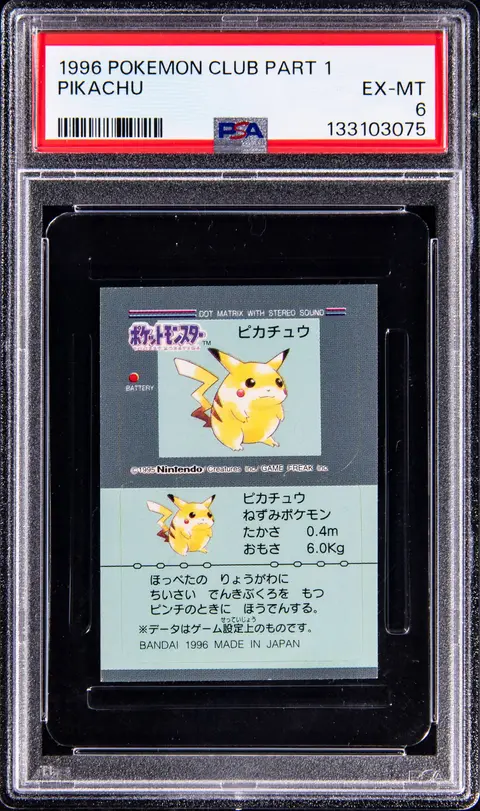
Sold Card
1996 Pokemon Club Part 1 Pikachu - PSA EX-MT 6 - Pop 1
Sale Price
Platform
Goldin1996 Pokémon Club Part 1 Pikachu – PSA EX-MT 6 – Pop 1
On February 16, 2026, Goldin closed a notable sale for an early-era Japanese Pikachu: a 1996 Pokémon Club Part 1 Pikachu graded PSA EX-MT 6, bringing in $55,800. For a non–first edition, non-Trophy Pikachu to reach that level in an EX-MT grade tells us a lot about how collectors are thinking about mid‑90s Japanese promos and the earliest years of the TCG.
In this breakdown, we’ll look at what this card is, why it matters, and what this sale could mean in the broader context of vintage Pokémon.
What exactly is the 1996 Pokémon Club Part 1 Pikachu?
This card is commonly referred to as the “Pokémon Card Fan Club” or “Pokémon Club” Pikachu. It comes from a mid‑1990s Japanese promotion tied to the official Pokémon fan club, predating much of the mainstream explosion seen in the West.
Key identifiers:
- Character: Pikachu
- Year: 1996
- Origin: Japanese Pokémon Club / Fan Club promotion (Part 1)
- Card attributes: Early Japanese Pikachu promo, not a standard pack-pulled card
- Grading company: PSA (Professional Sports Authenticator)
- Grade: EX-MT 6 (Excellent–Mint)
- Population: Pop 1 in PSA EX-MT 6 at the time of sale (meaning only one example has received this exact grade)
This is not a modern serial-numbered parallel and does not feature an autograph or patch. Its appeal is rooted in era, distribution method, and character:
- Era: Very early, 1996 Japanese release
- Distribution: Limited fan club promo, not something you could casually pull from booster packs
- Character: Pikachu, arguably the single most recognizable character in the Pokémon franchise
Why collectors care about this card
For many collectors, early Japanese promo cards represent the “deep cuts” of Pokémon history—cards that came before the explosive international boom, and often required some effort or membership to obtain.
A few reasons this Pikachu stands out:
Early Pikachu artwork and timeline
Anything with a 1996 date stamp connected to Pikachu places it close to the very beginnings of the TCG. These early cards help document how the brand was introduced in Japan and how the fan base first engaged with the card game.Fan club / mail-in style scarcity
While exact print runs can be difficult to verify, cards from Japanese fan club and mail-in promotions were generally produced in far lower quantities than mass‑release sets. Participation requirements (sign-ups, points, or mail campaigns) acted as a natural filter on supply.Character-driven demand
Pikachu sits in a small group of characters (alongside Charizard, sometimes Mewtwo and a few others) that command attention across eras and languages. That means even niche or obscure Pikachu issues tend to be tracked closely by character collectors.Condition sensitivity and age
Mid‑90s Japanese promos were not always stored with long‑term preservation in mind. Handling, mailing, and album storage often left them with edge wear, indentations, or surface issues, which makes higher-grade examples more notable.
The PSA EX-MT 6 grade and “Pop 1” label
PSA uses a 1–10 grading scale, with 10 as Gem Mint. EX-MT 6 (Excellent–Mint) generally means:
- Noticeable but moderate wear on corners and edges
- Possible small surface issues
- Overall solid presentation, but clearly not near mint
The pop report (short for population report) tells us how many copies of a given card have been graded at each grade level by a grading company. A “Pop 1” in PSA 6 means there is only one card in the PSA database at exactly EX-MT 6.
Pop 1 at a specific grade does not automatically mean the card is the single best or worst example; there may be other copies graded higher or lower. But in the context of a niche, early promo, it still signals that graded supply is thin and not many copies are being submitted.
Market context and comparable sales
Because this is a relatively obscure early Japanese Pikachu promo, direct sales comparisons (often called “comps”—short for comparables) are not as abundant as they are for more mainstream cards like Base Set Charizard.
When researching recent sales:
- Exact matching comps for a 1996 Pokémon Club Part 1 Pikachu in PSA 6 are scarce or absent on major public marketplaces.
- Higher- or lower-grade examples of early Japanese Pikachu promos, including other fan club or mail-in issues, typically trade infrequently and often privately.
What we can say based on the broader pattern of early Pikachu promos:
- Top-grade examples (PSA 9–10) of similar-era Pikachu promos can command strong premiums because of a small and dedicated collector base.
- Mid-grade, low-pop early promos like this one tend to see more price volatility, simply because they appear at auction so rarely that each sale can set a new reference point.
At $55,800, this Goldin sale signals that:
- Serious collectors are willing to allocate substantial capital to non‑trophy, non-pack Pikachu promos when the card checks the right boxes (era, rarity, character).
- Price anchoring for this specific card may now use this sale as a starting point, given the lack of obvious prior public records.
Without a robust history of identical past sales, it’s difficult to label this result as definitively high, low, or typical. Instead, it is better understood as a fresh benchmark for this specific issue and grade.
Where this card fits in the vintage Pokémon landscape
This card sits squarely in the vintage era of Pokémon (mid‑1990s through roughly 2000), and more specifically in the early Japanese promo segment, which has been gaining more structure in recent years:
- Collectors are increasingly mapping out and documenting obscure promos, prize cards, and fan club pieces.
- As information improves, previously under-the-radar cards tend to see more demand once the community understands their backstory and approximate scarcity.
Within that framework, the 1996 Pokémon Club Part 1 Pikachu checks several collector‑friendly boxes:
- Historical relevance: It is tied to the fan club infrastructure that helped build and organize the earliest Pokémon TCG community in Japan.
- Brand icon: It features Pikachu at a time when the character was still being defined visually and culturally.
- Graded supply constraints: The pop report remains thin, with this example standing alone at PSA 6.
How collectors might interpret this Goldin sale
A single auction result should not be treated as a price guarantee or a roadmap for future returns. But it can still offer useful signals for collectors and small sellers:
Increased attention on early Japanese promos
A $55,800 sale for a PSA 6 example from a niche 1996 promotion reinforces that early Japanese promos are now a firmly established part of the high‑end Pokémon conversation, not just a side interest.Character-focused collecting is maturing
Pikachu‑specific collectors are clearly willing to chase rare and obscure issues, not just the big flagship releases. That can influence how people build character PCs (personal collections), including a shift from just iconic cards to more comprehensive character runs.Rarity and context matter as much as grade
While a PSA 6 is a mid‑tier grade on paper, the combination of early date, limited distribution, and low graded population can still command a premium. This sale is a reminder that grade alone doesn’t dictate value—context around the card matters.Auctions can set reference points in thin markets
When public sales data is limited, a result like this becomes an anchor for future negotiations and listings, even if conditions (demand, broader market sentiment) change over time.
What this means for newcomers and returning collectors
If you’re new or coming back to Pokémon and you see a $55,800 fan club Pikachu sale on Goldin from February 16, 2026, it’s easy to feel like the market is inaccessible. A few takeaways can help frame it more constructively:
Most collecting lanes are much more affordable.
Early promos like this are a niche, high‑end segment. There are many other ways to enjoy vintage Pokémon—ungraded copies, lower‑tier promos, or late‑1990s sets—without entering five‑figure territory.Understanding the story behind a card is crucial.
Cards like the 1996 Pokémon Club Part 1 Pikachu derive value from history and scarcity as much as from condition. Learning those stories helps you spot what genuinely interests you.Use sales like this as educational case studies.
Instead of treating them as signals to chase the same card, treat them as examples of how collectors reward:- Early era
- Limited distribution
- Iconic characters
- Documented scarcity (thin pop reports)
At figoca, we focus on surfacing that kind of contextual data so collectors can understand why a card sold, not just what it sold for.
Final thoughts
The 1996 Pokémon Club Part 1 Pikachu PSA EX-MT 6 Pop 1 sale for $55,800 at Goldin on February 16, 2026, underlines how far the hobby has come in recognizing early Japanese promos as key pieces of Pokémon history.
Even in a middle grade, this card’s combination of early release date, fan club origin, and Pikachu artwork makes it a reference point for character collectors and vintage specialists. As more information surfaces and more copies are graded, the market picture will become clearer, but for now, this result stands as a strong marker of how the community values rare, historically important Pikachu cards.
As always, this sale is a data point—not a prediction. Collectors can use it to better understand the landscape of early Japanese promos, then decide which parts of that landscape fit their own collecting goals and budgets.