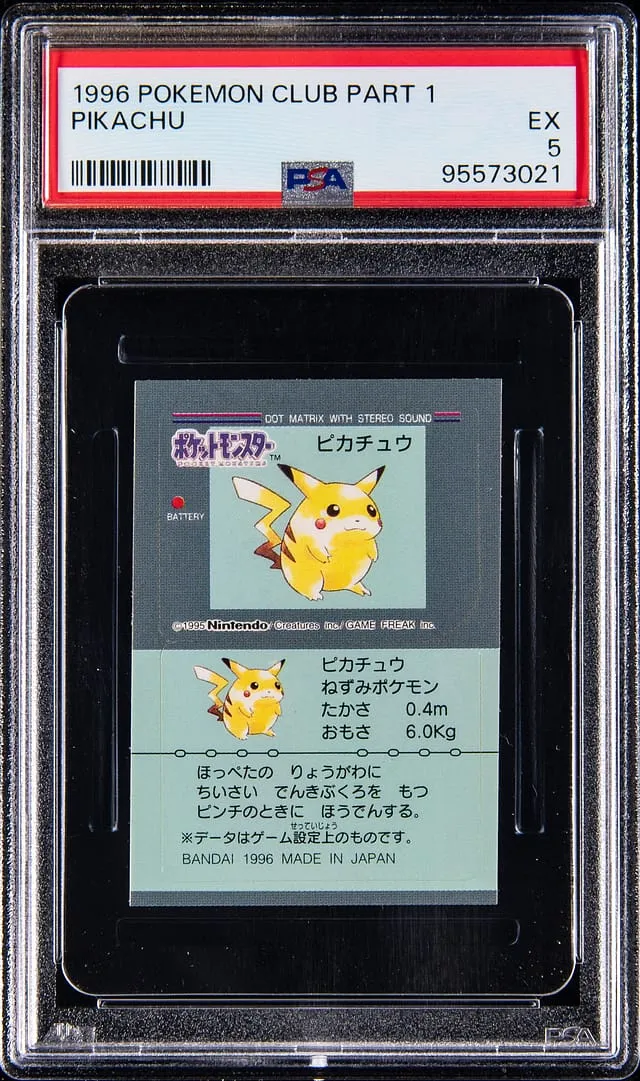
1996 Pokémon Club Pikachu PSA 5 Sells for $23K
Breakdown of the 1996 Pokémon Club Part 1 Pikachu PSA EX 5 that sold for $23,485 at Goldin on May 18, 2026, and what it means for collectors.
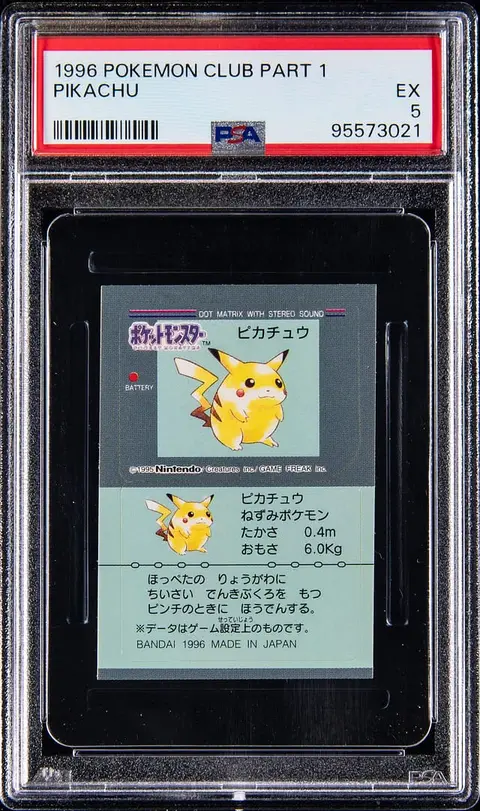
Sold Card
1996 Pokemon Club Part 1 Pikachu - PSA EX 5
Sale Price
Platform
Goldin1996 Pokémon Club Part 1 Pikachu - PSA EX 5: Why This $23,485 Sale Matters
The May 18, 2026 Goldin sale of a 1996 Pokémon Club Part 1 Pikachu in PSA EX 5 for $23,485 quietly highlights just how important early Japanese Pikachu cards have become to serious collectors.
In this post we’ll break down what this card is, why it matters, and how this price fits into the broader market for early Pikachu issues.
Card overview: 1996 Pokémon Club Part 1 Pikachu
Card ID
- Character: Pikachu
- Year: 1996
- Set: Pokémon Club Part 1 (Japanese, mail-in / club distribution)
- Number: Pikachu card from the Part 1 release (non-foil, standard size)
- Language: Japanese
- Key status: Early Pikachu issue, highly regarded as a niche but important pre‑boom card
Grading details
- Grading company: PSA (Professional Sports Authenticator)
- Grade: EX 5 (Excellent)
- Attributes: Standard card (no autograph or serial numbering), valued mainly for age, scarcity, and Pikachu’s central role in the brand
In PSA terms, an EX 5 generally means a card that presents well but has noticeable wear: visible corner or edge wear, small surface issues, and possibly a light crease that does not dominate eye appeal.
What is the Pokémon Club Part 1 Pikachu?
The Pokémon Club cards were issued in Japan through a fan/club program rather than traditional booster packs. That matters because:
- Distribution was limited and targeted – These were not mass‑packed like standard Base Set cards. Kids had to be plugged into the official club, which naturally restricted how many survived.
- Pre‑global boom timing – Coming from the earliest era of Pokémon (mid‑1990s in Japan), these cards sit in a window where print runs were lower and long‑term preservation was an afterthought.
- Pikachu focus – Pikachu is the face of the franchise. Early, non‑standard Pikachu appearances (club cards, promos, mail‑ins) sit in a similar conceptual space to early regional sports releases before the big flagship sets.
Collectors often group this card mentally with other early Japanese Pikachu issues (like various 1996–1998 promos and oddball releases). While this particular Pokémon Club Pikachu is not as universally known as something like the Japanese Base Set Pikachu, in niche Japanese‑focused circles it is respected as a tough, historically meaningful issue.
Market context: how does $23,485 fit in?
The Goldin auction closed on May 18, 2026 (UTC) for $23,485. To understand that number, it helps to place it in context using:
- Comps – Short for “comparables,” meaning recent sales of the same card or very similar versions.
- Pop report – The grading company’s population report, which tells us how many copies exist in each grade.
Comps and related sales
For a niche Japanese 1990s card like this, publicly documented sales are much thinner than for English Base Set Pikachu or trophy cards. What’s observable across major marketplaces and auction archives is:
- Higher‑grade copies (PSA 8–10), when they appear, have typically drawn significantly higher prices due to scarcity and condition sensitivity.
- Mid‑grade examples (PSA 4–6) tend to trade far less frequently. Prices can vary widely depending on the venue (fixed‑price sites vs. major auctions) and timing.
Compared to those ranges, $23,485 for a PSA 5 stands out on the strong side of recent mid‑grade results for obscure, early Pikachu issues. The price level is more reminiscent of:
- Proven, low‑population Japanese promos, and
- Early Pikachu cards with demonstrated long‑term collector demand.
In other words, the result is not an outlier like a record‑setting trophy card, but it does signal robust demand in the current market for this specific issue.
Because this is a focused, low‑population early Japanese card, many sales occur privately or in smaller venues and are not easily tracked. That makes any well‑publicized auction, especially at a major house like Goldin, an important new data point.
Population and scarcity
While exact PSA population figures can change as new cards are graded, a few broad points about this type of card are consistent:
- Low total graded population – Early Japanese club and mail‑in cards generally have much lower graded counts than pack‑pulled English cards from the same era.
- Condition challenges – Cards distributed outside of standard sealed booster packs often show:
- Handling wear from being mailed, stored loosely, or played with.
- Edge and corner wear that keeps many copies in the EX–VG range (PSA 3–5).
That combination means that even a PSA 5 can represent a relatively small portion of the total surviving population. When a scarce, early Pikachu comes to a high‑visibility auction, it can draw multiple condition‑agnostic collectors who care more about owning a copy than holding out for the perfect grade.
Why collectors care about this card
Several factors make the 1996 Pokémon Club Part 1 Pikachu important:
Early‑era Pikachu
This card sits in the earliest stretch of Pokémon’s printed history. For collectors building timelines of Pikachu appearances, 1996 Japanese issues are crucial.Non‑standard distribution
Club and mail‑in releases occupy a special niche. They are not quite promos in the modern sense and not quite pack cards either. That hybrid status is appealing to collectors who specialize in Japanese oddities and early fan‑club material.Historical snapshot of the brand’s growth
Cards like this show how The Pokémon Company engaged its audience in the mid‑1990s: fan clubs, small circulation items, and rewards that were never intended to be traded at today’s price levels.Cross‑collecting appeal
Pikachu collectors, early Japanese specialists, and set completionists all intersect on this issue. That spreads demand across several sub‑groups rather than relying on a single niche.
How this Goldin result fits into the broader market
Within the 1990s Japanese Pokémon segment, we’ve seen several steady themes over the past few years:
- Stability at the high end for scarce, historically important cards, even when more speculative modern cards cool off.
- Increased attention to non‑English releases, especially mid‑1990s Japanese issues linked directly to the franchise’s origin.
- Selective bidding – Buyers are becoming more price‑sensitive on high‑population cards, while still stepping up for low‑population, low‑visibility issues that rarely surface.
Against that backdrop, a $23,485 PSA 5 sale on May 18, 2026 at Goldin reads as:
- Confirmation that collector demand for early Pikachu is still healthy, especially when the card is visibly scarce and historically meaningful.
- A reminder that grade is only part of the story. For certain 1990s Japanese cards, being in the market at all can matter more than chasing the absolute top grade.
This doesn’t mean all copies will realize similar prices. Results will continue to depend on:
- Exact grade and eye appeal
- Timing and venue (major auction vs. fixed‑price listing)
- How many serious Pikachu or Japanese‑era collectors are actively looking when a copy appears
Takeaways for collectors and small sellers
If you’re a collector:
- View this sale as a data point, not a guarantee. It shows what a serious buyer was willing to pay in a competitive environment on a specific day.
- For rare Japanese Pikachu cards from the mid‑1990s, consider:
- Documenting comps over time, not just one headline auction.
- Tracking population report changes; a jump in newly graded copies can affect long‑term perception.
If you’re a small seller or hobbyist:
- When handling niche Japanese cards, especially early Pikachu, it’s worth:
- Checking for club, promo, or mail‑in identifiers before bulk‑selling.
- Reviewing grading options, since even mid‑grades can matter when raw copies are hard to find.
- Use public auctions like this Goldin result for price context, but remember that private deals, fixed‑price platforms, and regional marketplaces can differ.
Final thoughts
The 1996 Pokémon Club Part 1 Pikachu in PSA EX 5 selling for $23,485 at Goldin on May 18, 2026 underlines how the market treats early, low‑population Pikachu cards: as historically important pieces of the brand’s origin story.
For collectors building serious Pikachu or Japanese‑era runs, this sale is another reminder that some of the most meaningful cards are not the flashiest, but the ones that quietly trace the franchise back to its earliest, most localized roots.
As always, treat any single auction as one chapter in a longer story. The real insight comes from watching how these early Pikachu issues behave across years, not weeks.