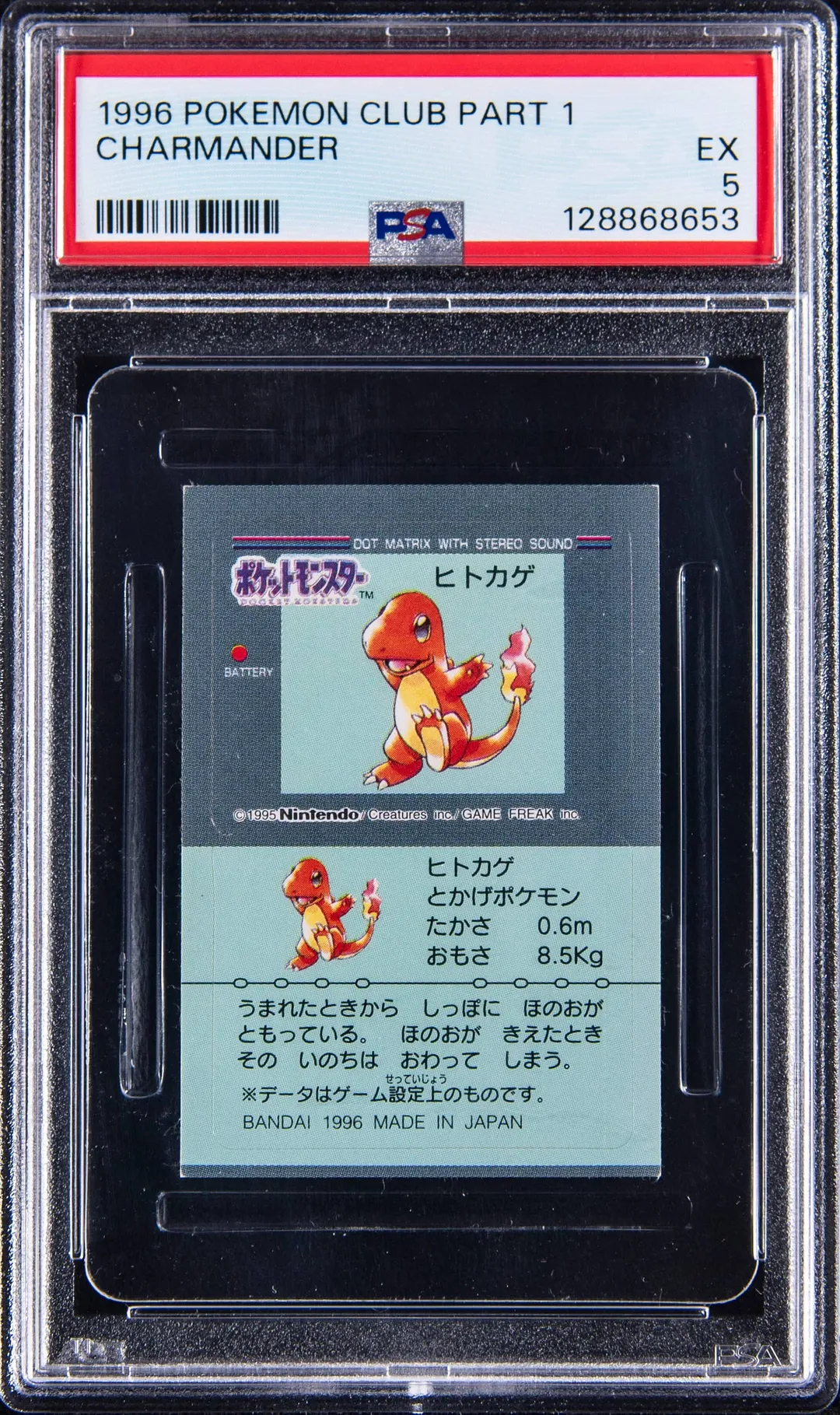
1996 Pokémon Club Charmander PSA 5 Sells for $16K
Breakdown of the $16,120 sale of a 1996 Pokémon Club Part 1 Charmander PSA EX 5 (pop 1) at Goldin on 02/16/26 and what it means for collectors.
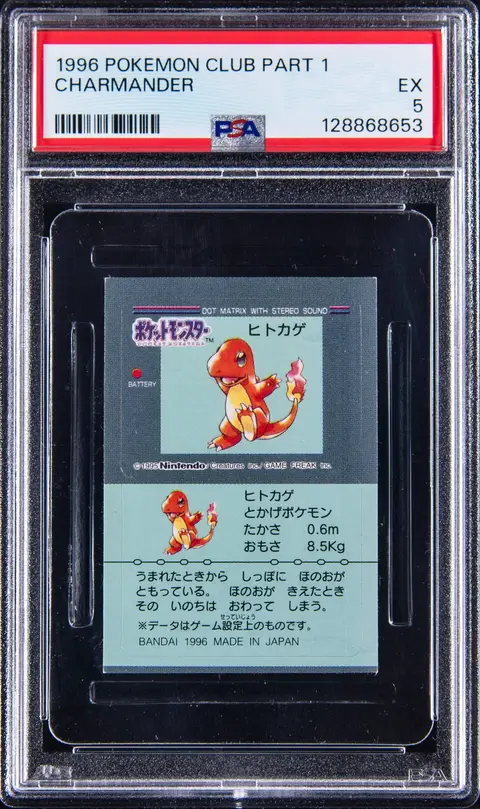
Sold Card
1996 Pokemon Club Part 1 Charmander - PSA EX 5 - Pop 1
Sale Price
Platform
Goldin1996 Pokémon Club Part 1 Charmander - PSA EX 5 - Pop 1 Sells for $16,120 at Goldin
Charmander has always been one of the hobby’s most recognizable starters, but certain early Japanese promos sit in a very different tier from the standard binder card. A recent sale at Goldin on 02/16/26 quietly highlighted that difference: a 1996 Pokémon Club Part 1 Charmander, graded PSA EX 5 and noted as a pop 1 (population 1), closed at $16,120.
In this breakdown, we’ll look at what this card actually is, why it matters to collectors, and how this sale fits into the current market for early Japanese Pokémon promos.
Card overview: what exactly sold?
Here are the key details for the card:
- Character: Charmander
- Year: 1996
- Set / Issue: Pokémon Club Part 1 (Japanese, promotional issue)
- Type: Early Japanese promo, pre–English release era
- Grading company: PSA (Professional Sports Authenticator)
- Grade: EX 5
- Population: Pop 1 at this grade per PSA pop report
- Auction house: Goldin
- Sale date: 02/16/26 (UTC)
- Sale price: $16,120
While this Charmander is not a “rookie card” in the traditional sports sense, it functions as an early, difficult promo of a flagship starter from the earliest days of the Pokémon TCG in Japan. Cards tied to the original Japanese promo ecosystem often carry a different kind of scarcity than pack-pulled base set cards.
What is the Pokémon Club Part 1 Charmander?
The term “Pokémon Club” refers to a Japanese fan/club environment in the mid‑1990s where certain cards were issued outside of standard booster packs. These types of promos typically required some form of membership, participation, or mail‑in process, which naturally limited how many were distributed and how well they were preserved.
While information about specific print runs can be incomplete, collectors generally agree on a few points for early Japanese promos like the Pokémon Club Part 1 cards:
- Low initial distribution: They were not sold in normal packs at retail scale.
- Condition challenges: Many were handled like regular trading cards by kids in the 1990s, not preserved as high-end collectibles.
- Niche awareness for years: Serious collectors have chased them for a long time, but they were largely unknown to casual hobbyists outside Japan until much later.
Within that context, Charmander stands out. It is a core first-generation starter and one of the faces of the franchise. Any early, hard-to-source Charmander promo tends to draw interest from character collectors and from people building deep runs of early Japanese issues.
Understanding PSA EX 5 and pop 1
This copy graded PSA EX 5, which PSA defines as “Excellent.” At EX 5, a card generally shows moderate wear, such as:
- Noticeable edge and corner wear
- Small creases or surface issues that are visible but not catastrophic
- Overall presentable eye appeal despite clear flaws
For many modern chase cards, a grade of 5 would be considered very low. But with 1990s Japanese promos, especially tougher issues like Club or mail-in cards, the grading scale behaves a little differently in practice.
Two key points here:
- Pop 1 at this grade: “Pop report” (population report) refers to the census of how many copies PSA has graded at each grade level. A pop 1 in EX 5 means there is currently only one copy in PSA’s database with that exact grade.
- Population context matters more than a single number: In some early promo runs, very few copies exist in high grades, and the majority that do surface have visible wear. So a card being a pop 1 in EX 5 can still represent a legitimately scarce supply in graded form, even if a handful of copies exist at other grades.
For set builders and deep character collectors, pop nuances can matter. A unique combination of card + grade can be a target if they’re aiming for a complete graded run.
Market context and recent sales
When we talk about “comps” (comparable sales), we’re looking for:
- The same card in different grades
- Closely related early Charmander promos
- Other Pokémon Club or similar 1990s Japanese promos
Publicly available data for this exact 1996 Pokémon Club Part 1 Charmander is limited. That’s consistent with:
- Low total graded population
- Infrequent auction appearances
- A collector base that tends to hold once they secure a copy
However, by looking at similar early Japanese promos and key 1990s Charmander/Charizard-adjacent pieces, a few patterns emerge:
- Early Japanese promos often achieve strong prices across a wide grade range, supported more by scarcity and historical importance than by condition perfection alone.
- Highly visible cards like the Japanese No.1/No.2/No.3 Trainer trophies or early CoroCoro promos have established that the market will support substantial valuations for rare 1990s Japanese issues with a documented story.
- Character-driven demand is stable for Charmander and Charizard. Even when broader market activity cools, historically important pieces tied to these characters tend to remain relatively liquid compared to more obscure promos.
Against that backdrop, a $16,120 result in PSA EX 5 for a pop‑scarce 1996 Pokémon Club Charmander fits the profile of a serious collector target rather than a casual impulse buy. It reflects:
- The premium placed on early Japanese origin (pre‑English release era)
- The difficulty of sourcing this specific promo in any graded form
- Ongoing demand for early Charmander/Charizard‑family pieces
Because available data on this specific card’s past auction history is thin, it’s more accurate to treat this as an informative benchmark than to call it a definitive record or outlier. For collectors tracking niche early promos, this sale provides a fresh reference point.
Why this card matters to collectors
Several layers of significance converge on this Charmander:
- Era: 1996 firmly places it in what many consider the “pre‑boom” phase of the Pokémon TCG, before international expansion and mass awareness of English Base Set.
- Distribution channel: Pokémon Club promos sit in a different category than standard pack-pulled cards. They are tied to specific programs and participation, not simple pack purchases.
- Character importance: Charmander is a foundational starter and the first step in the Charizard line, one of the most consistently collected character trees in the hobby.
- Promo ecosystem: Serious Pokémon collectors often pursue full runs of early promos (CoroCoro, Pokémon Center, Club, mail-ins, prize cards). Cards like this are essential pieces in those runs.
- Condition realism: Many surviving copies from 1990s Japan were handled as toys. That makes mid‑grade examples more respectable than they might appear if you’re only used to modern ultra‑rare, pack-fresh submissions.
For newcomers who have mainly seen English Base Set and modern chase sets, this Charmander shows how deep and varied the early Japanese side of the market can be.
How the $16,120 Goldin sale fits into the broader market
On 02/16/26, Goldin closed this PSA EX 5, pop 1 example at $16,120. Within the broader Pokémon market, this kind of result says a few things:
- Selective strength: Even when overall transaction volume ebbs and flows, scarce, historically significant promos often remain supported by focused collector demand.
- Character premiums: Charmander (and by extension Charizard) continues to command meaningful premiums for early and unusual printings, not just the usual base set and modern high-rarity cards.
- Graded promo literacy: More collectors are now comfortable evaluating promos by distribution story and pop report instead of simply chasing the highest numerical grade.
Because there are not many publicly documented sales of this exact card, it’s early to call this a long-term trend. For now, the sale functions as:
- A reference price for future sellers considering sending similar copies to major auction houses
- A data point for buyers trying to understand how the market values niche early Charmander promos in non‑gem conditions
Takeaways for collectors and small sellers
If you’re a newcomer, returning collector, or small seller, here are some practical lessons from this sale:
- Don’t overlook Japanese promos. Early Japanese releases, especially those tied to clubs, contests, or mail‑ins, can be significantly rarer than many English chase cards.
- Learn the story, not just the grade. Understanding how a card was distributed and how many are graded can matter more than simply chasing PSA 9 or 10 labels.
- Use comps as guides, not guarantees. A $16,120 sale in PSA EX 5 doesn’t guarantee that every copy or grade will achieve similar levels, but it does help outline a realistic range for serious collectors.
- Pay attention to pop reports. A pop 1 at PSA EX 5 doesn’t mean the card is unique, but it does underscore how few graded examples may be in the market at any given time.
As more of these niche promos surface at major auction houses like Goldin, the picture around early Pokémon Club cards will continue to sharpen. For now, the 02/16/26 sale of the 1996 Pokémon Club Part 1 Charmander at $16,120 stands as an instructive example of how the market values scarce, historically important Japanese promos—even in mid grade.
If you’re building a Charmander or early promo run, this is exactly the kind of card worth studying closely, even if it never ends up in your own case.