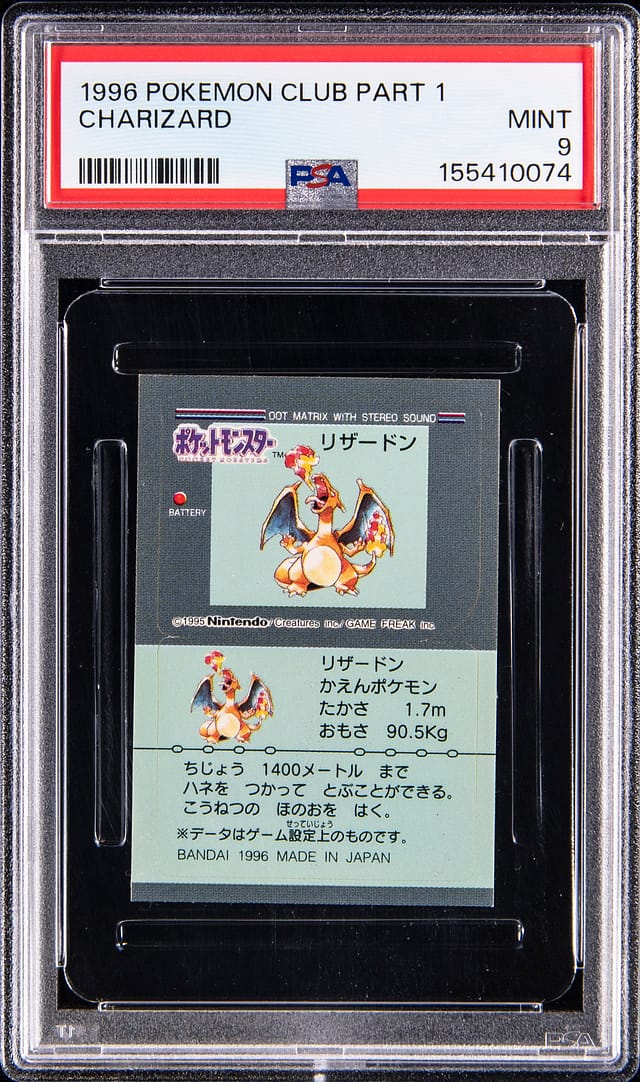
1996 Pokémon Club Charizard PSA 9 Pop 1 Sells for $294K
A 1996 Pokémon Club Part 1 Charizard PSA 9 Pop 1 sold for $294,021 at Goldin on May 18, 2026. Here’s what the result means for Charizard collectors.
Sold Card
1996 Pokemon Club Part 1 Charizard - PSA MINT 9 - Pop 1
Sale Price
Platform
Goldin1996 Pokemon Club Part 1 Charizard - PSA MINT 9 - Pop 1: Market Notes on a $294,021 Sale
On May 18, 2026, Goldin closed a major vintage Pokémon sale: a 1996 Pokémon Club Part 1 Charizard graded PSA MINT 9 realized $294,021. For a niche but historically important early Japanese Charizard, this is a meaningful data point for serious collectors tracking the top of the pre-TCG Pokémon market.
In this breakdown, we’ll walk through what this card actually is, why it matters, and how this result fits into the broader price landscape based on known population data and the behavior of similar high‑end Charizard issues.
What exactly is this card?
Card details
- Character: Charizard
- Year: 1996
- Set: Pokémon Club Part 1 (Japanese; hobby/club-focused issue, pre‑mainline TCG in the West)
- Variant: Standard issue from the Pokémon Club Part 1 release (not a modern parallel; no serial numbering, no autograph)
- Status: Early Japanese Charizard, viewed by many as a key pre‑TCG era issue rather than a traditional “rookie”
- Grading company: PSA (Professional Sports Authenticator)
- Grade: PSA MINT 9
- PSA population (“pop”): Pop 1 in PSA 9 at the time of sale
A quick vocabulary note for newer collectors:
- Pop report / population: how many copies of a card have been graded at each grade level by a grading company.
- Pop 1: only one copy exists in that grade with that grader.
This specific copy is currently the only PSA 9 example in the population report, which is what makes the “Pop 1” designation so important. There may be lower‑graded copies, and it’s always possible more raw (ungraded) copies exist, but in terms of PSA‑slabbed mint examples, this card has no peers at the moment.
Where this Charizard sits in the Pokémon timeline
1996 is a foundational year for Pokémon. While the English Base Set Charizard tends to dominate headlines, early Japanese issues and club/league distributions help complete the historical picture. The Pokémon Club Part 1 cards sit in that early era where distribution was limited and more community‑focused than mass‑market.
Collectors often care about a few things when it comes to early Charizard cards:
- Proximity to the franchise’s launch period.
- Relative scarcity compared with later reprints and mass‑produced sets.
- Artwork and design that capture early Pokémon aesthetics.
The Pokémon Club Part 1 Charizard checks these boxes: it’s early, it’s Japanese, and it wasn’t printed at modern ultra‑high volumes. That doesn’t automatically make it the rarest or most iconic Charizard, but it does place it in a lane collectors track closely alongside other early Japanese releases and promos.
Grading, pop report, and scarcity
The PSA MINT 9 grade is key for this sale. In vintage and early‑era trading cards, condition scarcity can matter as much as print scarcity.
Important context points:
- Mint 9 is near the top of the scale. PSA 10 (GEM MINT) is the only grade above it, and some vintage issues never achieve a PSA 10 at all.
- Pop 1 at PSA 9 means there is exactly one PSA 9 copy in existence at the time of this sale. If there are no PSA 10s graded, then this card is currently sitting at the top of the graded condition pyramid for this issue.
When a card is both:
- Early and historically significant for a marquee character (Charizard), and
- The single finest (or tied for finest) known example,
collectors often treat that copy as the reference point for the card’s ceiling, especially when it surfaces at a major auction house like Goldin.
Market context and price behavior
This sale closed at $294,021 through Goldin on May 18, 2026.
For context, Charizard’s market is anchored by a few well‑known pillars:
- 1996 Japanese Base Set Charizard (especially PSA 10)
- 1999 English Base Set Charizard in various printings and grades
- Key trophy and promo cards (e.g., No. 1/2/3 Trainers, specific prize promos)
Those cards have established the idea that early, high‑grade Charizard can command six‑figure prices under the right conditions. The Pokémon Club Part 1 Charizard isn’t as widely recognized as Base Set or the most famous trophies, but it taps into the same collector logic: early Charizard, tight supply, top‑of‑population example, and a major marketplace.
Because this PSA 9 is a pop 1 and these cards rarely surface publicly, there isn’t a deep stack of identical comps (comparable sales) to line up next to this result. Instead, collectors tend to look at:
- Lower‑grade examples of the same card, if any have sold recently.
- Prices for other early Japanese Charizard issues in PSA 9 and PSA 10.
- The general health of high‑end Charizard and vintage Pokémon auctions across the big houses.
Within that framework, a $294k result is high, but not out of line with what the top of the Charizard market has shown it can sustain for genuinely scarce, early pieces in elite condition. It is best treated as a reference point rather than a broad market benchmark, because:
- This is the only PSA 9 on record right now.
- The buyer and underbidders were, by necessity, competing over a unique opportunity, which can push results above what more common cards achieve.
How this sale fits into the broader Charizard market
A few observations for collectors and small sellers watching this space:
Charizard’s top tier remains strong. High‑end, low‑population early Charizard continues to find deep demand at major auction houses. While prices across the broader hobby have seen normal cycles of cooling and consolidation, the very best examples of iconic characters often behave differently from mid‑tier or mass‑produced cards.
Early Japanese issues are firmly on the radar. Over the past several years, collectors have increasingly treated early Japanese promos, club cards, and other non‑English releases as essential pieces of the Pokémon story, not just side curiosities. This sale reinforces that trend for cards outside the familiar base sets.
Population structure matters as much as headline grades. A PSA 9 with a pop of 1 can behave more like a PSA 10 in a more highly graded issue. When evaluating comps, it’s important to look beyond the number on the label and actually check the population report structure: how many of each grade exist, and is there anything above it?
Individual results are not guarantees. This sale is useful market information, but it’s still just one data point. Unique population situations, timing, and bidder mix all influence outcomes. For collectors, it’s more helpful to see results like this as markers of demand rather than price promises.
What this means for different types of collectors
For newcomers and returning collectors
- You don’t need a six‑figure card to enjoy the hobby, but watching sales like this gives a sense of how deep the collector base is for key characters like Charizard.
- If you’re exploring vintage or early Japanese cards, pay attention to set history and how the cards were distributed. Club and promo issues can have very different scarcity profiles from standard booster products.
For active hobbyists and small sellers
- When researching your own cards, check both recent sales and population reports. A card with modest previous sales but very low population at high grades can have more upside in competitive auctions than its last comp might suggest.
- On the flip side, don’t assume that because one pop‑1 card sold high, all cards from the same era or character should follow. Unique grading and scarcity situations drive unique results.
Final thoughts
The $294,021 sale of the 1996 Pokémon Club Part 1 Charizard PSA MINT 9 (Pop 1) at Goldin on May 18, 2026, is a clear signal that serious collectors continue to place strong value on early, low‑population Charizard cards—especially when they represent the best‑known example of a historically meaningful issue.
For anyone tracking the evolution of the Pokémon market, this result belongs on the short list of notable vintage‑era Charizard sales. It won’t define prices for every Charizard, but it adds another chapter to the story of how collectors rank early Japanese releases alongside the more famous base sets.
As always, treat it as a data point, not a guarantee—and use it as a starting point to dive deeper into the early Japanese side of the Pokémon hobby.