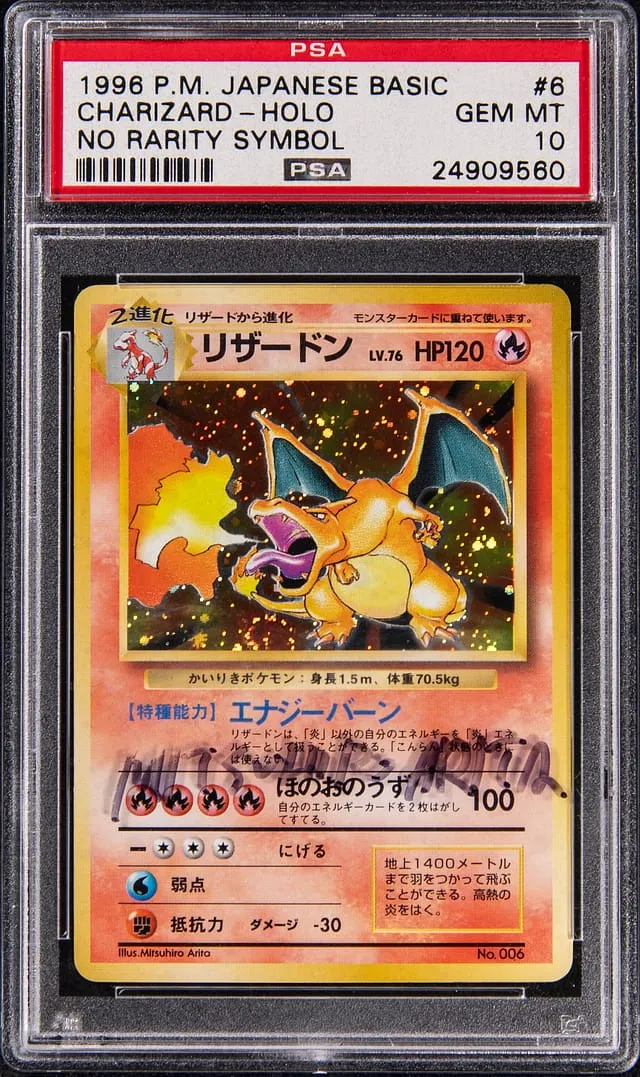
1996 No Rarity Charizard PSA 10 Sells for $1.23M
Goldin sold a 1996 Japanese Base Set No Rarity Charizard PSA 10 with Arita-signed case and Beckett LOA for $1,232,200. Here’s the collector context.
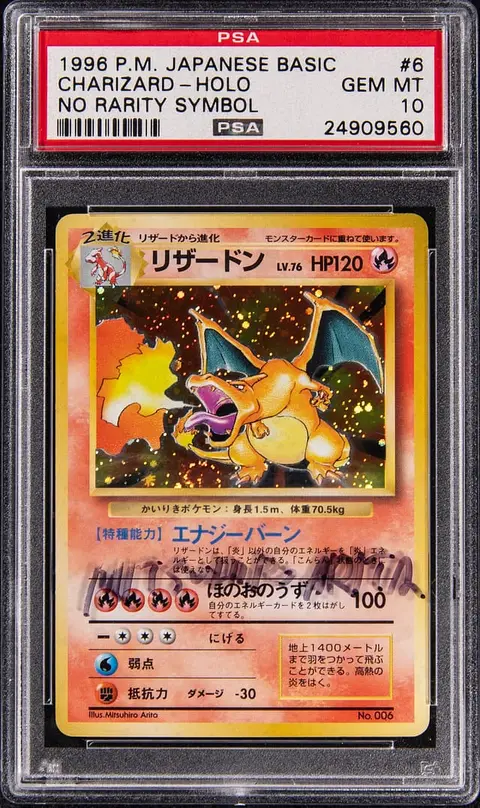
Sold Card
1996 Pokemon Japanese Base Set Holo #6 Charizard, No Rarity Symbol - Case Signed by Mitsuhiro Arita - PSA GEM MT 10 - Beckett LOA
Sale Price
Platform
Goldin1996 Pokémon Japanese Base Set Holo Charizard is already one of the most studied cards in the hobby. When a no rarity copy surfaces in a PSA GEM MT 10 holder, with a case signed by illustrator Mitsuhiro Arita and a Beckett letter of authenticity (LOA) backing that signature, collectors tend to pay attention.
On March 8, 2026, Goldin sold a 1996 Pokémon Japanese Base Set Holo #6 Charizard, No Rarity Symbol, PSA 10 GEM MT, for $1,232,200. The PSA case is hand‑signed by Mitsuhiro Arita, and the autograph is supported by a Beckett LOA. This combination – early Japanese printing, no rarity symbol, perfect PSA grade, and an authenticated artist signature on the slab – makes this a standout result in the high‑end Pokémon market.
What exactly is this card?
Let’s break down the key details collectors care about:
- Character: Charizard
- Year: 1996
- Set: Japanese Base Set Holo
- Card number: #6
- Variant: No Rarity Symbol (early print run without the small rarity icon in the bottom right)
- Language/Region: Japanese
- Era: Early/WotC‑era Pokémon (often treated similarly to vintage in TCG terms)
- Grading company: PSA (Professional Sports Authenticator)
- Grade: GEM MT 10 (PSA’s highest standard grade – sharp corners, centering, gloss, and surface)
- Special attributes:
- No rarity symbol variant (key early print run)
- PSA slab signed by Mitsuhiro Arita (the card’s original illustrator)
- Beckett LOA confirming the authenticity of Arita’s signature
This is not a “rookie card” in the sports sense, but within Pokémon it is a key issue: one of the earliest Charizard printings from the original Japanese Base Set and a cornerstone of early TCG history.
Why the no rarity Charizard matters
For collectors newer to Japanese Pokémon, the “no rarity symbol” detail can be confusing at first glance. Here’s why it matters:
- Early print run: No rarity symbol Base Set cards are generally considered among the earliest Japanese prints, predating the standard Japanese Base Set that has rarity icons.
- Visual tell: On a typical Japanese Base Set holo Charizard, a small rarity symbol appears at the bottom right of the card’s text box. On the no rarity variant, that symbol is missing.
- Collector perception: Many collectors treat the no rarity holo Charizard as a premium version of the standard Japanese Base holo, roughly analogous to an early test print or first‑run variant in other hobbies.
When you layer on a PSA 10 grade and an Arita‑signed PSA case, you’re combining early print significance, flagship character status, and a very high condition benchmark with an authenticated connection to the original illustrator.
Market context and price range
This Goldin sale closed at $1,232,200 on March 8, 2026. To understand what that means, it’s useful to look at related sales and the broader market for this card and its close cousins.
Related sales and comps
In hobby language, “comps” are comparable sales – recent transactions for the same card or very similar versions that help frame current price levels.
While exact, up‑to‑the‑day transaction data for this specific configuration (PSA 10, no rarity Charizard, Arita‑signed case, Beckett LOA) is limited, there are several key reference points from recent years:
- No Rarity Charizard, high grades (PSA 8–10, unsigned):
- Public auction results have shown strong five‑ and six‑figure prices, with PSA 9 and PSA 10 copies sometimes reaching well into the upper six‑figure range, depending on timing, promotion, and overall market sentiment.
- Population (the “pop report” – how many copies exist at each grade) is very low at PSA 10. That scarcity generally puts a large premium on top grades.
- Artist‑signed slabs and cards:
- Arita‑signed Charizard cards and cases have emerged as a niche within the Charizard market. Premiums vary widely depending on whether the autograph is on the card or on the slab, the card’s grade, and whether the signature is authenticated by a major third party like Beckett.
Against that backdrop, a sale above the one‑million‑dollar mark for a PSA 10 no rarity Charizard with an authenticated Arita signature on the case places this result toward the upper end of Charizard market history, particularly for Japanese‑language copies. This is not a routine result; it’s closer to the top tier of public Charizard sales.
How this price fits the broader Pokémon market
Some additional context for collectors:
- High‑end consolidation: Over the past few years, the very top of the Pokémon market – especially first‑generation Charizard and Pikachu cards, Trophy cards, and ultra‑scarce variants – has tended to consolidate around a relatively small pool of buyers. Public sales like this give everyone else a glimpse into that segment.
- Japanese vs. English: Historically, English Base Set 1st Edition Charizard has received more mainstream attention, but serious collectors have increasingly indexed toward rare Japanese variants, including no rarity Base. This sale aligns with that trend of Japanese high‑end cards gaining more visibility.
- Condition scarcity: Early Pokémon cards were often played with, not preserved. As a result, PSA 10 examples of niche early variants like no rarity holos remain extremely limited. That scarcity shows up in both price levels and the infrequency of public sales.
None of this guarantees where prices will go next, but it does help explain why the March 8 Goldin result landed where it did.
The role of the Arita signature and Beckett LOA
One unique twist on this particular copy is that the PSA case – not the card itself – is signed by Mitsuhiro Arita, Charizard’s original illustrator.
Key points for collectors evaluating this kind of item:
- Signature placement: Because the card is graded and encapsulated by PSA, Arita signed the outer slab instead of the raw card surface.
- Authentication: A Beckett LOA (Letter of Authenticity) is included, verifying that the autograph is genuine.
- Collector appeal: Some collectors prefer signatures directly on the card; others like the cleanliness and preservational aspect of a slab‑signed copy. The Beckett LOA helps standardize trust in the autograph, which can be especially important at this price level.
Putting these together, this copy sits at the intersection of graded high‑end Charizard, early Japanese print variants, and original‑artist memorabilia.
Why collectors care about this card
Even if you’re not shopping in the million‑dollar tier, understanding why this card matters can help make sense of the broader market:
- Flagship character: Charizard remains the flagship character for many Pokémon TCG collectors, similar to how Michael Jordan or Mickey Mantle function in sports cards. When Charizard moves, the rest of the Pokémon market tends to take notice.
- Historic set: 1996 Japanese Base Set is where it all started for the Pokémon TCG. Early printings like no rarity cards carry that origin‑story appeal.
- Scarcity at the top grade: PSA 10 examples of niche early variants never appear often, and many are locked away in long‑term collections.
- Art and nostalgia: Arita’s illustration is one of the most recognizable images in the franchise. A case signed by the artist creates a clear, collectible link between the original creative work and the physical card.
For newer or returning collectors, this sale is a reminder that:
- Early Japanese variants can be important and valuable in their own right, not just as side notes to English prints.
- Population reports, print variants, and authenticated signatures all play a role in how the market values a given copy.
Takeaways for everyday collectors and small sellers
You don’t need a seven‑figure card in your safe to learn something practical from this sale.
Here are a few grounded observations:
- Know your variants: Small printing differences – like a missing rarity symbol – can dramatically change a card’s significance. When in doubt, compare your card to verified images from trusted databases and grading company registries.
- Understand grading impact: Condition drives value. Even on less expensive cards, upgrading from a well‑played copy to a clean, well‑preserved one can make a real difference when you sell or trade.
- Document signatures carefully: If you’re collecting or selling signed cards or cases, third‑party authentication (PSA/DNA, Beckett, etc.) can help the market understand and trust what you have.
- Use comps, but with context: Look at recent sales of the same card and very similar versions, but note differences in grade, variant, and signatures. A sale like this one sits at the high end of many variables simultaneously.
Final thoughts
Goldin’s March 8, 2026 sale of the 1996 Pokémon Japanese Base Set Holo #6 Charizard, No Rarity Symbol, PSA GEM MT 10, with a Mitsuhiro Arita‑signed case and Beckett LOA, marks another data point in the evolving story of high‑end Pokémon.
For most collectors, it’s a reference sale rather than a direct comp. But as a case study, it highlights how early print runs, condition scarcity, and authenticated artist connections can combine to push a card into rarefied territory.
As always, whether you’re picking up your first Japanese holo or weighing a major upgrade, grounding your decisions in clear information – set, variant, condition, population, and recent sales – will serve you far better than chasing headlines alone.