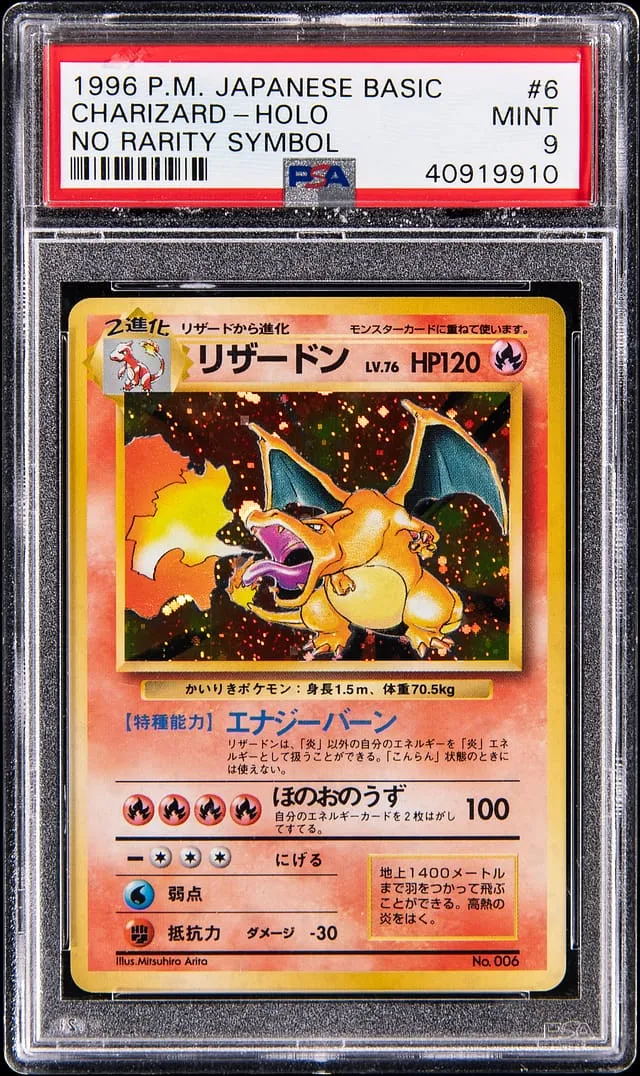
1996 Japanese No Rarity Charizard PSA 9 Sells for $80K
Goldin sold a 1996 Pokémon Japanese Base No Rarity Charizard PSA 9 for $80,520 on May 11, 2026. See how this result fits the vintage Pokémon market.
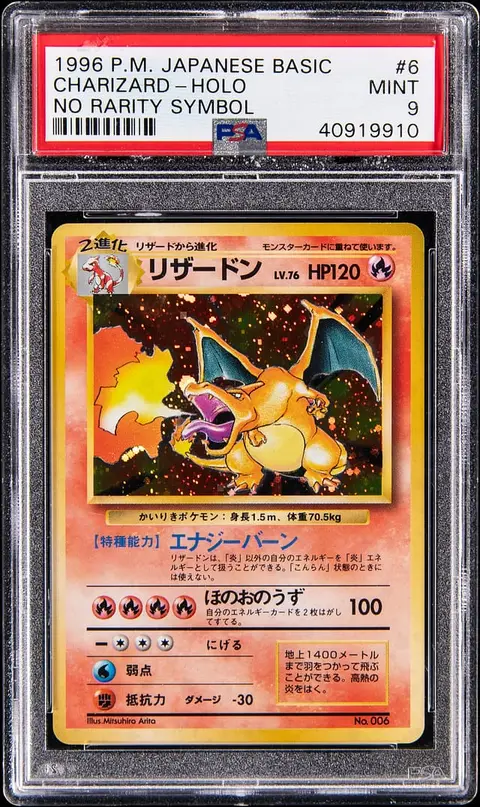
Sold Card
1996 Pokemon Japanese Base Set Holo #6 Charizard, No Rarity Symbol - PSA MINT 9
Sale Price
Platform
Goldin1996 Pokémon Japanese Base Set Holo Charizard “No Rarity Symbol” cards sit in a small group of issues that define the entire Pokémon TCG. When one surfaces in a strong grade, the hobby pays attention.
On May 11, 2026, Goldin closed a copy of the 1996 Pokémon Japanese Base Set Holo #6 Charizard, No Rarity Symbol, graded PSA MINT 9, for $80,520. For a card most collectors never see in person, this is a useful data point for understanding how the market is currently valuing early Japanese Pokémon grails.
What exactly is this card?
Let’s break down the full title:
- Character: Charizard
- Year: 1996
- Set: Japanese Base Set (the original Pokémon TCG release in Japan)
- Card number: #6
- Finish: Holographic (Holo)
- Variant: No Rarity Symbol (early print run version without the standard rarity icon in the lower right)
- Grading company: PSA (Professional Sports Authenticator)
- Grade: PSA 9 (MINT)
- Attributes: No autograph, patch, or serial numbering; the rarity is driven by the early print status and condition.
This is not a “rookie card” in the sports sense, but for Charizard and for Pokémon as a whole, Japanese Base Set is the origin point. Within that set, the No Rarity Symbol variant is widely regarded as the earliest and scarcest print run, making this a key issue for serious Charizard and vintage Pokémon collectors.
Why the “No Rarity Symbol” matters
Most Japanese Base Set cards have a small symbol in the lower right corner of the artwork box that shows rarity (circle, diamond, star). No Rarity Symbol copies lack that mark.
While there are still open questions about exact print quantities, collectors generally treat No Rarity cards as an early, short-run print. For Charizard specifically, that means:
- It’s from the very first wave of Japanese Pokémon TCG cards.
- It’s significantly tougher to find than the standard Japanese Base Charizard.
- Centering, print quality, and edge wear make high PSA grades especially challenging.
Put simply, this is one of the purest “day one” Charizard cards you can own.
Market context for this PSA 9 sale
A single auction never tells the entire story, so it helps to frame this $80,520 result with broader context.
Relative to other No Rarity Charizards
Looking across major auction houses and marketplaces over the past few years, a general pattern has emerged:
- PSA 10 No Rarity Charizard: When they surface, these tend to chase very high-end prices, often well into six figures. They trade infrequently and are effectively blue-chip pieces within vintage Pokémon.
- PSA 9 No Rarity Charizard: These have shown a wide range depending on timing, overall hobby sentiment, and auction venue. Sales have clustered in the mid–five-figure to low–six-figure range. An $80,520 result sits toward the stronger side of that band without being an outlier for a premium example in a prominent auction.
- Lower grades (PSA 7–8): These offer a more accessible entry into the No Rarity tier but still command a significant premium over standard Japanese Base Charizard in comparable grades.
Because supply is thin, there aren’t many truly “apples-to-apples” comps (short for comparables — recent sales of similar items used to gauge price context). That means each PSA 9 sale can vary, but this Goldin result is consistent with the idea that high-grade No Rarity Charizard remains a core target for advanced collectors.
Versus other early Charizards
When you compare to other iconic Charizard issues:
- 1999 English Base Set 1st Edition Holo Charizard: This is the face of the hobby for many western collectors. High-grade copies (especially PSA 10) have seen highly publicized six-figure and, at times, higher results.
- 1996 Japanese Base Set standard Holo Charizard (with rarity symbol): More available than No Rarity and priced accordingly, with a clear hierarchy by grade.
The No Rarity version often sits at or near the top of the early Charizard ladder in terms of scarcity and prestige, particularly in Japan-focused collections.
Why collectors care about this card
Several factors make the 1996 Japanese Base Holo Charizard No Rarity Symbol a cornerstone card:
Historical importance
This set marks the birth of the Pokémon TCG in Japan. The No Rarity print represents the earliest wave of that release. For collectors who care about origin stories, this is about as early as it gets.Character appeal
Charizard has been a flagship character since the late 1990s—prominent in the video games, anime, and early TCG marketing. Many collectors returning to the hobby identify Charizard as the card they chased as kids.Era and scarcity
- This card is from the vintage era (mid‑1990s), where print runs were significantly smaller than modern sets.
- Surviving high-grade copies of early Japanese holos, especially a niche variant like No Rarity, are genuinely limited.
Condition sensitivity
Japanese cards are known for solid print quality, but these early holos can still suffer from:- Holo scratching
- Edge chipping
- Back surface wear and print lines
Achieving a PSA 9 (MINT) means the card presents extremely well, with only minor flaws keeping it from a 10.
Understanding the PSA 9 grade
PSA 9 (MINT) generally indicates:
- Sharp corners
- Strong surface gloss
- Centering within PSA’s 9 tolerances
- Very minor flaws visible only under close inspection
For a No Rarity Charizard, the difference between PSA 9 and PSA 10 can translate into a significant price gap, because the PSA 10 population is extremely low. The PSA 9 tier often becomes the “target grade” for collectors who want a top-end example without paying the absolute peak premium attached to a 10.
Population reports (often called the pop report) from PSA show how many copies exist in each grade. While specific numbers can change as new cards are submitted, No Rarity Charizard is widely understood to have:
- A small total graded population compared to later Charizard issues.
- A very limited number of 9s and 10s, which supports stronger pricing when high-grade copies appear.
How this Goldin sale fits into the bigger picture
The $80,520 result at Goldin on May 11, 2026 doesn’t reset the Charizard record books, but it does reinforce a few key themes:
- Stability at the top end: Even as broader hobby prices have moved through ups and downs, top-tier vintage Pokémon pieces like No Rarity Charizard continue to find strong demand when offered through major auction houses.
- Ongoing recognition of Japanese origins: The market continues to reward collectors who focus on early Japanese releases, especially in premium condition. Japanese-origin keys are no longer niche; they’re a central part of high-end Pokémon discussions.
- Separation between variants: The price gap between No Rarity and standard Japanese Base Charizard highlights how much the market values subtle production differences once they’re widely understood.
For both seasoned and newer collectors, this sale is another reference point when evaluating where early Japanese Pokémon icons sit relative to English 1st Edition and other flagship releases.
What this means for different types of collectors
A few practical takeaways, without making any predictions or recommendations:
Newcomers and returning collectors
Think of this card as a reference for the upper tier of vintage Pokémon. You don’t need to chase a No Rarity Charizard to participate in the hobby, but following sales like this can help you understand how the very top of the market behaves.Active hobbyists
This auction gives you a fresh comp when you’re weighing different Charizard paths—Japanese vs. English, No Rarity vs. standard, high grade vs. mid grade. It’s also a reminder to read listings carefully; small text like “No Rarity Symbol” can represent a huge difference in both scarcity and price.Small sellers and traders
Use high-end results as a benchmark for how the market currently values attributes, not just characters: early print, variant, and condition. You can apply the same thinking to more accessible cards in your inventory.
Final thoughts
The 1996 Pokémon Japanese Base Set Holo #6 Charizard, No Rarity Symbol in PSA MINT 9 that sold for $80,520 at Goldin on May 11, 2026 is another data point in the evolving story of vintage Pokémon.
It confirms that:
- Early Japanese printings remain central to high-end Pokémon collecting.
- Scarce variants like No Rarity continue to command a meaningful premium.
- Condition and grading still matter as much as ever when it comes to the hobby’s most important cards.
For figoca collectors tracking the top of the market, this sale is worth bookmarking—both as a snapshot of where No Rarity Charizard sits today and as a reference point for whatever comes next in the vintage Pokémon segment.