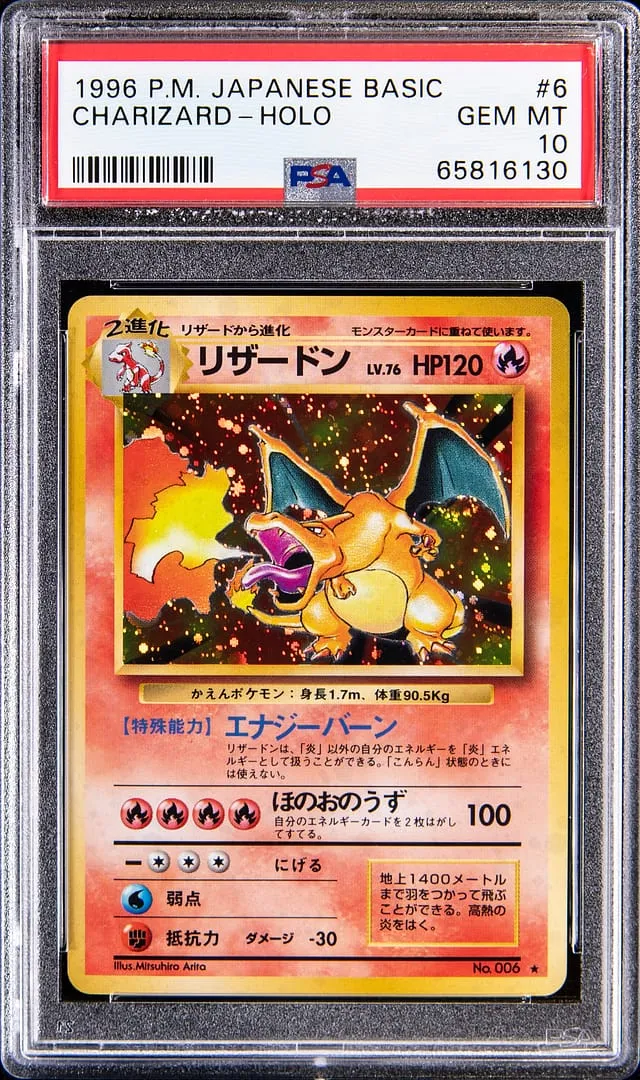
1996 Japanese Base Charizard PSA 10 Sells for $34k
A PSA 10 1996 Japanese Base Set Holo Charizard sold for $34,771 at Goldin on April 13, 2026. Here’s what that result means for Pokémon collectors.
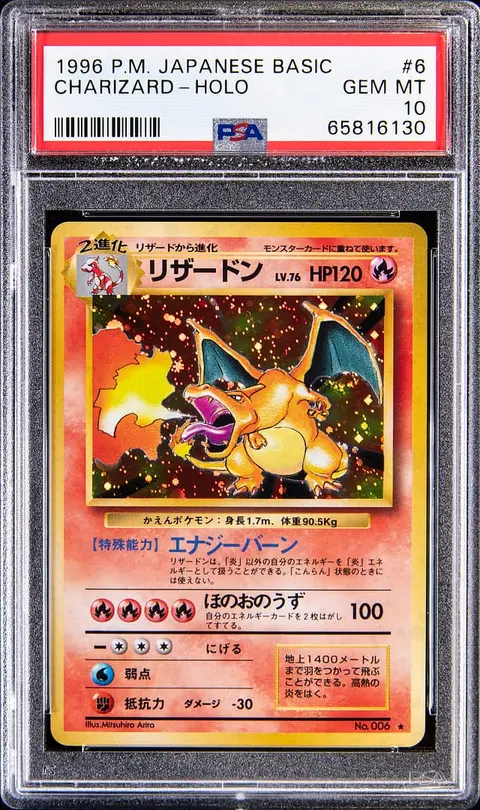
Sold Card
1996 Pokemon Japanese Base Set Holo #6 Charizard - PSA GEM MT 10
Sale Price
Platform
Goldin1996 Pokémon Japanese Base Set Holo Charizard in PSA 10 is one of those cards that quietly sits near the top of a lot of want‑lists. It’s early, it’s iconic, and in high grade it’s much tougher than the English counterpart many of us grew up with.
On April 13, 2026, Goldin sold a 1996 Pokémon Japanese Base Set Holo #6 Charizard graded PSA GEM MT 10 for $34,771. For a card that isn’t first edition and isn’t a trophy, that is a meaningful result and worth unpacking.
The card at a glance
- Character: Charizard
- Year: 1996
- Set: Pokémon Japanese Base Set (No Rarity symbol version is considered the earliest print, but typical Base holos are still early prints)
- Card number: #6
- Variant: Holographic (Holo)
- Grading company: PSA (Professional Sports Authenticator)
- Grade: GEM MT 10 (PSA’s highest standard grade)
- Attributes: No auto, no serial numbering – this is a straight pack‑pulled holo from the original Japanese release.
This is not a “rookie card” in the sports sense, but in Pokémon terms it’s a key early Charizard and a cornerstone of the original Japanese Base Set.
Why this Charizard matters
For many collectors, Japanese Base Set is where the TCG truly begins. While English 1st Edition Base gets most of the mainstream attention, the 1996 Japanese print run predates the 1999 English release and has its own mystique:
- Earliest TCG Charizard artwork in its home market
- Classic Ken Sugimori art, mirrored across multiple languages
- Historical importance as part of the first Pokémon TCG run released in Japan by Media Factory
Within that context, a PSA 10 copy stands out. Early Japanese holos were not always stored with grading in mind. Surface scratches, holo print lines, and centering issues add up, so a true GEM MT 10 is significantly tougher than a typical raw copy pulled from an old binder.
Population and scarcity in high grade
Population reports (often shortened to pop report) are counts of how many copies a grading company has given each grade. For this card, PSA’s pop report shows a strong number of total graded copies, but a comparatively thin population at PSA 10. That’s a common pattern for vintage and late‑90s cards: lots of survivors, fewer true gems.
In practice, that means:
- PSA 7–8: more available, often collected for nostalgia at a lower buy‑in.
- PSA 9: the workhorse grade; strong eye appeal with minor flaws.
- PSA 10: the condition‑sensitive, registry‑level copy that many set builders and high‑end Charizard collectors target.
Recent sales and price context
When collectors talk about “comps,” they mean comparable recent sales – essentially reference points. Looking across recent public auction and marketplace data for the 1996 Japanese Base Holo Charizard:
- PSA 8 and PSA 9 copies typically land in a much lower bracket than this Goldin sale, reflecting both the grading gap and wider availability.
- PSA 10 sales have generally formed the top end of the market for this card, with realized prices historically well above lower grades and more in line with serious Charizard collectors and set registries.
The $34,771 Goldin sale on April 13, 2026 sits toward the upper part of the observed range for PSA 10 examples over the past couple of years, though exact figures fluctuate depending on timing, auction venue, and card eye appeal. It doesn’t appear to be a wild outlier but rather a strong, high‑end result that reinforces the card’s position in the market.
It’s also important to view these numbers against the broader Pokémon trend since the 2020–2021 spike:
- Many modern cards have retraced heavily from peak prices.
- High‑end, historically important pieces – especially early Charizards and key vintage holos – have tended to be more resilient, even if they’ve also seen volatility.
This sale fits that pattern: not a new all‑time record, but a solid marker that demand for top‑tier early Charizard examples remains healthy.
Comparing to other Charizard keys
Collectors often compare this card to a few adjacent Charizard benchmarks:
- 1999 English 1st Edition Base Holo Charizard (PSA 9/10): Generally commands higher headline prices, driven by nostalgia from Western collectors and extreme demand.
- No Rarity Japanese Charizard: Considered an even earlier and scarcer printing; usually sits in its own lane as a niche, premium variant.
- Other Japanese 90s Charizards (e.g., Bandai Carddass, early promos): Each has its own collector base, but the Base Set holo remains the most globally recognizable.
The 1996 Japanese Base Holo in PSA 10 sits as a middle ground: more accessible and recognizable than ultra‑scarce trophies, but significantly more serious than casual binder copies. It’s a key piece for collectors who want early Charizard history without stepping into the very top tier of six‑figure trophy competition.
What might be driving interest now
A few broader hobby trends help frame this Goldin result:
Mature Pokémon collecting base
The earliest wave of Pokémon fans is now well into adulthood, with more disposable income. Many are refining from broad “buy everything” approaches into focused collections of early, important cards in top grades.Shift toward quality over quantity
In a market that has cooled off its speculative extremes, there’s been more focus on culturally important cards and true high‑grade examples rather than chasing every new release.Charizard’s enduring status
As the franchise’s most iconic monster, Charizard still anchors a lot of serious Pokémon collections. When collectors choose just a handful of cards to represent the brand’s history, this Base Set artwork almost always makes the cut.
None of this guarantees future outcomes, but it does provide context for why a PSA 10 copy of this card can still attract significant bidding.
Takeaways for collectors and small sellers
If you’re a newer or returning collector:
- This sale shows how condition and grading matter. The gap between raw, PSA 8–9, and PSA 10 is substantial for key 90s Pokémon cards.
- Understanding set history – Japanese vs. English, Base vs. later reprints – can help you decide where you want to focus.
If you’re a small seller:
- High‑end results like this underscore the importance of carefully pre‑screening vintage holos. Even sub‑10 grades can be worthwhile when the card is historically important.
- Knowing current comps for each grade helps you set realistic expectations and decide whether to send a card to PSA, BGS, or CGC.
Where this Goldin sale fits in the bigger picture
The $34,771 April 13, 2026 Goldin sale doesn’t rewrite the record books, but it does reinforce a few themes:
- Early, iconic Charizard art continues to command attention.
- Japanese Base Set holos, especially in PSA 10, sit firmly in the "serious collector" lane.
- Even in a more measured market, top‑tier vintage Pokémon holds a meaningful place.
For collectors tracking the health of the Pokémon high end, this result is another data point suggesting that demand for truly premium early Charizard cards remains steady, even as the broader hobby continues to normalize after its peak years.
As always, it’s best to use sales like this as context, not a forecast. For most of us, the real value is in understanding the history and choosing the versions of Charizard that fit both our budgets and our collecting goals.