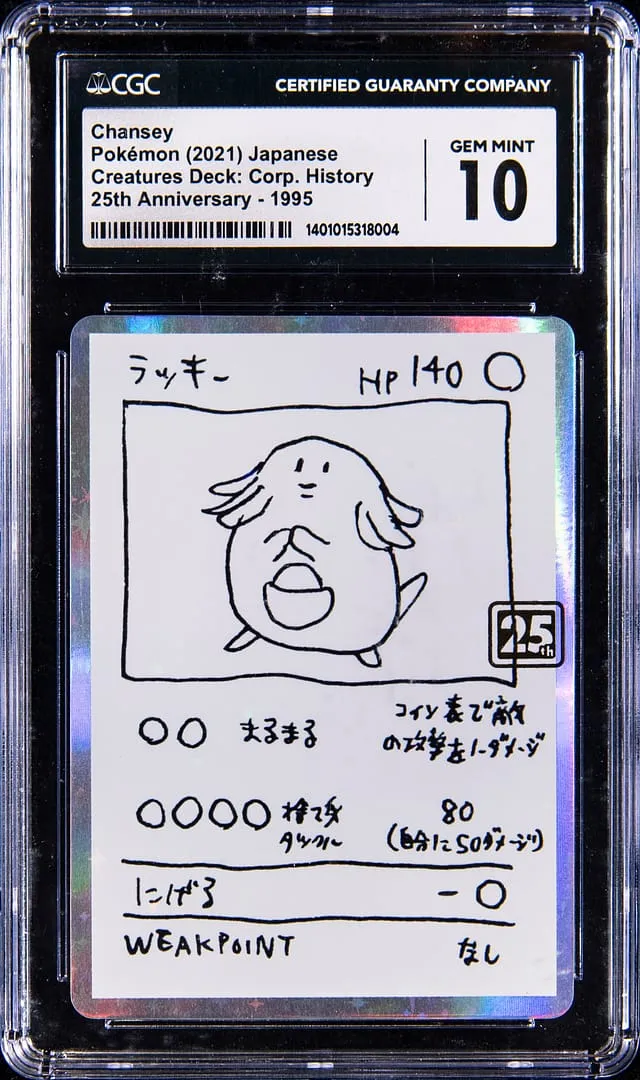
1995 Beta Chansey CGC 10 from Creatures Deck Sells
A CGC GEM MINT 10 1995 Beta Chansey from the 2021 Creatures Deck sold for $47,580 at Goldin on May 18, 2026. Here’s the context for collectors.
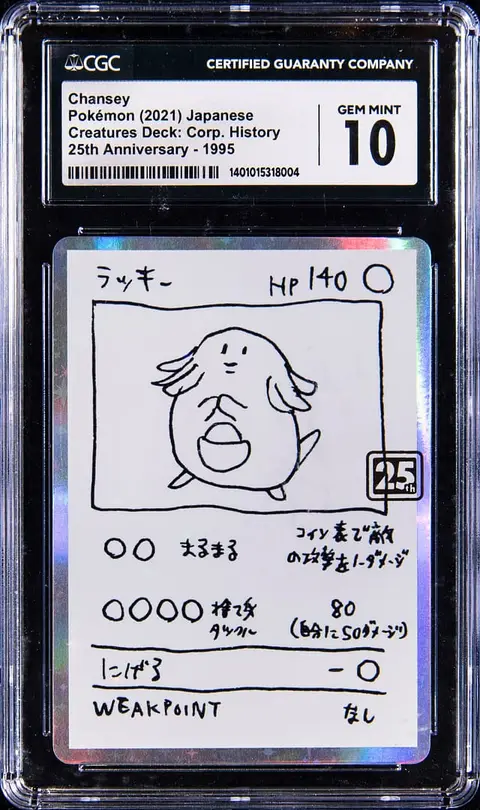
Sold Card
2021 Pokemon Japanese Creatures Deck: Corporate History 25th Anniversary 1995 Beta Chansey - CGC GEM MINT 10
Sale Price
Platform
Goldin2021 Pokemon Japanese Creatures Deck: Corporate History 25th Anniversary 1995 Beta Chansey - CGC GEM MINT 10 Sells for $47,580
On May 18, 2026, Goldin closed a notable sale for a card that quietly sits at the crossroads of game design history and high-end Pokémon collecting:
2021 Pokémon Japanese Creatures Deck: Corporate History 25th Anniversary – 1995 Beta Chansey – CGC GEM MINT 10
Hammer price: $47,580
Auction house: Goldin
Sale date (UTC): 2026-05-18
For many collectors, this isn’t just another Chansey. It’s a window into how the Pokémon Trading Card Game (TCG) began.
1. What card is this, exactly?
Let’s unpack the long title and why it matters.
- Character: Chansey (one of the early, high-HP support Pokémon in the TCG’s first era)
- Year on slab: 2021 (release year of the commemorative deck)
- Origin concept date: 1995 (the “beta” design era for the TCG)
- Set: Pokémon Japanese Creatures Deck: Corporate History 25th Anniversary
- Subset / card theme: “1995 Beta Chansey” – a reproduction of an internal early-version card used in the development of the Pokémon TCG
- Grading company: CGC (Certified Guaranty Company)
- Grade: GEM MINT 10 (CGC’s highest standard non-Pristine 10 for perfect centering and surface with virtually no visible flaws)
- Attributes:
- Japanese-language, commemorative deck card
- Released as part of a closed, historically focused product celebrating 25 years of Creatures Inc. and the TCG
- Not a pack-pulled mass-release; it originates from a specialty deck with limited distribution
This is not a rookie card in the usual sports sense, and it’s not the same as the 1999 Japanese Base or English Base Set Chansey. Instead, it’s a high-grade, modern printing of a historically important beta-era design from inside Creatures Inc., the company that co-created the Pokémon TCG.
2. What is the Creatures Deck: Corporate History 25th Anniversary?
In 2021, Creatures Inc. produced a special “Corporate History” 25th Anniversary deck to document the company’s story and the evolution of the Pokémon TCG. The product was never a standard retail booster set; it functioned more as an internal or commemorative release with controlled circulation.
Cards in this deck include:
- Reproductions of early prototype or beta designs from the mid-1990s
- Cards referencing key business milestones and game design decisions
- Unique layouts and templating that reflect how the game looked in its earliest concept stages
For collectors, this means:
- You are not just collecting a character; you are collecting design history.
- Population (how many graded copies exist) is naturally constrained by both the limited distribution of the deck and the still-developing grading flow for this niche product.
Within that context, the “1995 Beta Chansey” stands out because Chansey has always been important in the early TCG metagame and design:
- High HP for its era
- Healing and stall roles that shaped early gameplay
- Strong association with early Base Set-era strategies
3. Why a CGC GEM MINT 10 matters here
When we talk about grade, we’re referring to a third-party company’s condition assessment on a 1–10 scale. GEM MINT 10 means the card shows essentially no noticeable flaws to the naked eye and meets tight standards on centering, edges, corners, and surface.
CGC has built a reputation for:
- Detailed surface and centering analysis
- Tight grading standards, especially on modern and ultra-modern Pokémon
As a result, a CGC 10 tends to be viewed as a genuinely top-end condition example, not just a routine grade. For a specialty product like the Creatures Corporate History deck, GEM MINT 10s can be particularly meaningful because:
- The deck was not necessarily produced or stored with today’s grading culture in mind.
- Some copies may remain sealed in decks or in collections, never submitted for grading.
The combination of niche product + historical subject matter + top grade is what pushes this beyond a simple modern Chansey card.
4. Market context and recent sales
Because this is a specialized, relatively low-volume item, there are far fewer public sales than for standard Pokémon sets like Base, Neo, or modern booster-era products.
When checking major marketplaces and auction archives (including Goldin, PWCC, and fixed-price platforms), a few patterns emerge:
- Sales volume is low. Only a limited number of the 1995 Beta Chansey from the Creatures deck have surfaced in auction, and even fewer in top grades like CGC 10, PSA 10, or BGS 10.
- Pricing spreads are wide. Earlier sales for Creatures deck beta cards (across various characters) show a broad range depending on:
- Character popularity
- Grading company and label
- Whether the card is recognized by collectors as a true “prototype-style” piece
- Cross-card context. Other historically significant Creatures deck or internal design cards in high grade have drawn strong interest, often landing in the high four-figure to five-figure territory, with key cards sometimes extending beyond that range.
Against that backdrop, this $47,580 result at Goldin on 2026-05-18 places this CGC GEM MINT 10 Chansey:
- In the upper tier of realized prices for modern-era historical or prototype-themed Pokémon cards
- Clearly above run-of-the-mill modern Chansey cards, even in PSA or CGC 10
- In line with what we’ve seen when the market recognizes a card as a documented piece of TCG design history, not just a character reprint
Because public data for this exact card/grade remains thin, it’s more useful to see this sale as part of a broader pattern: top-grade, historically anchored Pokémon pieces can command sustained collector demand in a narrow but serious segment of the market.
5. Collector significance: why do people care about this card?
Several factors come together for this 1995 Beta Chansey:
a. Design and development history
This item is tied directly back to 1995, the conceptual birth period of the Pokémon TCG:
- The art, layout, and templating reflect pre-release thinking about how Pokémon might play on a card.
- It captures how designers at Creatures Inc. were experimenting with HP values, attacks, and card structure.
Owning this card in high grade is, for many advanced collectors, a way to own a museum piece of the ruleset, not just of the franchise’s characters.
b. Intersection of eras: 1990s concept, 2020s printing
The card sits at the intersection of two hobby eras:
- Vintage concept (mid-1990s) – referencing the earliest years of Pokémon TCG development.
- Ultra-modern printing (2021) – produced with modern card quality and then graded under current standards.
This can appeal to:
- Vintage-focused collectors who care about the game’s roots
- Ultra-modern collectors who prioritize pristine condition and strong holder presentation
c. Chansey’s early-game importance
In early TCG play, Chansey was not just flavor text – it was a functional cornerstone:
- Its high HP made it a defensive wall.
- It played a role in stall and control strategies that defined parts of the early metagame.
For players who remember that era, a beta-design Chansey is a powerful nostalgia trigger that predates even the first retail sets.
d. Scarcity in high grade
Unlike mass-printed Base Set cards, supply here is constrained from both ends:
- The source product (the Creatures Corporate History deck) was not an open, ongoing retail release.
- Not every card that exists has been, or will be, sent in for grading.
Layer in the difficulty of hitting CGC GEM MINT 10, and this particular copy sits in a very small pool of top-end examples.
6. How this sale fits into the broader Pokémon market
Within the Pokémon hobby, we can loosely sort cards into:
- Mass-market chase cards (e.g., modern alt arts, secret rares)
- Vintage flagship cards (Base Set holos, early promos)
- Historical or prototype-adjacent pieces (test prints, internal promos, commemorative decks like this one)
This 1995 Beta Chansey firmly sits in the third category. Compared with more common modern hits:
- It doesn’t rely on pack odds or parallel tiers (no “gold”, “rainbow”, or “alt art” labeling).
- Its appeal is more about documentation and provenance than about raw visual flash.
That’s an important distinction for collectors:
- Price action on cards like this tends to be driven by long-term collectors of Pokémon history rather than short-term speculation.
- Comps (recent comparable sales) can be sparse, so each major auction result helps shape expectations for future listings.
The $47,580 realized at Goldin adds another data point suggesting that serious collectors continue to value:
- Clear ties to the origins of the game
- Strong third-party grading
- Recognized auction-house provenance
7. Takeaways for collectors and small sellers
If you’re newer to this side of the hobby or returning after a long break, here are a few practical observations:
Know the difference between character nostalgia and card history.
- Plenty of Chansey cards exist, but very few connect this directly to the TCG’s beta design timeline.
Treat comps with care.
- For niche items like the Creatures Corporate History cards, there may be only a handful of meaningful public sales. One strong result doesn’t automatically set a universal ongoing price, but it does help establish a realistic range for high-end copies.
Grading company and label matter.
- A CGC GEM MINT 10 carries specific expectations around condition. When evaluating or listing similar items, factor in how that grade aligns with other major grading companies.
Document provenance when you can.
- Noting that a card came from a recognized auction (like this Goldin sale on 2026-05-18) can matter to collectors who care about traceable history.
Focus on what you can verify.
- Population reports, auction results, and grading data are more useful than rumors. For this Chansey, the confirmed data point is clear: a CGC GEM MINT 10 example realized $47,580 at Goldin on May 18, 2026.
Closing thoughts
The 2021 Pokémon Japanese Creatures Deck: Corporate History 25th Anniversary – 1995 Beta Chansey – CGC GEM MINT 10 sale at Goldin is another reminder that the Pokémon market isn’t only about chase cards from the latest set.
A small, historically focused subset of collectors is building collections around the story of how the game was created, and they are willing to compete for the very best documented examples.
For anyone tracking the evolution of the Pokémon TCG market, this $47,580 Goldin result is a meaningful marker in how collectors value beta-era design history in ultra-modern, high-grade form.