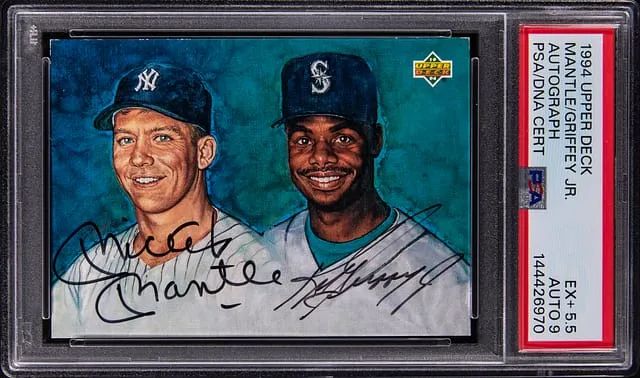
1994 Upper Deck Mantle/Griffey Dual Auto Sells for $23K
A PSA 5.5, PSA/DNA 9 1994 Upper Deck Mantle/Griffey dual autograph sold for $23,180 at Goldin. Here’s what it means for collectors and the market.
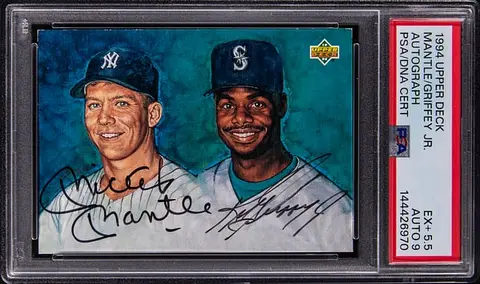
Sold Card
1994 Upper Deck Autograph Mickey Mantle/Ken Griffey Jr. Dual-Signed Card - PSA EX+ 5.5, PSA/DNA MINT 9
Sale Price
Platform
Goldin1994 Upper Deck’s dual-signed Mickey Mantle / Ken Griffey Jr. card has quietly become one of the most studied pieces of 1990s cardboard. A recent sale at Goldin on 2026-03-15 added another important data point: a copy graded PSA EX+ 5.5 with a PSA/DNA MINT 9 autograph grade closed at $23,180.
In this post, we’ll unpack what this card is, why collectors care, and how this sale fits into the broader market for Mantle/Griffey dual autos.
The card: 1994 Upper Deck Mantle / Griffey dual autograph
Card details
- Year: 1994
- Set: Upper Deck (base brand, not SP)
- Players: Mickey Mantle and Ken Griffey Jr.
- Teams pictured: New York Yankees (Mantle) and Seattle Mariners (Griffey Jr.)
- Type: Dual on-card autograph
- Autograph: Both signatures are hard-signed directly on the card, not stickers
- Grading: PSA EX+ 5.5 (card), PSA/DNA MINT 9 (autographs)
- Attributes: Iconic 1990s dual auto; often treated as a key hobby issue rather than a traditional “chase parallel”
Upper Deck’s 1994 Mantle/Griffey dual autograph is not a rookie card for either player. Instead, it’s prized as a crossover of eras: Mantle as a post-war Yankees icon and Griffey Jr. as the face of 1990s baseball and the early modern hobby.
The card’s photograph—Mantle and Griffey together—is part of why it resonates. It visually links the vintage and “junk wax”/early-modern periods into one image, something few other licensed cards did at the time.
Why collectors care about this card
1. A bridge between vintage and modern
Mantle occupies a similar place in vintage baseball that Griffey does in the early modern era: both are hobby headliners, both have instantly recognizable flagship cards, and both attract collectors who might not follow every current season.
Having both autographs on the same 1994 Upper Deck card makes it a symbolic bridge:
- Mantle ties back to 1950s–60s Topps and the traditional, low-print-run era.
- Griffey Jr. represents late-1980s/1990s mass production, as well as the move into glossy, premium products.
For many collectors who grew up in the 1980s and 1990s, this card feels like a natural centerpiece that summarizes their connection to the hobby.
2. On-card dual autographs from the early 1990s
Today, multi-player autographs are common in high-end products, but in 1994, a certified on-card dual autograph from two generational names was not routine.
Key points that affect collector interest:
- On-card autographs: Both Mantle and Griffey signed directly onto the card surface. Collectors generally prefer this to sticker autos because it feels more “connected” to the card and the photo.
- Licensed, pack-issued auto: The card comes from a mainstream licensed product, not a later buyback or aftermarket signing.
3. Historical importance inside the 1990s hobby
The early-to-mid 1990s were a transitional period: companies experimented with inserts, parallels, and autographs that would eventually shape the modern market. The Mantle/Griffey dual sits among the more memorable experiments of that time.
Collectors often group this card mentally with other era-defining 1990s inserts and autos—not because it’s the scarcest in a print-run sense, but because of its subject pairing and timing.
Understanding the grades: PSA EX+ 5.5 with PSA/DNA MINT 9
This specific copy received two distinct grades:
Card grade: PSA EX+ 5.5
EX+ 5.5 suggests visible handling or printing flaws—edge wear, corner wear, surface issues, or a mix of those. For 1990s cards, EX-level grades are well below the top of the population but still collectible, especially for significant autos.Autograph grade: PSA/DNA MINT 9
PSA/DNA separately evaluates the signature quality. A MINT 9 auto grade indicates strong pen strength, good placement, and no major skipping or smudging—just shy of a GEM MINT 10. For a dual autograph, getting both signatures to that level of presentation is important.
In practice, many collectors of this card prioritize the autograph presentation over the technical card grade. Strong eye appeal on the front and bold ink often matter more than minor corner or edge flaws on the back.
Market context: where does $23,180 fit in?
This Goldin sale closed at $23,180 on 2026-03-15.
To place that in context, collectors usually look at “comps” (comparable sales)—recent, verified sales of the same card or close equivalents in different grades.
Recent and typical ranges
While exact numbers vary by auction house and by how strong the autographs look, a few general patterns have emerged in recent years for this card:
- High-grade card and strong autos (PSA 9 card, PSA/DNA 9–10 autos, or equivalent from other companies) typically command the top tier of realized prices.
- Mid-grade card with strong autos (around PSA 5–7 card, PSA/DNA 9–10 autos) often sell meaningfully below top-grade examples but remain highly liquid because they provide a more accessible way into the card without sacrificing autograph quality.
- Lower autograph grades or heavy fading tend to trade at a noticeable discount, even when the card grade is similar.
This Goldin result fits into the mid-grade/strong-auto bucket: the 5.5 card grade is modest, but the PSA/DNA MINT 9 autograph grade is a clear positive.
Based on recent public auction data and marketplace listings for similar Mantle/Griffey dual autos, a result in the low–to–mid five figures is consistent for strong-auto copies that don’t hit the top of the grading scale. High-end examples in notably better card grade and equally strong ink have pushed higher, while copies with weaker autographs or more obvious eye-appeal issues have sold lower.
This sale does not appear to be an outlier record; instead, it reinforces a band of pricing that has been consolidating around these levels for solid, collector-grade examples.
Factors influencing demand right now
Several steady, long-running themes support interest in this card:
Mantle’s enduring status
Mantle remains one of the cornerstone names of the entire baseball card hobby. His vintage base cards, particularly the 1952 Topps, anchor many collections. Any well-known, licensed Mantle autograph—especially one paired with another star—benefits from that underlying demand.Griffey’s role in 1990s nostalgia
Griffey Jr. is deeply tied to the 1990s boom: magazine covers, video games, and a flood of base and insert cards. As more 1990s kids return to the hobby as adults, they often look for premium Griffey pieces to represent that era.1990s insert and auto rediscovery
Over the past several years, collectors have spent more time and money revisiting 1990s inserts, parallels, and autographs. The focus has shifted from sheer print run to historical importance and design. The Mantle/Griffey dual auto fits neatly into that narrative.Grading and authentication confidence
With PSA grading the card itself and PSA/DNA authenticating and grading the autographs, buyers can rely on a widely recognized third-party opinion. That confidence tends to support consistent demand, especially at auction houses like Goldin that cater to both advanced and newer collectors.
There is no single recent event or news item driving this sale. Instead, the price sits at the intersection of steady interest in Mantle, renewed enthusiasm for Griffey, and a broader appreciation for 1990s certified autographs.
How collectors are treating this card
Regardless of grade, many hobbyists view the 1994 Upper Deck Mantle/Griffey dual auto as:
- A PC centerpiece (PC = personal collection) for collectors who focus on 1990s, Mantle, Griffey, or Yankees/Mariners legends.
- A “set piece” of 1990s innovation, similar in significance (though not identical in scarcity) to other landmark inserts and autographs of that decade.
- A conversation card—something that tells a story about two eras of the game in one photo.
Collectors who target this card often weigh three things:
- Auto strength: Is the ink bold, centered, and clean?
- Front-eye appeal: Do any flaws distract from the image or signatures?
- Overall value vs. grade premium: Some are willing to trade down from a higher card grade to a mid-grade example if they can secure better autographs at a more approachable price.
The Goldin result for this PSA 5.5 / PSA-DNA 9 copy underscores that approach. The marketplace clearly placed strong value on the dual signatures and the overall presentation, even though the numeric card grade sits in the middle of the scale.
What this sale tells us about the market
From a market-analysis perspective, this 2026-03-15 Goldin sale suggests a few takeaways:
- Stable demand for iconic 1990s autos: The realized price aligns with other recent results rather than spiking unpredictably. That signals a relatively mature, informed market for this specific card.
- Autograph quality continues to carry weight: The MINT 9 auto grade likely helped this copy perform better than a similar EX+ card with weaker ink.
- Collector-grade examples remain important: Not every serious collector is chasing PSA 9–10 slabs. Mid-grade examples with strong presentation continue to draw healthy bidding.
For newer collectors, this result is a reminder that “key issues” are not limited to rookie cards. Some of the most meaningful hobby pieces are cross-era, story-rich autographs like this one.
Final thoughts
The 1994 Upper Deck Mickey Mantle / Ken Griffey Jr. dual-signed card is a cornerstone of 1990s baseball collecting. This PSA EX+ 5.5, PSA/DNA MINT 9 example selling for $23,180 at Goldin on 2026-03-15 doesn’t rewrite the record books, but it does add another clear, public marker for where the market values strong, collector-grade copies.
For Mantle and Griffey collectors, it remains one of the most compelling ways to bring two eras of the game—and two eras of the hobby—onto a single card.