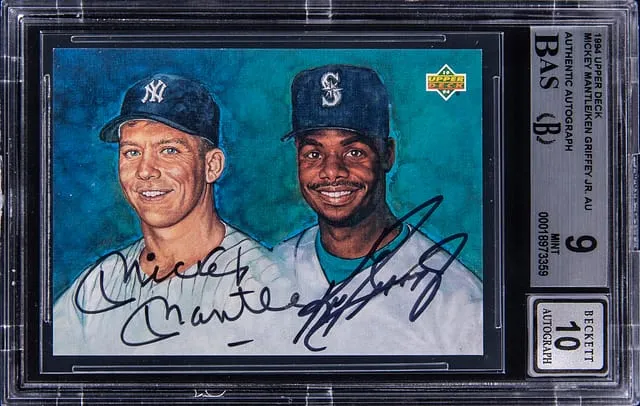
1994 UD Mantle/Griffey Dual Auto BGS 9 Sells for $61K
Goldin sold a 1994 Upper Deck Mickey Mantle/Ken Griffey Jr. dual auto BGS 9, auto 10 for $61,000 on May 10, 2026. figoca breaks down the sale and context.
Sold Card
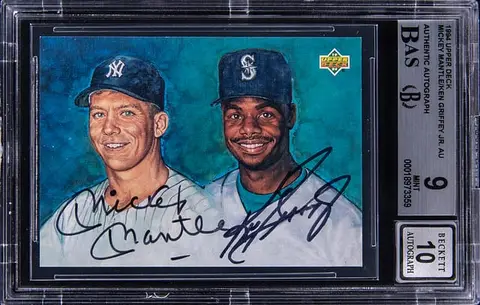
1994 Upper Deck Mickey Mantle/Ken Griffey Jr. Dual-Signed Card - BGS MINT 9, Beckett 10
Sale Price
Platform
Goldin1994 Upper Deck Mickey Mantle/Ken Griffey Jr. Dual-Signed Card Sells for $61,000
On May 10, 2026, Goldin closed the sale of a hobby favorite: a 1994 Upper Deck dual-signed Mickey Mantle / Ken Griffey Jr. card, graded BGS MINT 9 with a Beckett 10 autograph, for $61,000.
For many collectors, this card is one of the most recognizable multi-player autographs of the 1990s. It links the final chapter of Mickey Mantle’s career in the public eye with the early prime of Ken Griffey Jr., and it comes from a brand—Upper Deck—that helped define the look and feel of modern baseball cards.
The Card: 1994 Upper Deck Mantle/Griffey Dual Auto
Here’s what we know and can reasonably say about the card itself:
- Year & Set: 1994 Upper Deck Baseball
- Players: Mickey Mantle and Ken Griffey Jr.
- Teams pictured: New York Yankees (Mantle), Seattle Mariners (Griffey Jr.)
- Type: Dual-signed insert card (on-card autographs, not stickers)
- Autographs: Both Mantle and Griffey signed directly on the card
- Grading company: Beckett Grading Services (BGS)
- Card grade: BGS MINT 9
- Autograph grade: Beckett 10 (often referred to as a “Gem Mint” or “10” auto)
- Key attributes:
- On-card dual autograph from a Hall of Famer and an inner-circle modern legend
- From the mid-1990s, a transitional era between vintage and truly modern products
- Widely treated as a “key issue” Mantle/Griffey hobby card, even though it’s not a rookie card for either player
This isn’t a rookie card. Mantle’s true playing-days cards are from the 1950s and 60s, and Griffey’s flagship rookie is his 1989 Upper Deck card. But within the autograph and insert market, this is one of the better-known dual autos pairing a historic Yankee icon with a modern star who helped define the 1990s hobby.
Why This Card Matters to Collectors
A bridge between eras
Mantle represents the golden-age Yankee mystique and the postwar boom in sports cards. Griffey represents the late-80s/90s boom and the rise of premium, photography-driven products—Upper Deck, in particular.
This card puts them together on one canvas:
- Mantle: already a long-retired Hall of Famer and enduring hobby icon by 1994.
- Griffey: an active superstar outfielder whose 1989 Upper Deck rookie was a centerpiece card for an entire generation of collectors.
For people who grew up chasing Mantle stories and later ripping packs with Griffey on the wrapper, this dual-signed card is essentially a single, tangible link between two collecting generations.
Upper Deck’s role in hobby history
Upper Deck was still relatively young in 1994, but it had already changed the hobby landscape with:
- sharper photography,
- higher-end card stock, and
- a focus on premium inserts and autographs.
On-card autographs—where the players sign the card itself—were a big deal in this era. They felt special because they were still relatively rare compared with today’s products, which can be dense with autos, relics, and parallels.
The Mantle/Griffey dual auto is one of the more recognizable examples of what Upper Deck was trying to do at the time: blend quality design with signature-heavy inserts that felt truly premium.
Autograph quality and grading
Autograph grading is crucial for a card like this. Beckett separately grades the card itself and the ink on it. A BGS MINT 9 with a Beckett 10 auto tells us:
- The card (corners, edges, surface, centering) is in high-end condition for the issue.
- The signatures are bold, consistent, and clean enough to warrant a perfect score.
For dual-signed cards—especially with an older signer like Mantle—ink can fade, streak, or suffer from pressure issues over time. A 10 auto grade helps this copy stand out.
Market Context: Where Does $61,000 Fit?
The Goldin sale on May 10, 2026, closed at $61,000. To make sense of that number, it helps to look at broader directional context and how collectors typically evaluate this card.
Directional comps and related sales
Market data for this exact card in BGS 9/10 form is relatively thin. The card is notable, but not so frequently traded that there are constant, identical comps (comparable past sales) to point to.
That said, a few general patterns tend to hold:
- Raw or ungraded copies and those with lower overall grades or weaker autograph grades generally trade at a noticeable discount to high-grade, 10-auto examples.
- Higher-card-grade copies (such as BGS 9.5), if and when they appear, often command a premium over BGS 9, especially when paired with a strong auto grade.
- Other Mantle/Griffey dual autos or Mantle dual autos from the 1990s also reinforce that collectors treat these as premium, nostalgia-heavy pieces rather than routine inserts.
Because publicly reported sales for this exact configuration (1994 Upper Deck Mantle/Griffey dual auto, BGS 9 with 10 auto) are infrequent, the Goldin result functions as a fresh data point for the upper end of the condition and presentation range.
Interpreting the $61,000 result
Within the broader Mantle and Griffey autograph market, $61,000 clearly puts this example in the premium tier:
- Mantle is one of the most collected names in the entire hobby; his signature commands consistent interest.
- Griffey remains one of the most beloved players of the modern era and a core figure in 1990s collecting.
- Dual, on-card autos from the mid-1990s of these two together are not easily replaced.
Given the scarcity of identical comps, it’s more accurate to say this Goldin sale sets a current reference point for a high-grade, strong-auto example rather than declaring it definitively “cheap” or “expensive” compared with a well-documented curve.
Era and Scarcity Considerations
The 1994 Upper Deck set comes from the mid-1990s, often lumped into what collectors call the “junk wax” or overproduction era. But that term mostly applies to base cards—standard, mass-printed cards—not to premium, on-card autographs like this one.
Key differences:
- Base cards: widely printed, often with very little long-term scarcity.
- Autograph inserts: intentionally much more limited and harder to pull, particularly dual autos and cards bearing the signature of a legend like Mantle.
So while 1994 products in general may have been printed in significant quantities, the dual-signed Mantle/Griffey cards themselves are not common, especially in strong, graded condition and with top-tier auto grades.
How Collectors Might View This Card Going Forward
Without predicting prices, we can outline why collectors continue to pay attention to this card:
- Historical connection: It literally pairs the face of 1950s–60s Yankee lore with the face of late-80s/90s Upper Deck baseball.
- On-card autographs: For many hobbyists, on-card signatures are still the preferred format over stickers because they feel more personal and integrated with the design.
- Graded assurance: A BGS MINT 9 with a Beckett 10 auto answers common questions about condition and ink quality up front.
For newcomers and returning collectors, this sale is a reminder that not all 1990s cards are interchangeable or overproduced. Specific inserts and autographs—especially those that map onto powerful stories or player pairings—can occupy their own lane in the market.
Key Takeaways from the Goldin Sale
- The 1994 Upper Deck Mickey Mantle / Ken Griffey Jr. dual-signed card remains one of the most recognizable 1990s dual autos in baseball.
- On May 10, 2026, Goldin sold a BGS MINT 9 copy with a Beckett 10 autograph for $61,000.
- Direct, same-grade comps are limited, so this result functions as a fresh high-end data point rather than a simple repeat of a known price level.
- The card sits at the intersection of two eras—Mantle’s postwar icon status and Griffey’s modern boom—and captures the role Upper Deck played in reshaping the hobby.
As more graded copies surface through major auction houses, the picture around price trends and grade premiums for this specific issue should become clearer. For now, the Goldin sale stands as a notable marker for one of the defining dual autographs of the 1990s.